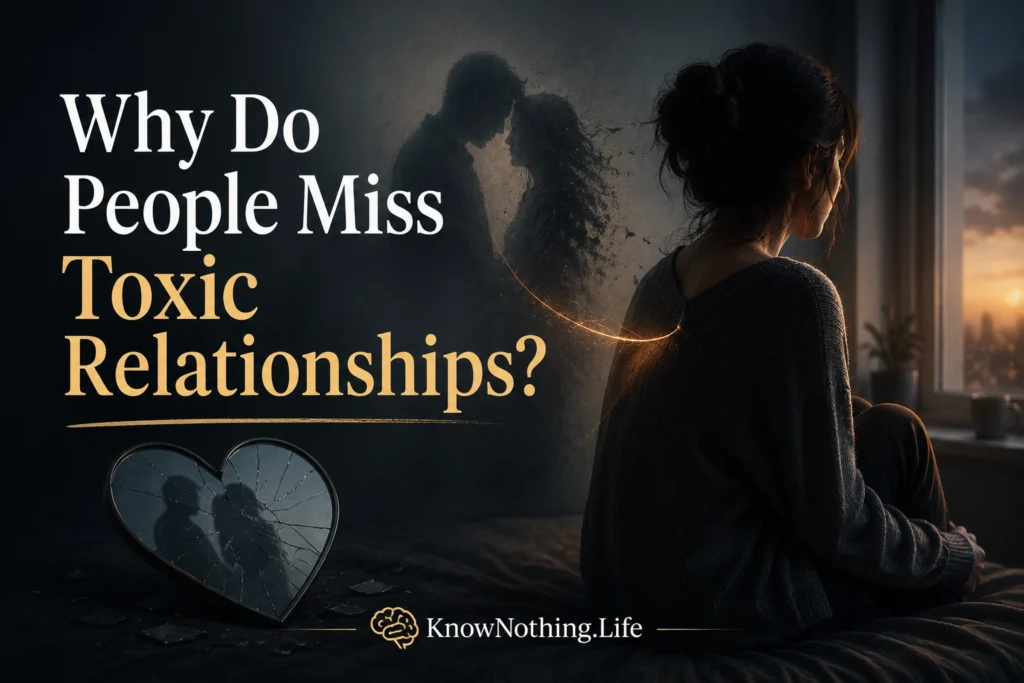
Missing a toxic relationship can feel confusing, humiliating, and even frightening. A person may know the relationship was unhealthy, remember the manipulation, criticism, instability, betrayal, or emotional exhaustion, and still feel pulled back toward it. They may miss the person who hurt them, romanticize the good moments, crave contact, or feel empty without the chaos. From the outside, this can look irrational. From the inside, it can feel like grief mixed with addiction, hope, memory, fear, and longing.
The first important truth is that missing a toxic relationship does not mean the relationship was secretly good. It also does not mean the person is weak, foolish, or dishonest with themselves. Human attachment is not governed only by logic. The nervous system learns patterns through repetition, intensity, reward, threat, and emotional dependency. A toxic relationship can train the brain and body to associate love with anxiety, relief, pursuit, and emotional highs. When the relationship ends, the mind may grieve not only the person, but the cycle itself.
Attachment and the Need for Connection
Human beings are wired for attachment. John Bowlby, the founder of attachment theory, argued that emotional bonds are central to survival and psychological development. In childhood, attachment keeps vulnerable children close to caregivers. In adulthood, attachment helps people form intimate bonds, trust others, and regulate emotional pain. Mary Ainsworth’s later research showed that attachment patterns can become secure, anxious, avoidant, or disorganized depending on early relational experiences.
Toxic relationships often activate attachment systems powerfully. If a partner is sometimes affectionate and sometimes cold, sometimes available and sometimes rejecting, the unstable pattern can intensify longing. An anxiously attached person may become especially focused on regaining closeness after conflict or withdrawal. The relationship may feel painful, but the threat of losing it feels worse. This is why people may miss someone who made them feel unsafe: the attachment system may interpret distance as danger, even when distance is actually protective.
Intermittent Reinforcement and Emotional Addiction
One of the strongest psychological explanations is intermittent reinforcement. B. F. Skinner’s work on operant conditioning showed that rewards delivered unpredictably can produce persistent behavior. When affection, praise, apology, sex, attention, or kindness arrives inconsistently, the person receiving it may become more attached, not less. The unpredictability creates emotional suspense. The next good moment always feels possible.
In a toxic relationship, the highs often follow the lows. A cruel argument may be followed by tenderness. Withdrawal may be followed by passionate reunion. Betrayal may be followed by apology and promises. The brain begins to chase relief. The person may not be addicted to suffering itself, but to the emotional swing from pain to comfort. That swing can feel intensely bonding because the same person who causes distress also becomes the source of relief. This is one reason toxic love can be so hard to leave behind.
Trauma Bonding
The term trauma bond is often used to describe attachment formed through cycles of fear, harm, apology, hope, and reconciliation. Psychologist Patrick Carnes helped popularize the concept in relation to exploitative and abusive relationships. Trauma bonding does not mean two people simply had a difficult relationship. It refers to a powerful attachment that can develop when mistreatment is mixed with emotional dependency and intermittent reward.
A trauma bond can make the mind defend the relationship even after harm is obvious. The person may minimize what happened, blame themselves, focus on the partner’s wounded side, or believe that one more conversation will finally bring closure. The bond is strengthened by confusion. If someone was always cruel, leaving might be simpler. But toxic relationships often include real affection, shared history, private jokes, intense intimacy, and moments that felt deeply meaningful. The mixture of love and harm makes the memory difficult to organize.
The Brain Remembers the Highs
Memory is not a perfect recording. It is selective, emotional, and often shaped by present pain. After a toxic relationship ends, the brain may replay the best scenes: the first attraction, the deep conversations, the moments of being chosen, the apologies, the physical closeness, the future plans. Painful memories may fade temporarily because the mind is trying to reduce loss. This does not mean the harm was imaginary. It means grief often edits memory.
Psychologist Daniel Kahneman distinguished between the experiencing self and the remembering self. The experiencing self lives through each moment; the remembering self creates the story afterward. A person may have been unhappy for much of the relationship but still remember a few powerful peaks. Those peaks can dominate the emotional narrative. The mind may say, “I miss them,” when more precisely it means, “I miss who they sometimes were,” or “I miss how I felt during the rare good moments.”
The Fantasy of Who They Could Have Been
People often miss not only the relationship that existed, but the relationship they hoped it would become. They miss the imagined future: the healed partner, the stable version, the apology that finally changed everything, the love story that survived the chaos. This fantasy can be more difficult to release than the real relationship because it was never fully tested by reality.
The philosopher Søren Kierkegaard wrote, “Life can only be understood backwards; but it must be lived forwards.” Toxic relationships often trap people between backward understanding and forward hope. Looking back, they can see the damage. Looking forward, they still imagine repair. The mind asks, “What if this time would have been different?” That question can keep a person emotionally attached long after the evidence suggests the pattern was unlikely to change.
Identity and Self-Worth
Toxic relationships can reshape identity. Over time, a person may become accustomed to proving their worth, managing the other person’s moods, earning affection, explaining themselves, apologizing excessively, or trying to become “enough.” When the relationship ends, they may feel lost because so much of their energy was organized around another person’s approval.
Carl Rogers believed psychological health depends partly on congruence: alignment between the real self and lived experience. Toxic relationships often create the opposite. A person may suppress needs, hide anger, accept disrespect, or abandon boundaries to keep the bond alive. When the relationship ends, the emptiness may not be pure love. It may be the shock of no longer having a role to perform. Missing the relationship can sometimes mean missing a familiar identity, even if that identity was painful.
Familiar Pain Can Feel Like Home
People may also miss toxic relationships because familiar pain can feel safer than unfamiliar peace. If someone grew up around emotional unpredictability, criticism, neglect, abandonment, or chaos, a toxic relationship may feel recognizable. It may not feel good, but it may feel known. Calm love can even feel strange or boring at first because the nervous system has learned to equate intensity with connection.
This does not mean people consciously choose suffering. It means the body can confuse familiarity with safety. John Bowlby’s attachment theory helps explain why early relational patterns can shape adult expectations. If love was once inconsistent, the adult nervous system may be drawn to inconsistency because it knows how to survive there. Healing often requires learning that peace is not emptiness, stability is not lack of passion, and love does not need to feel like an emergency.
Cognitive Dissonance and Justification
Leon Festinger’s theory of cognitive dissonance also helps explain why toxic relationships linger in the mind. Cognitive dissonance occurs when people experience tension between conflicting beliefs or behaviors. For example, “This person hurt me” conflicts with “I loved them deeply” or “I sacrificed so much for this relationship.” To reduce the discomfort, the mind may create explanations: they did not mean it, they were wounded, I overreacted, the good outweighed the bad, or maybe I should have tried harder.
The more someone invested, the harder it can be to accept that the relationship was damaging. Years of effort, forgiveness, emotional labor, money, family involvement, or shared dreams create psychological sunk costs. The mind does not want suffering to feel meaningless. Missing the toxic relationship may partly be an attempt to preserve the belief that the pain had a purpose.
Loneliness After Chaos
When a toxic relationship ends, the silence afterward can feel unbearable. Chaos creates constant stimulation. There are arguments to analyze, messages to interpret, moods to monitor, apologies to evaluate, and emotional fires to put out. When that cycle stops, the nervous system may not immediately feel peace. It may feel withdrawal.
This is why people sometimes mistake calm for emptiness. A life without constant emotional crisis can initially feel dull, lonely, or unreal. The body has been living in a state of alertness, and it may take time to recalibrate. Missing the toxic relationship may not mean the person wants harm back. It may mean their nervous system is adjusting to a life without adrenaline, uncertainty, and emotional surveillance.
Why Missing Them Is Not a Sign to Return
One of the most important distinctions is between missing someone and needing them back. Missing is an emotional event. Returning is a decision. Emotions are real, but they are not always reliable guides. A person can miss something that was harmful. They can crave a pattern that damaged them. They can grieve a relationship they should not resume.
Healthy reflection asks not only “Do I miss them?” but “What exactly do I miss?” Is it the person as they truly were, or the version they occasionally showed? Is it love, or relief from loneliness? Is it intimacy, or the familiar role of trying to earn love? Is it connection, or the hope that the past can finally be repaired? These questions matter because clarity often begins when longing becomes specific.
Final Thoughts
People miss toxic relationships because attachment, memory, identity, fear, hope, and biology are deeply powerful. The mind remembers the highs. The body remembers the bond. The nervous system misses the familiar rhythm. The heart grieves the imagined future. None of this proves the relationship was healthy. It proves only that human beings are capable of bonding under complicated and painful conditions.
The way forward is not self-blame. It is understanding. Missing a toxic relationship is often part of detaching from it. Grief does not always point backward; sometimes it is the mind’s way of releasing what it once believed it needed. The deeper task is to separate love from chaos, longing from truth, and familiarity from safety. A person can miss the relationship and still choose healing. They can honor what felt real while refusing to return to what harmed them. That is not contradiction. It is recovery.