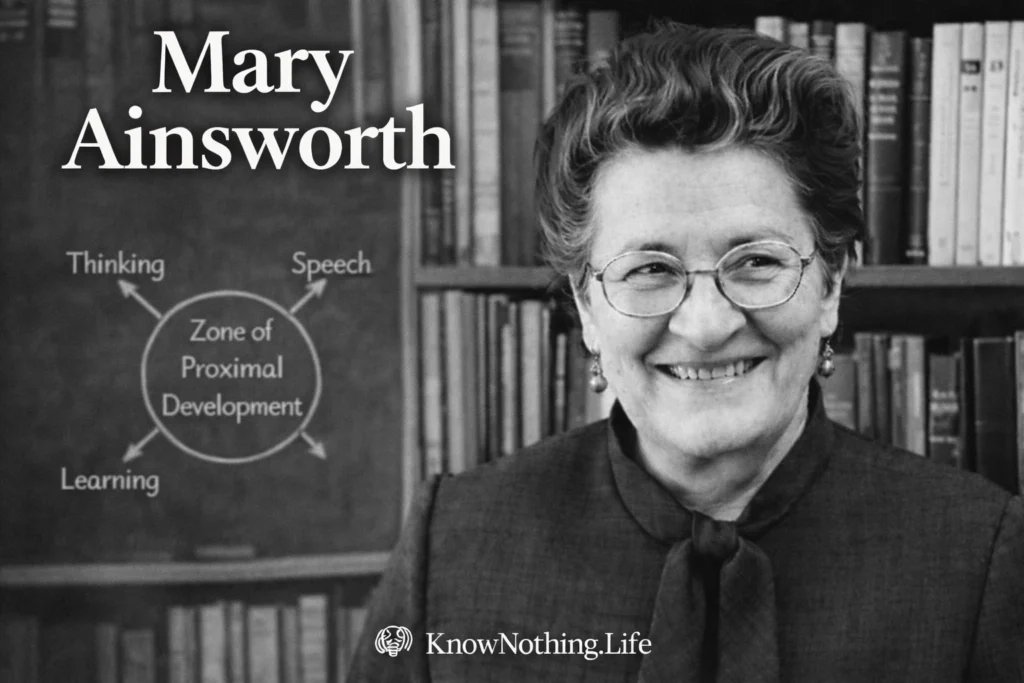
Few psychologists have changed modern understanding of childhood, parenting, and emotional development as deeply as Mary Ainsworth. Best known for her work on attachment theory and the Strange Situation procedure, Ainsworth transformed John Bowlby’s broad theory of infant-caregiver bonding into a research-based framework that could be observed, measured, and applied. Her work helped psychology understand that early attachment is not simply affection, dependency, or habit. It is a powerful emotional system that shapes how children explore the world, respond to stress, and develop expectations about relationships.
Ainsworth’s influence extends across developmental psychology, clinical therapy, parenting research, education, and modern relationship science. Her studies revealed that children differ meaningfully in how they use caregivers for comfort and security, and those differences are closely tied to patterns of caregiving sensitivity. Concepts such as secure attachment, avoidant attachment, ambivalent attachment, caregiver sensitivity, and the secure base became central to psychology largely because of her work. In giving attachment theory a rigorous observational method, Ainsworth helped explain why early relationships matter so profoundly across the human lifespan.
Early Life and Intellectual Formation
Mary Dinsmore Salter Ainsworth was born on December 1, 1913, in Glendale, Ohio, and grew up primarily in Canada after her family moved to Toronto. From an early age, she showed strong intellectual curiosity and a serious interest in understanding human behavior. As a teenager, she encountered psychological writing that sparked her fascination with personality, development, and emotional life. That early interest led her to study psychology at the University of Toronto, where she completed her undergraduate, master’s, and doctoral work.
At Toronto, Ainsworth studied under psychologist William E. Blatz, whose security theory shaped her early thinking about emotional confidence and human development. Blatz argued that security gives individuals the confidence to explore and adapt. This idea became one of the foundations of Ainsworth’s later attachment work. Long before she became associated with Bowlby, she was already thinking about the relationship between emotional security, independence, and development. This early training prepared her to see infant attachment not as weakness or dependency, but as the psychological foundation that makes exploration possible.
Work With John Bowlby
Ainsworth’s career changed dramatically when she moved to London and began working with John Bowlby at the Tavistock Clinic. Bowlby was developing a new theory of attachment that challenged both psychoanalysis and behaviorism. Traditional psychoanalytic theory often explained infant attachment as secondary to feeding, while behaviorism interpreted closeness through reinforcement. Bowlby proposed something more radical: infants are biologically prepared to seek closeness to caregivers because attachment promotes survival.
Ainsworth became one of Bowlby’s most important collaborators, but she was never simply a follower of his ideas. Her great contribution was methodological and observational. Bowlby supplied the broad evolutionary theory, while Ainsworth helped demonstrate how attachment could be studied in real children and real caregiving relationships. She turned attachment from an elegant theory into a measurable developmental science. Her work helped prove that the infant’s relationship with the caregiver is not incidental to development. It is one of development’s central organizing systems.
The Uganda Study and Naturalistic Observation
One of Ainsworth’s most important early research projects took place in Uganda, where she conducted detailed observations of mothers and infants in everyday settings. Rather than relying only on laboratory experiments or clinical reports, she watched how attachment developed naturally in family life. She observed how infants used their mothers as sources of comfort, how they responded to separation or distress, and how maternal responsiveness shaped the emerging attachment relationship.
This research was crucial because it showed Ainsworth’s gift for careful observation. She noticed that securely attached infants were not simply clingy or dependent. They were often more confident explorers because they trusted the caregiver’s availability. The caregiver functioned as a “secure base” from which the child could move outward into the world and return when distressed. This idea became one of the most important concepts in developmental psychology. Ainsworth later wrote that attachment behavior is activated most strongly when the child is “tired, hungry, ill, or alarmed,” emphasizing that attachment is especially visible under conditions of vulnerability.
The Strange Situation
Ainsworth’s most famous contribution was the Strange Situation procedure, developed through her later research in Baltimore. The procedure placed infants and caregivers in a structured sequence of separations and reunions. A child would enter an unfamiliar room with the caregiver, encounter a stranger, experience brief separations from the caregiver, and then be reunited. The key was not simply whether the child cried when separated, but how the child used the caregiver upon reunion.
The Strange Situation revealed distinct patterns of attachment. Securely attached infants were upset by separation but generally comforted by reunion, returning to exploration once reassured. Avoidant infants appeared emotionally distant, often avoiding or ignoring the caregiver after reunion. Ambivalent or resistant infants showed intense distress and difficulty being soothed, seeking contact while also resisting comfort. Ainsworth’s work showed that these patterns reflected different histories of caregiver responsiveness. Her famous insight was that a secure attachment gives the child confidence to explore because the caregiver is trusted as a reliable emotional base.
Attachment Styles and Caregiver Sensitivity
Ainsworth’s research demonstrated that attachment quality is closely tied to caregiver sensitivity. Sensitive caregivers notice infant signals, interpret them accurately, and respond promptly and appropriately. This does not mean perfect parenting. It means emotionally attuned caregiving that teaches the child the world is safe enough to explore and that distress can be met with comfort. Secure attachment grows from repeated experiences of being understood and soothed.
Insecure attachment patterns, by contrast, often develop when caregiving is inconsistent, rejecting, intrusive, or emotionally unavailable. Avoidant attachment may emerge when children learn that expressing distress brings little comfort, leading them to suppress visible need. Ambivalent attachment may develop when caregiving is unpredictable, making the child unsure whether comfort will be available. Ainsworth’s work helped psychology move beyond vague ideas about love and affection. She showed that specific patterns of interaction shape children’s emotional expectations, self-regulation, and relationship behavior.
Major Works and Scientific Contributions
Ainsworth’s major works helped define attachment research for generations. Her book Infancy in Uganda presented her naturalistic observations of infant-mother relationships and introduced many of the ideas that would later become central to attachment theory. Her most influential collaborative work, Patterns of Attachment, written with Mary Blehar, Everett Waters, and Sally Wall, formally presented the Strange Situation research and classification system that became foundational in developmental psychology.
Beyond specific books, Ainsworth’s greatest scientific contribution was showing that emotional relationships could be studied with precision. She brought rigor to a field that could easily have remained abstract or sentimental. Her research gave psychologists a way to observe attachment behavior, classify relationship patterns, and connect early caregiving to later development. She once described the attached child as using the caregiver as “a secure base from which to explore,” a phrase that remains one of the most important descriptions in attachment theory.
Criticism and Later Development
Ainsworth’s work also generated debate. Some critics argued that the Strange Situation was too brief to capture the full complexity of child-caregiver relationships. Others questioned whether attachment classifications developed in American middle-class samples could be applied universally across cultures. In some societies, infant independence and separation from caregivers are handled very differently, which can affect how children behave in the Strange Situation.
Later researchers expanded and refined her work. Mary Main and Judith Solomon identified disorganized attachment, a fourth pattern often associated with frightened, frightening, or severely disrupted caregiving. Cross-cultural research also complicated attachment theory while largely preserving its central insight: children develop organized strategies for dealing with caregiver availability, separation, and stress. These refinements did not diminish Ainsworth’s contribution. They showed the strength of the research tradition she helped build.
Legacy and Lasting Influence
Mary Ainsworth permanently changed psychology by showing that early emotional bonds are observable, patterned, and developmentally powerful. Her research helped establish attachment theory as one of the most influential frameworks in modern psychology. Today, attachment concepts are used in child development research, family therapy, trauma treatment, adoption studies, parenting education, and adult relationship science.
Her work also changed how society thinks about caregiving. Ainsworth helped demonstrate that responsiveness is not indulgence, and emotional availability is not weakness. A child who trusts a caregiver is often more capable of independence, not less. This idea transformed parenting theory by showing that security and exploration are not opposites. Security makes exploration possible.
Final Thoughts
To study Mary Ainsworth is to understand one of developmental psychology’s most important truths: children grow through relationships before they grow away from them. Her work showed that attachment is not merely about closeness, comfort, or affection. It is the emotional foundation from which confidence, exploration, resilience, and later intimacy begin.
Ainsworth’s legacy endures because her research gave scientific form to something deeply human. Every child must learn whether the world is safe, whether distress will be answered, and whether connection can be trusted. By observing those early patterns with extraordinary care, Mary Ainsworth helped psychology understand how the first bonds of life echo far beyond infancy.