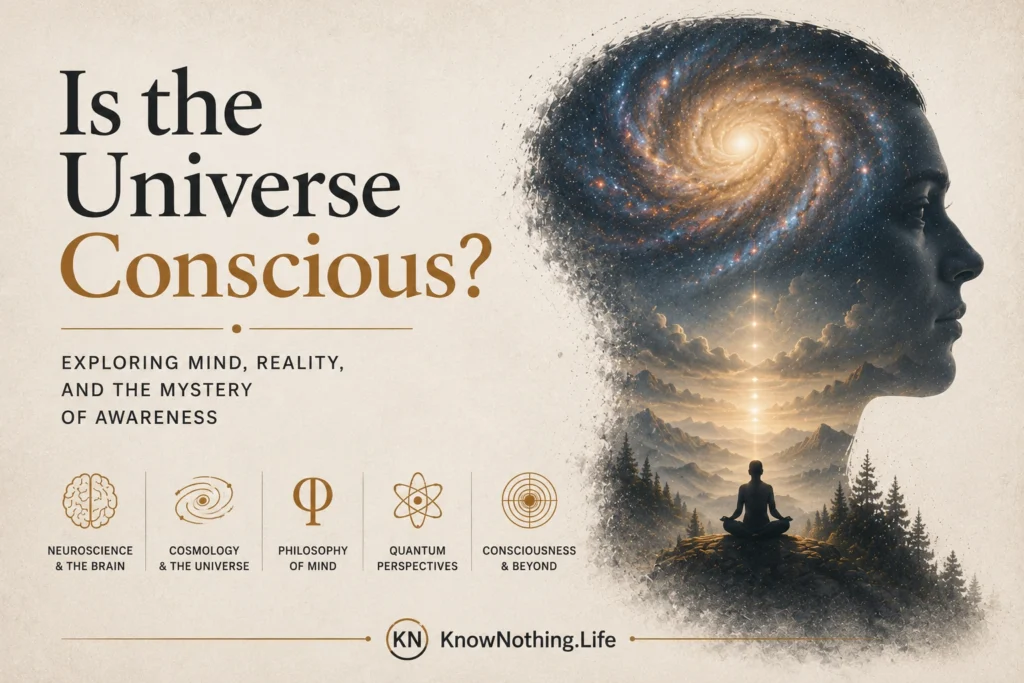
Few questions stretch the limits of human thought more than this one: Is the universe conscious? For centuries, philosophers, mystics, scientists, and theologians have wondered whether consciousness is merely something that exists inside individual brains or whether it is somehow woven into the fabric of reality itself. The question sits at the intersection of cosmology, neuroscience, philosophy, religion, and metaphysics. It challenges assumptions about what consciousness is, where it comes from, and whether human awareness is an isolated phenomenon or part of something vastly larger.
Modern science has revealed that humans occupy a tiny corner of an immense cosmos. The observable universe contains hundreds of billions of galaxies, each containing billions of stars. Yet within this vast expanse, matter has somehow organized itself into living systems capable of thought, imagination, memory, and self-awareness. This creates a profound mystery. If consciousness emerged from the universe, can consciousness be entirely separate from it? Or does the existence of conscious beings suggest that awareness may be a fundamental aspect of reality itself?
The answer depends largely on how one defines consciousness. If consciousness means subjective experience—the feeling of being aware—then the question becomes whether the universe itself possesses something analogous to an inner life. If consciousness instead refers to information processing, responsiveness, or self-organization, then the argument takes a different direction. The debate is not merely scientific. It touches humanity’s oldest questions about meaning, existence, and the nature of reality.
The Traditional Scientific View
The dominant scientific position has long been that consciousness is a product of biological brains. According to this view, awareness emerges when matter is organized in sufficiently complex ways. Human consciousness arises from networks of neurons exchanging electrical and chemical signals. The brain does not receive consciousness from the universe; it generates consciousness through physical processes.
This perspective is often associated with materialism, the philosophical belief that physical matter is fundamental and that mental phenomena arise from physical systems. From this standpoint, asking whether the universe is conscious may be like asking whether a mountain or a river is conscious. The universe contains conscious organisms, but that does not mean the universe itself possesses awareness. Just as individual cells can be alive without a planet being alive, individual minds can be conscious without the cosmos being conscious.
Materialists point to the strong relationship between brain states and mental states. Damage specific parts of the brain and consciousness changes. Alter brain chemistry and subjective experience changes. Sleep, anesthesia, injury, disease, and psychoactive substances all affect awareness in predictable ways. These observations suggest that consciousness depends heavily on biological structures rather than existing independently throughout the universe.
The Hard Problem of Consciousness
Yet consciousness remains one of science’s deepest unsolved mysteries. Philosopher David Chalmers famously described consciousness as the “hard problem.” Scientists can increasingly explain how brains process information, recognize objects, store memories, and make decisions. What remains difficult is explaining why any of these processes should produce subjective experience at all.
Why does neural activity feel like something from the inside? Why is there an experience of redness when seeing a rose? Why is there a sense of self observing thoughts? Physical descriptions of brain activity explain mechanisms but do not fully explain experience. This gap has led some thinkers to question whether consciousness can be reduced entirely to matter.
The hard problem has reopened discussions once considered philosophical speculation. If consciousness cannot be fully explained as a byproduct of physical processes, perhaps it is more fundamental than previously assumed. Rather than emerging late in cosmic history, consciousness may exist in some form at deeper levels of reality.
Panpsychism: Consciousness Everywhere
One of the most influential alternatives is panpsychism. The term comes from Greek roots meaning “all” and “mind.” Panpsychism proposes that consciousness, or at least proto-consciousness, is a fundamental property of the universe. Just as matter possesses mass and energy possesses measurable properties, awareness may exist in primitive forms throughout reality.
This does not mean that rocks think, planets dream, or galaxies have conversations. Rather, panpsychists suggest that the building blocks of reality may possess extremely basic forms of experience. Human consciousness then emerges from the combination and organization of these simpler forms. In this view, consciousness is not created from non-conscious matter. Instead, complex minds arise from more fundamental conscious components.
Philosophers such as Galen Strawson and Philip Goff have argued that panpsychism may provide a more coherent solution to the hard problem than traditional materialism. If consciousness exists at the foundations of reality, then it is no longer necessary to explain how subjective experience suddenly appears from entirely unconscious matter. Awareness was present all along, becoming increasingly complex as systems evolved.
The Universe as a Mind
Some thinkers take the idea even further. Rather than suggesting consciousness exists everywhere, they propose that the universe itself may constitute a single conscious entity. This concept appears in many philosophical and spiritual traditions. Ancient Stoics believed the cosmos was permeated by a rational principle called the logos. Certain forms of Hindu philosophy describe reality as an expression of universal consciousness. Mystical traditions around the world often speak of an underlying unity connecting all minds and all existence.
In modern philosophy, this perspective is sometimes associated with idealism. Rather than viewing consciousness as emerging from matter, idealism suggests that consciousness is primary and that matter emerges within consciousness. Philosopher Bernardo Kastrup has argued for contemporary versions of this idea, proposing that individual minds may resemble dissociated parts of a larger universal consciousness.
While such theories remain controversial, they offer a striking reversal of conventional thinking. Instead of asking how matter produces mind, they ask how mind produces the appearance of matter. Under this framework, the universe would not merely contain consciousness. The universe itself would be fundamentally mental in nature.
Physics and Cosmic Awareness
Physics has occasionally inspired speculation about cosmic consciousness, though mainstream physics does not currently support such conclusions. Quantum mechanics, with its strange observer-related questions, has fueled popular discussions for decades. Some have suggested that consciousness plays a role in the collapse of quantum possibilities into observed realities.
Most physicists remain skeptical of these interpretations. Nevertheless, the peculiar nature of quantum theory has encouraged broader reflection about the relationship between observation and reality. Physicist John Wheeler proposed the concept of a “participatory universe,” suggesting that observers play an active role in bringing aspects of reality into being through observation. Although Wheeler did not claim that the universe is conscious, his ideas contributed to discussions about consciousness and cosmology.
Theoretical physics continues to reveal that reality is stranger than common sense suggests. Space and time may emerge from deeper structures. Matter and energy transform into one another. Information appears increasingly important in understanding physical systems. While none of this proves cosmic consciousness, it demonstrates that the universe may be more mysterious than traditional mechanistic models once implied.
Arguments Against Cosmic Consciousness
Critics argue that theories of universal consciousness often lack empirical evidence. Extraordinary claims require extraordinary proof, and there is currently no direct scientific observation demonstrating that the universe possesses awareness. Consciousness, as far as we know, appears associated with complex information-processing systems such as brains.
There is also the problem of scale. Human consciousness depends on billions of neurons interacting through highly organized networks. The universe as a whole does not obviously possess comparable structures. Galaxies are separated by enormous distances and do not communicate in ways resembling neural systems. To many scientists, comparing the universe to a mind is metaphorical rather than literal.
Another concern is explanatory power. A theory gains scientific value when it generates testable predictions. Critics argue that universal consciousness theories often explain everything and therefore predict little. If every observation is compatible with cosmic consciousness, the theory becomes difficult to evaluate scientifically.
Why the Question Matters
Whether or not the universe is conscious, the question reveals something important about human beings. Consciousness remains the most immediate fact of experience. Every thought, sensation, memory, emotion, and perception occurs within awareness. Yet awareness itself remains mysterious. We know what consciousness is from the inside, but we struggle to explain it from the outside.
The question also challenges human assumptions about separation. Modern culture often treats individuals as isolated entities moving through an indifferent universe. The possibility of cosmic consciousness suggests a radically different perspective: that minds may be connected to something larger than themselves. Even if this idea ultimately proves incorrect, exploring it encourages deeper reflection on identity, existence, and humanity’s place within the cosmos.
Final Thoughts
So, is the universe conscious? The honest answer is that no one knows. Mainstream science currently explains consciousness as an emergent property of complex brains and finds no compelling evidence that the universe itself possesses awareness. Yet consciousness remains one of the least understood phenomena in existence, and alternative theories continue to attract serious philosophical attention.
Perhaps consciousness is a rare accident produced by biological evolution. Perhaps it is a fundamental property of reality present in every corner of the cosmos. Or perhaps the distinction between mind and universe is itself mistaken. The mystery remains unresolved.
What is certain is that the universe has produced beings capable of asking whether the universe is conscious. In a cosmos billions of years old and unimaginably vast, matter has organized itself into creatures who can wonder about existence itself. Whether that fact points toward cosmic awareness or simply reflects the remarkable power of evolution, it remains one of the most extraordinary realities we know. The question may not yet have an answer, but it continues to illuminate the profound mystery of being alive and aware in the universe at all.