Sleep is a universal biological process, essential for survival and deeply intertwined with physical health, cognitive function, and emotional well-being. Despite occupying roughly a third of human life, its functions were long misunderstood, often regarded as a passive state of rest. Modern science, however, has revealed sleep to be an active and highly regulated process, involving complex neural activity and critical physiological functions.
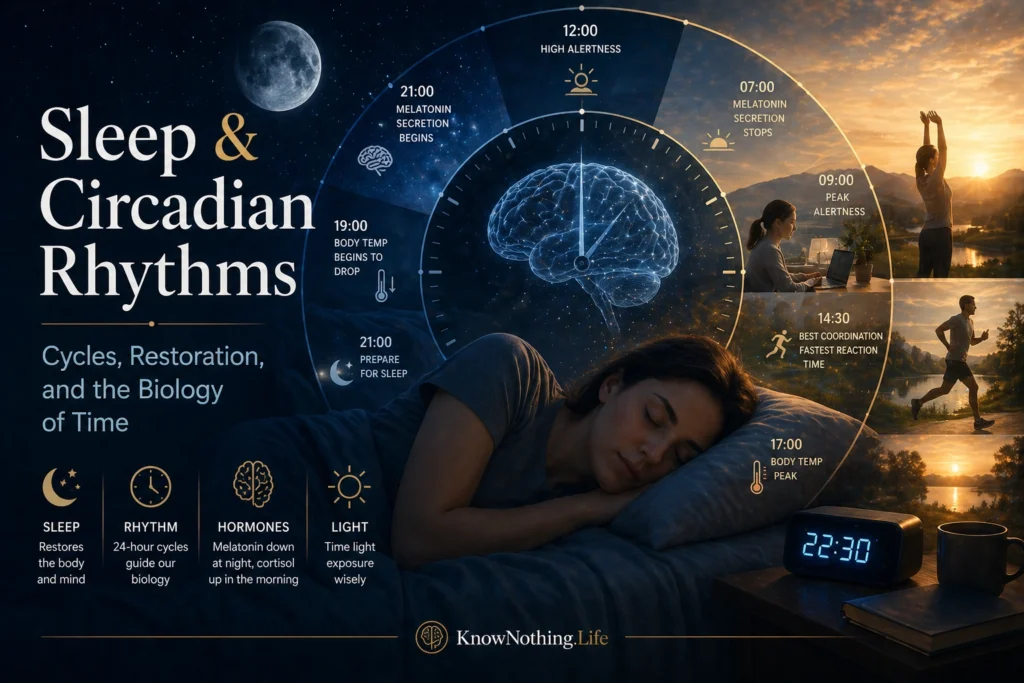
Closely linked to sleep is the concept of circadian rhythms—internal biological clocks that regulate cycles of wakefulness and rest over approximately 24 hours. These rhythms influence not only sleep but also hormone release, body temperature, metabolism, and cognitive performance. As chronobiologist Franz Halberg, who helped pioneer the field, emphasized, biological processes are fundamentally rhythmic, reflecting the organism’s adaptation to the Earth’s rotation. Understanding sleep and circadian rhythms therefore provides insight into how the body organizes time and maintains balance.
The Architecture of Sleep
Sleep is not a uniform state but consists of distinct stages that cycle throughout the night. These stages are broadly divided into non-rapid eye movement (NREM) sleep and rapid eye movement (REM) sleep. NREM sleep includes lighter stages, where the body begins to relax, and deeper stages, often referred to as slow-wave sleep, which are associated with physical restoration and reduced brain activity.
REM sleep, by contrast, is characterized by heightened brain activity, vivid dreaming, and temporary muscle paralysis. During REM, the brain exhibits patterns similar to wakefulness, suggesting that it plays a crucial role in cognitive processes such as memory consolidation and emotional regulation. The alternation between NREM and REM stages creates a dynamic cycle that repeats multiple times during a typical night.
Sleep researcher Allan Rechtschaffen famously remarked, “If sleep does not serve an absolutely vital function, then it is the biggest mistake the evolutionary process has ever made.” This statement underscores the importance of sleep, highlighting that its persistence across species suggests a fundamental role in survival and adaptation.
Circadian Rhythms and the Biological Clock
Circadian rhythms are governed by an internal clock located in the suprachiasmatic nucleus (SCN) of the hypothalamus. This clock synchronizes physiological processes with the external environment, particularly the light–dark cycle. Light signals received through the eyes are transmitted to the SCN, which adjusts the timing of biological rhythms accordingly.
One of the key outputs of the circadian system is the regulation of melatonin, a hormone produced by the pineal gland that promotes sleep. Melatonin levels rise in the evening, signaling the body that it is time to prepare for rest, and decrease in the morning, facilitating wakefulness. This hormonal cycle aligns internal processes with environmental cues, ensuring that sleep occurs at appropriate times.
Research by Jeffrey C. Hall and colleagues on the genetic basis of circadian rhythms has revealed that these cycles are driven by molecular feedback loops within cells. These findings demonstrate that circadian rhythms are not merely behavioral patterns but are embedded in the biology of the organism, operating at both systemic and cellular levels.
Functions of Sleep
Sleep serves multiple functions that are critical for both physical and mental health. One of its primary roles is in the consolidation of memory. During sleep, particularly REM and slow-wave stages, the brain processes and organizes information acquired during the day, strengthening important connections and discarding irrelevant ones. This process enhances learning and supports cognitive performance.
Sleep also plays a vital role in emotional regulation. Lack of sleep is associated with increased irritability, reduced emotional control, and heightened stress responses. Neuroimaging studies have shown that sleep deprivation affects the amygdala, a region involved in emotional processing, leading to exaggerated reactions to negative stimuli.
In addition to cognitive and emotional functions, sleep is essential for physical health. It supports immune function, regulates metabolism, and facilitates the repair of tissues. Neuroscientist Matthew Walker, in Why We Sleep, emphasizes that “sleep is the single most effective thing we can do to reset our brain and body health each day,” highlighting its comprehensive impact on well-being.
Sleep Disorders
Disruptions in sleep and circadian rhythms can lead to a range of disorders, affecting both quality of life and overall health. Insomnia, characterized by difficulty falling or staying asleep, is one of the most common sleep disorders. It can result from stress, anxiety, or irregular sleep patterns, often creating a cycle of sleep deprivation and increased distress.
Other disorders include sleep apnea, which involves repeated interruptions in breathing during sleep, and narcolepsy, a condition marked by excessive daytime sleepiness and sudden sleep attacks. Circadian rhythm disorders, such as delayed sleep phase syndrome, occur when the internal clock is misaligned with the external environment, leading to difficulties in maintaining a regular sleep schedule.
The study of sleep disorders has highlighted the importance of maintaining regular sleep patterns and aligning behavior with circadian rhythms. Treatments often involve behavioral interventions, such as cognitive-behavioral therapy for insomnia (CBT-I), as well as medical approaches when necessary. These strategies aim to restore balance and improve both sleep quality and overall functioning.
Modern Challenges to Circadian Rhythms
In contemporary society, natural circadian rhythms are often disrupted by artificial lighting, shift work, and irregular schedules. Exposure to light at night, particularly from electronic devices, can interfere with melatonin production, delaying sleep onset and reducing sleep quality. This phenomenon has become increasingly common with the widespread use of screens.
Shift work presents another significant challenge, as it requires individuals to be active during times when their biological clocks are programmed for rest. This misalignment can lead to chronic sleep deprivation, increased risk of health problems, and reduced cognitive performance. The long-term effects of circadian disruption include higher rates of cardiovascular disease, metabolic disorders, and mental health issues.
Chronobiologist Till Roenneberg has introduced the concept of “social jetlag” to describe the mismatch between biological and social time. He argues that modern lifestyles often force individuals to operate against their natural rhythms, with significant consequences for health and well-being.
Integration of Sleep, Brain, and Behavior
Sleep and circadian rhythms are deeply integrated with brain function and behavior. The regulation of sleep involves multiple brain regions, including the hypothalamus, brainstem, and cortex, as well as interactions between neurotransmitters and hormones. This complex system ensures that sleep occurs at appropriate times and supports the body’s needs.
Behavior, in turn, influences sleep. Habits such as irregular sleep schedules, caffeine consumption, and exposure to light can affect the timing and quality of sleep. This bidirectional relationship highlights the importance of considering both biological and behavioral factors in understanding sleep.
Philosophically, sleep also raises questions about consciousness and the nature of the mind. During sleep, particularly in REM stages, the brain generates vivid experiences that are disconnected from external reality. These phenomena suggest that consciousness is not solely dependent on external input but can arise from internal processes, offering insight into the nature of perception and imagination.
Conclusion
Sleep and circadian rhythms are fundamental to human health and functioning, reflecting the body’s need for regular cycles of activity and rest. Through complex interactions between neural, hormonal, and environmental factors, these systems regulate a wide range of processes, from memory and emotion to metabolism and immune function.
As modern life continues to challenge natural rhythms, understanding the importance of sleep has become increasingly critical. By aligning behavior with biological cycles and addressing disruptions when they occur, individuals can support both physical and mental well-being. Ultimately, the study of sleep and circadian rhythms reveals the profound ways in which time is embedded in the biology of life, shaping the rhythms of mind and body.