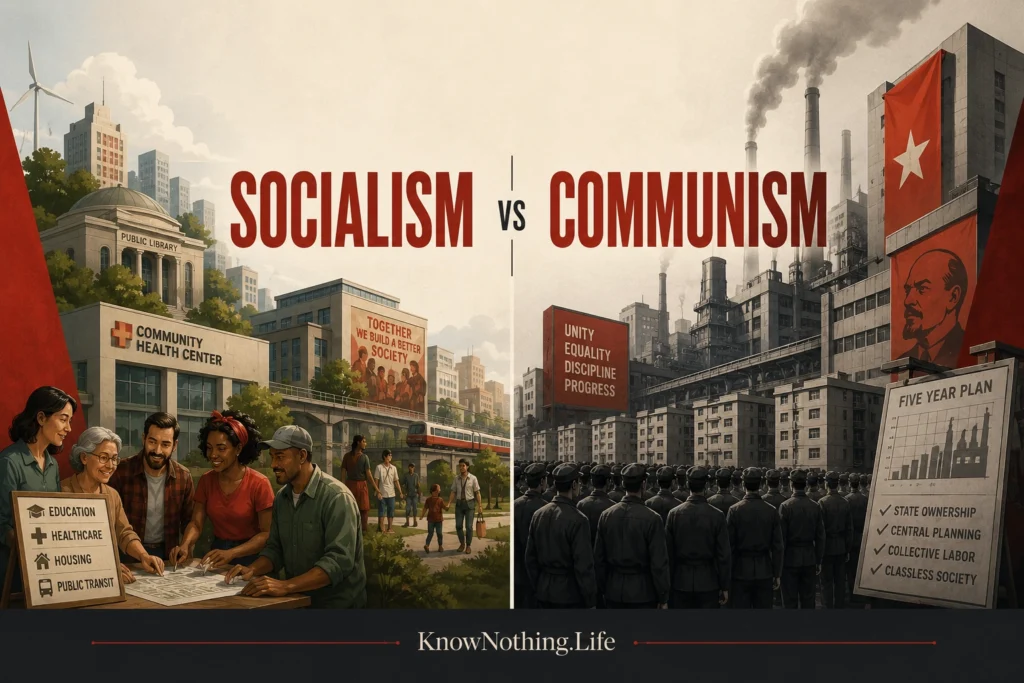
Socialism and communism are two of the most debated political and economic ideas in modern history. They are often used as if they mean the same thing, especially in casual political arguments, but they are not identical. Both criticize capitalism, especially the concentration of wealth and power in the hands of owners, corporations, and financial elites. Both ask whether economic life should be organized around private profit or collective welfare. Both are concerned with inequality, labor, exploitation, ownership, and the distribution of resources. But they differ in scope, method, historical meaning, and political practice.
The simplest distinction is this: socialism is a broad family of ideas arguing that major parts of the economy should be socially owned, publicly regulated, or organized for the common good; communism is a more radical vision of a classless, stateless, moneyless society in which the means of production are collectively owned and private class power has disappeared. In Marxist theory, socialism is often treated as a transitional stage between capitalism and communism. In modern politics, however, socialism can also mean democratic socialism, social democracy, public ownership, welfare-state capitalism, worker cooperatives, or mixed economies with strong social protections. Communism usually refers either to Marx’s revolutionary theory or to twentieth-century states governed by communist parties.
The Origins of Socialist Thought
Socialist ideas emerged in response to the inequalities of industrial capitalism. During the eighteenth and nineteenth centuries, factories, wage labor, urban poverty, and private ownership transformed Europe and North America. Industrialization created enormous wealth, but also dangerous working conditions, child labor, long hours, crowded cities, and a sharp divide between owners and workers. Early socialist thinkers argued that capitalism treated labor as a commodity and allowed a small owning class to profit from the work of many.
Before Karl Marx, there were already socialist reformers and visionaries. Henri de Saint-Simon imagined a society organized around productive labor and scientific planning. Charles Fourier proposed cooperative communities as alternatives to competitive capitalism. Robert Owen, a Welsh industrialist and reformer, tried to improve workers’ lives through model communities and cooperative experiments. These early socialists were often called “utopian socialists” because they proposed ideal communities rather than a full theory of class struggle and historical change.
Marx, Engels, and Scientific Socialism
Karl Marx and Friedrich Engels transformed socialist thought by giving it a historical and economic theory. In The Communist Manifesto (1848), they argued that history is driven by class struggle. Their famous opening claim—“The history of all hitherto existing society is the history of class struggles”—framed politics as a conflict between those who own the means of production and those who must sell their labor. Under capitalism, Marx argued, the bourgeoisie owns factories, land, and capital, while the proletariat survives through wages.
Marx’s major work, Das Kapital, analyzed capitalism as a system built on surplus value: workers produce more value than they receive in wages, and owners keep the difference as profit. For Marx, capitalism was dynamic and productive, but also unstable and exploitative. He believed it would eventually produce crises and sharpen class conflict. Socialism, in Marxist theory, would arise when workers took control of the state and economy. Communism would eventually follow when class divisions disappeared and the state itself became unnecessary.
Socialism as a Broad Tradition
Socialism is broader than Marxism. Some socialists are revolutionary; others are democratic reformers. Some want state ownership of major industries; others prefer worker cooperatives, public banking, strong unions, universal healthcare, rent control, or democratic planning. Some socialists reject markets entirely; others support market socialism, where firms may compete but ownership is social, cooperative, or public. This variety is why socialism is difficult to define in one sentence.
A useful way to understand socialism is through the question of ownership. Capitalism centers on private ownership of productive assets. Socialism asks whether those assets should be controlled by society, workers, communities, or the public rather than by private owners seeking profit. But different socialists answer that question differently. A democratic socialist may support elections, civil liberties, public services, and gradual reform. A Marxist-Leninist may argue for a revolutionary party and centralized state power. A social democrat may support capitalism with heavy regulation, welfare programs, and strong labor rights, though some socialists argue that social democracy is not socialism because it leaves private ownership intact.
Communism as a Final Vision
Communism, in its theoretical form, is more radical than socialism. Marx and Engels described communism as a society beyond class rule, exploitation, and private ownership of the means of production. In The Communist Manifesto, they famously wrote that the theory of the communists may be summed up as “abolition of private property.” By this, they did not mean personal belongings like clothing, furniture, or toothbrushes. They meant private ownership of productive property: factories, mines, land, railways, and capital used to extract profit from labor.
In Marx’s later formulation, especially in Critique of the Gotha Programme, communism involves different phases. The lower phase still contains traces of the old society and distributes according to labor. The higher phase is summarized by the famous principle: “From each according to his ability, to each according to his needs.” In this ideal, production is no longer organized around profit, classes no longer exist, and the state as an instrument of class rule fades away. Whether such a society is possible remains one of the great debates in political theory.
The Role of the State
One of the biggest differences between socialism and communism concerns the state. In democratic socialism, the state may be used to regulate capitalism, redistribute wealth, nationalize industries, provide universal services, and protect workers. The state is seen as a democratic tool that can be shaped by voters, unions, parties, and institutions. In authoritarian socialist systems, however, the state becomes the central planner and controller of political and economic life.
Classical communism, at least in Marx’s ultimate vision, imagines the eventual disappearance of the state. Marx saw the state as an instrument of class power. Once classes disappeared, the state would no longer be necessary in the same form. But in twentieth-century communist regimes, the opposite often occurred: the state became extremely powerful. The Soviet Union, Maoist China, and other communist-party states created centralized governments, one-party rule, secret police, censorship, and planned economies. Supporters claimed this was a necessary transitional stage; critics argued that it betrayed the emancipatory promise of communism.
Democracy, Revolution, and Reform
Socialists and communists have often disagreed about how change should happen. Many socialists believe capitalism can be transformed through democratic means: elections, labor unions, public policy, taxation, welfare programs, nationalization, and gradual reform. Democratic socialists argue that political democracy should be extended into economic life. If people can vote for political leaders, they ask, why should workers have no democratic power over workplaces that shape their lives?
Communists, especially Marxist-Leninists, have often argued that capitalism cannot be peacefully reformed because the ruling class will use wealth, media, law, and force to protect itself. Lenin’s State and Revolution argued that workers must overthrow the capitalist state and establish a dictatorship of the proletariat as a transitional form of rule. Critics respond that revolutionary states often concentrate power in party elites rather than workers themselves. This disagreement—reform or revolution—has divided the left for more than a century.
Markets, Planning, and Ownership
Another key difference concerns markets. Socialism does not always mean abolishing markets. Some socialists favor market socialism, in which enterprises are owned by workers, communities, or the public but still exchange goods through markets. Others favor democratic planning, where investment and production are guided by social needs rather than profit. Social democracy, common in many European welfare states, accepts private markets while using taxation, regulation, and public services to reduce inequality.
Communism, in its ideal form, moves beyond markets, wage labor, and money. Production is organized according to need rather than exchange value. In practice, communist states used central planning to allocate labor, resources, and production targets. This allowed rapid industrialization in some cases but also produced shortages, inefficiencies, bureaucracy, coercion, and lack of consumer responsiveness. Critics such as Friedrich Hayek argued that central planning cannot process dispersed economic information as effectively as markets. Socialists have responded in different ways, with some defending planning and others seeking hybrid models.
Common Confusions
One major confusion is treating all public spending as socialism. Public schools, roads, libraries, police, fire departments, Medicare, Social Security, or unemployment insurance are not automatically socialism in the strict sense. They are public programs that can exist within capitalist economies. Socialism concerns ownership and control of production, not merely government activity. A capitalist country can have a large welfare state while still being capitalist if most productive property remains privately owned.
Another confusion is treating all socialist ideas as communist dictatorship. Many socialists explicitly reject one-party rule, censorship, and authoritarianism. Democratic socialists emphasize civil liberties, elections, pluralism, and worker democracy. Conversely, many communist regimes called themselves socialist because they claimed to be building socialism as a stage toward communism. This overlapping language explains why the terms are so often tangled.
Strengths and Criticisms
Socialism’s strength is its moral focus on inequality, exploitation, poverty, and democratic control over economic life. It asks whether freedom is meaningful when people lack healthcare, housing, education, stable work, or bargaining power. It argues that political rights alone are incomplete without economic security. Its critics argue that socialism can weaken incentives, reduce innovation, expand bureaucracy, and concentrate power in the state.
Communism’s strength is its radical critique of class domination and its vision of a society beyond exploitation. It asks whether capitalism’s inequalities are reformable or built into the system itself. Its critics argue that communist revolutions have repeatedly produced authoritarian states, economic repression, political violence, and the suppression of individual freedom. Defenders argue that those states were distorted by war, isolation, underdevelopment, or betrayal of the original ideal. The debate remains unresolved because communism exists both as a philosophical ideal and as a historical record.
Final Thoughts
Socialism and communism are related but not identical. Socialism is a broad tradition that seeks greater social ownership, economic equality, and democratic control over production. Communism is a more radical theory and ideal that aims for a classless, stateless society beyond private ownership, wage labor, and exploitation. In Marxist theory, socialism is often the transition; communism is the final goal. In modern politics, socialism may range from democratic reform to revolutionary transformation, while communism usually refers either to Marxist theory or communist-party states.
The difference matters because political language is often used carelessly. Calling every welfare program “communism” obscures real distinctions. Calling every socialist a supporter of authoritarian rule is inaccurate. At the same time, ignoring the historical failures of communist regimes is intellectually dishonest. A serious understanding requires separating ideals from institutions, theory from history, and slogans from actual economic structures.
At their core, both socialism and communism ask one enduring question: who should control the wealth, labor, and productive power of society? Capitalism answers: private owners and markets. Socialism answers: society, workers, or the public should have greater control. Communism answers: class ownership itself should disappear. The debate continues because it is not only about economics. It is about freedom, equality, power, work, human dignity, and the kind of society people believe justice requires.