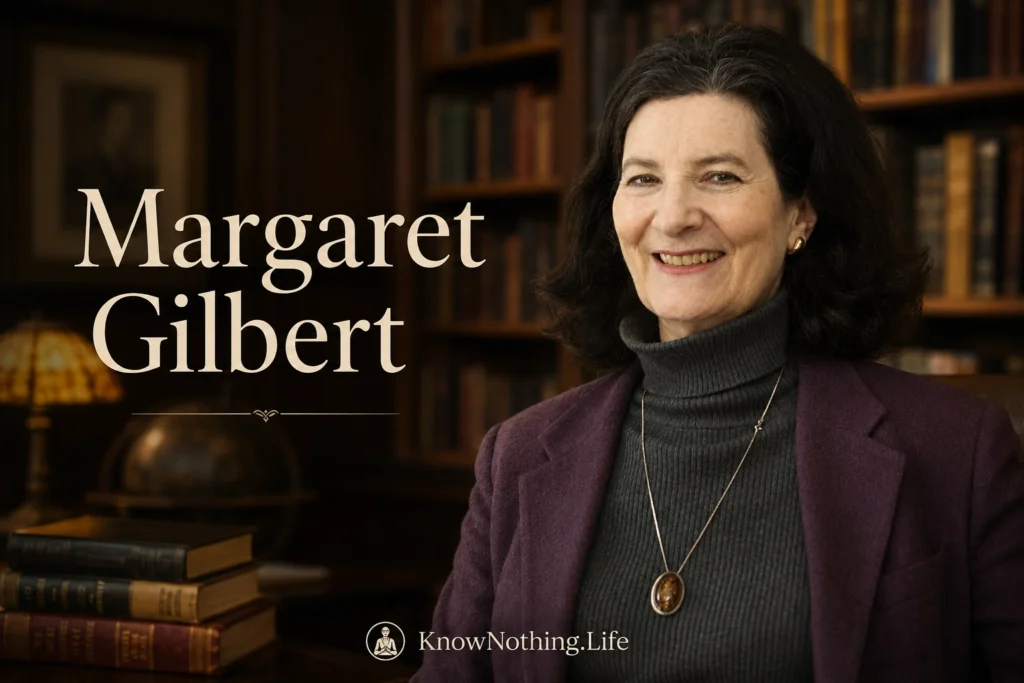
Margaret Gilbert was born in 1942 in the United Kingdom and became one of the most important contemporary philosophers of social life. Her work belongs to social ontology, moral philosophy, political philosophy, philosophy of law, and the philosophy of action, but its central question is simple and profound: what changes when separate individuals become a “we”? People walk together, make promises, form political communities, share beliefs, join committees, grieve together, love one another, and hold one another responsible. Gilbert’s philosophy asks what kind of reality these shared activities have.
Gilbert studied at Cambridge University, where she received a B.A. with a double first in Classics and Philosophy and later an M.A. She went on to Oxford University, earning a B.Phil. with double distinction and a D.Phil. in philosophy. Her teachers and intellectual surroundings connected her to major strands of twentieth-century philosophy, including ordinary language philosophy, ethics, political theory, and analytic metaphysics. From the start, her work combined conceptual precision with attention to ordinary social experience.
The Problem of the Social World
Gilbert’s philosophical career developed around a problem that many philosophers had either ignored or treated too quickly. What is a social group? Is a group only a collection of individuals? When people say “we believe,” “we agreed,” “we decided,” or “we are walking together,” are they merely summarizing private mental states, or is there a distinct social fact involved? Gilbert argued that many social phenomena cannot be reduced to individual attitudes added together.
This made her work especially important in the philosophy of social science. Earlier thinkers such as Émile Durkheim, Georg Simmel, Max Weber, and David Lewis had all addressed social facts, conventions, or collective life in different ways. Gilbert entered that tradition with the tools of analytic philosophy. She wanted to explain how collective phenomena can be real without becoming mysterious. Her answer centered on the idea that human beings can bind themselves together through joint commitment.
On Social Facts
Gilbert’s landmark book On Social Facts, published in 1989, established her reputation as a founding figure in contemporary social ontology. The book examined social groups, collective belief, social convention, shared action, group languages, and mutual recognition. It asked whether social groups are real in any sense beyond the thoughts and actions of their individual members. Gilbert’s answer was that many central social phenomena are “plural subject” phenomena.
A plural subject exists when individuals are jointly committed to act, believe, feel, or intend as a body. This does not mean they become one literal mind. It means they stand in a normative relation to one another. They are no longer merely parallel individuals with similar goals. They are participants in a shared commitment that gives each person a standing to expect, demand, and rebuke certain behavior from the others. In that way, Gilbert gave philosophical depth to everyday words such as “we,” “together,” “ours,” and “agreed.”
Joint Commitment
Gilbert’s most famous concept is joint commitment. Her own summary captures the heart of the idea: “A joint commitment binds people together as one.” This binding is not necessarily moral in the narrow sense, and it is not always created by formal contract. Two people can be jointly committed to walking together, discussing a topic, supporting a policy, maintaining a friendship, or acting as members of an association. Once the joint commitment exists, each participant has a special standing in relation to the others.
This is why joint commitment is so important. If two people merely happen to walk side by side, neither has the right to complain if the other turns away. But if they are walking together, one may rebuke the other for abandoning the walk without notice. The social fact changes the normative landscape. Gilbert showed that ordinary social life is filled with these small but powerful bonds. They explain why promises, agreements, conversations, shared plans, and group membership feel different from coincidental coordination.
Living Together and Political Obligation
Gilbert developed these ideas further in Living Together: Rationality, Sociality, and Obligation, published in 1996, and Sociality and Responsibility, published in 2000. These works expanded her plural subject theory into questions about rationality, responsibility, blame, obligation, and social unity. She argued that many obligations arise not from private choice alone, nor from morality alone, but from participation in joint commitments. Social life creates claims between people.
Her book A Theory of Political Obligation: Membership, Commitment, and the Bonds of Society, published in 2006, applied this framework to political philosophy. Political obligation is the problem of why citizens are obligated to uphold the institutions of their society. Gilbert argued that membership in a political society may involve a form of joint commitment. The citizen is not merely someone who happens to live under a state; the citizen may be part of a plural subject whose members are bound together by political institutions, laws, and shared commitments.
Rights, Demands, and Moral Standing
In Rights and Demands: A Foundational Inquiry, published in 2018, Gilbert turned to rights theory. She focused on demand-rights, a central class of rights involving the standing to demand action from another person. To have a right, in this sense, is not merely to benefit from someone’s duty. It is to have the authority to require performance and to rebuke non-performance. This made rights part of the same larger philosophical field as agreements, promises, and joint commitments.
Gilbert’s work on rights is important because it challenges overly abstract accounts of obligation. Rights are not just logical positions in a moral system. They structure relationships between persons. If I have a right against you, I stand to you in a particular way. You owe something to me, not merely to morality in general. Gilbert’s theory therefore connects social ontology with legal and moral philosophy. It asks how people acquire the authority to make claims on one another.
Collective Belief, Emotion, and Life in Groups
Gilbert has also written extensively on collective belief and collective emotion. When people say “we believe this,” “we are angry,” or “we regret what happened,” they may not be reporting that every member privately has the same belief or feeling. Instead, they may be expressing a collective stance grounded in joint commitment. A committee can believe a proposal is sound even if some members privately doubt it. A community can mourn, celebrate, or take responsibility in ways that are not reducible to identical individual emotions.
Her later book Life in Groups: How We Think, Feel, and Act Together, published in 2023, continued this project. It gathered essays on collective beliefs, emotions, preferences, obligations, and rational choice. The title expresses the scope of Gilbert’s career. She has spent decades explaining how human beings think, feel, act, and become accountable together. Her philosophy shows that much of human life is neither purely individual nor vaguely collective. It is structured by specific social bonds.
Honors, Influence, and Lasting Legacy
Gilbert has taught at the University of Manchester, the University of Connecticut, and the University of California, Irvine, where she is Distinguished Professor and Abraham I. Melden Chair in Moral Philosophy. She is also Professor Emerita at the University of Connecticut. Her honors include election to the American Academy of Arts and Sciences and the Lebowitz Prize for Philosophical Achievement and Contribution. Her work has influenced philosophy, law, political theory, sociology, psychology, anthropology, game theory, and even robotics.
Margaret Gilbert’s lasting importance lies in her explanation of how social reality is made. She showed that the word “we” is not a casual grammatical convenience. It can mark a genuine normative bond. Through joint commitment, people create shared actions, collective beliefs, agreements, promises, rights, obligations, political communities, and forms of responsibility. Her philosophy remains essential because it reveals the hidden architecture of ordinary life: the many ways human beings become answerable to one another by becoming, in some sense, one.