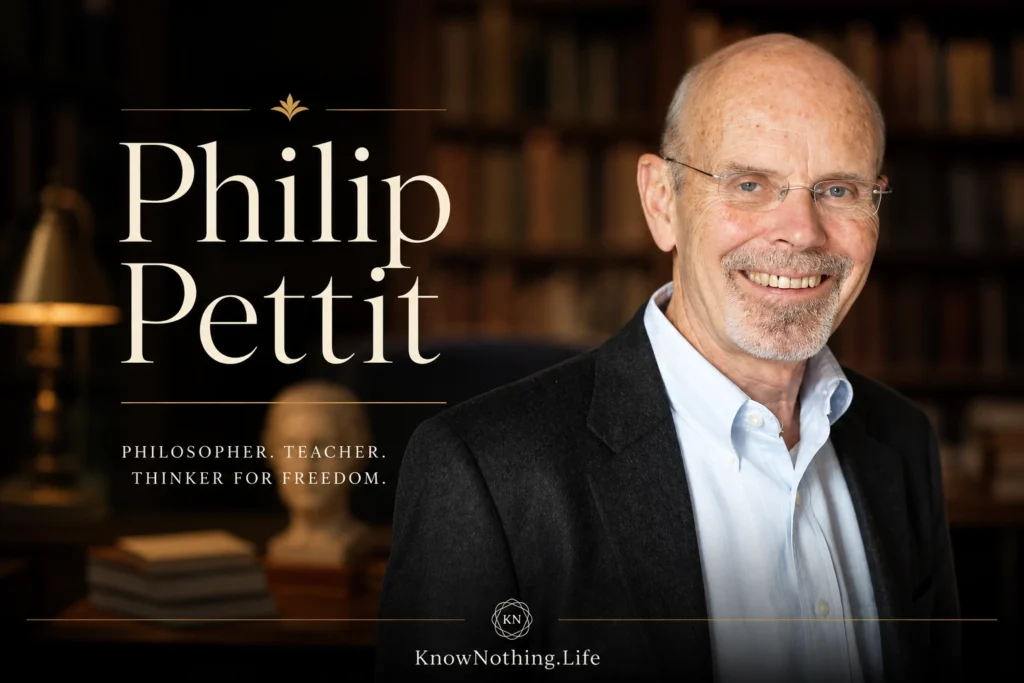
Philip Noel Pettit was born in 1945 in Ballygar, County Galway, Ireland, and became one of the most influential moral and political philosophers of the contemporary era. His work is best known for reviving republican political theory and giving modern philosophy one of its most powerful definitions of liberty: freedom as non-domination. Pettit’s importance lies in the way he changed the question of freedom. Instead of asking only whether someone is actively interfered with, he asked whether that person lives under another’s uncontrolled power.
Pettit studied at Maynooth College, earning degrees from the National University of Ireland, and completed his Ph.D. at Queen’s University Belfast in 1970. His early academic career took him through University College Dublin, Trinity Hall at Cambridge, and the University of Bradford before he moved in 1983 to the Australian National University. There he became a major figure in social and political theory, philosophy of mind, and moral philosophy. In 2002, he joined Princeton University, where he became L.S. Rockefeller University Professor of Human Values, while also holding a distinguished position at the Australian National University.
From Mind and Agency to Politics
Before Pettit became widely associated with republicanism, he was already working across several connected areas: philosophy of mind, metaphysics, ethics, agency, and social explanation. His book The Common Mind: An Essay on Psychology, Society and Politics explored how individual minds are shaped by social life, language, norms, and shared practices. Pettit was never interested in treating persons as isolated atoms. Human beings think, choose, speak, and act within social worlds that make agency possible.
That concern with agency became central to his later political philosophy. In A Theory of Freedom: From the Psychology to the Politics of Agency, Pettit connected personal freedom with social and political conditions. Freedom is not merely an inner feeling of choice. It depends on whether people can act without being subject to the arbitrary will of others. This bridge between psychology and politics is one of Pettit’s distinctive achievements. He showed that to understand freedom properly, we must understand both the agent who chooses and the social structures that can support or undermine choice.
Republicanism and Freedom as Non-Domination
Pettit’s most famous book, Republicanism: A Theory of Freedom and Government, published in 1997, revived an older republican tradition and made it central to contemporary political theory. The book argued that freedom should not be understood simply as non-interference. A person may be left alone and still be unfree if someone else has the unchecked power to interfere at will. Pettit’s classic example comes from the ancient distinction between the free person and the slave. A kindly master may not interfere often, but the slave remains unfree because the master’s power is always there.
This is the heart of freedom as non-domination. Domination exists when one person or group depends on the arbitrary power of another. The problem is not only actual interference, but vulnerability. A worker dominated by an employer, a citizen dominated by an unchecked ruler, a spouse dominated by a threatening partner, or a community dominated by a corporation may all live under power they cannot contest. As Pettit has explained, “everyone knows what it is to be dominated: what it is to live under the power of another.” His philosophy gave that ordinary experience a precise political language.
Against Liberal Non-Interference
Pettit’s theory challenged the dominant liberal idea that liberty means absence of interference. On the liberal view, a law, tax, regulation, or command often appears as a reduction of freedom because it interferes with individual choice. Pettit argued that this is too simple. Some interference can reduce domination rather than increase it. Laws against domestic violence, workplace abuse, racial discrimination, corruption, monopolistic control, or arbitrary state power may interfere with some choices, but they can make people freer by protecting them from private or public domination.
This is why Pettit’s republicanism does not fit neatly into simple left-right politics. It is not libertarian anti-statism, because it sees law as necessary for freedom. But it is also not blind statism, because the state itself can dominate unless controlled by citizens. A free society needs law, rights, accountability, transparency, contestation, and democratic control. Pettit’s ideal is not a world without interference, but a world where interference is not arbitrary. The question is always: who holds power, how is it controlled, and can those affected challenge it?
Democracy on the People’s Terms
Pettit developed these ideas further in On the People’s Terms: A Republican Theory and Model of Democracy, published in 2012 from his Seeley Lectures at Cambridge. In that work, he argued that democracy should not be reduced to majority rule or periodic elections. A government can win elections and still dominate citizens if its power is unchecked, opaque, or captured by elites. Republican democracy requires public control over government, not merely public selection of rulers.
For Pettit, the people must be able to contest, monitor, and influence the power exercised in their name. This leads to a constitutional vision of democracy with courts, legislatures, transparency rules, public reason, independent institutions, civic participation, and protections for minorities. The people’s power must be more than a moment at the ballot box. It must be a continuing structure of control. Pettit’s republicanism therefore links freedom and democracy: citizens are free when they are not ruled by another’s uncontrolled will, including the uncontrolled will of their own government.
Public Life, Spain, and Republican Reform
Pettit’s work had an unusual impact beyond the academy. His republican theory influenced political discussions in Spain during the government of José Luis Rodríguez Zapatero. Pettit later coauthored A Political Philosophy in Public Life: Civic Republicanism in Zapatero’s Spain with José Luis Martí. This episode mattered because it showed that Pettit’s philosophy was not merely theoretical. It could be used as a lens for evaluating real reforms involving transparency, equality, civil rights, democratic accountability, and resistance to domination.
Pettit himself has described being invited to assess how faithfully Zapatero’s government lived up to republican principles. The guiding phrase “no dominación” became associated with that political project. Whether one agrees with every policy or not, the episode shows the practical force of Pettit’s central idea. Political philosophy, for him, should not float above public life. It should clarify the standards by which institutions can be judged. A society is not just when citizens are lucky enough to avoid abuse; it is just when they are protected against being subject to abuse in the first place.
Group Agency, Ethics, and the State
Pettit’s work also extends beyond republican liberty. With Christian List, he wrote Group Agency: The Possibility, Design, and Status of Corporate Agents, a major work on how groups, organizations, and institutions can act as agents. This subject connects naturally with his political theory. If corporations, governments, committees, and institutions can exercise agency, then they can also dominate, deliberate, decide, and be held responsible in distinctive ways. Pettit’s philosophy repeatedly asks how individual agency and collective agency interact.
His later works include Just Freedom: A Moral Compass for a Complex World, The Robust Demands of the Good, The Birth of Ethics, and The State. These books show the breadth of his interests: justice, moral obligation, virtue, respect, social norms, ethics, and the functional requirements of political order. In The State, Pettit turned to the basic question of what states do before asking what a just state should do. This realist turn did not abandon republicanism. It strengthened it by asking what institutions must be capable of if they are to protect people from domination.
Honors and Lasting Importance
Pettit has received major international honors, including election to the American Academy of Arts and Sciences, honorary membership in the Royal Irish Academy, fellowship of the British Academy, and appointment as a Companion of the Order of Australia. His work has also been the subject of the edited volume Common Minds: Themes from the Philosophy of Philip Pettit, a sign of his wide influence across philosophy, political theory, and social thought.
Philip Pettit’s lasting importance lies in his transformation of the modern idea of freedom. He showed that people can be unfree even when no one is currently interfering with them, if they live under power they cannot contest. He also showed that law and government can either dominate people or protect them from domination, depending on how power is structured. His philosophy remains essential because it gives political life a demanding test: not simply whether people are left alone, but whether they can stand before others without fear, dependence, or subjection. Pettit made freedom social, institutional, and republican again.