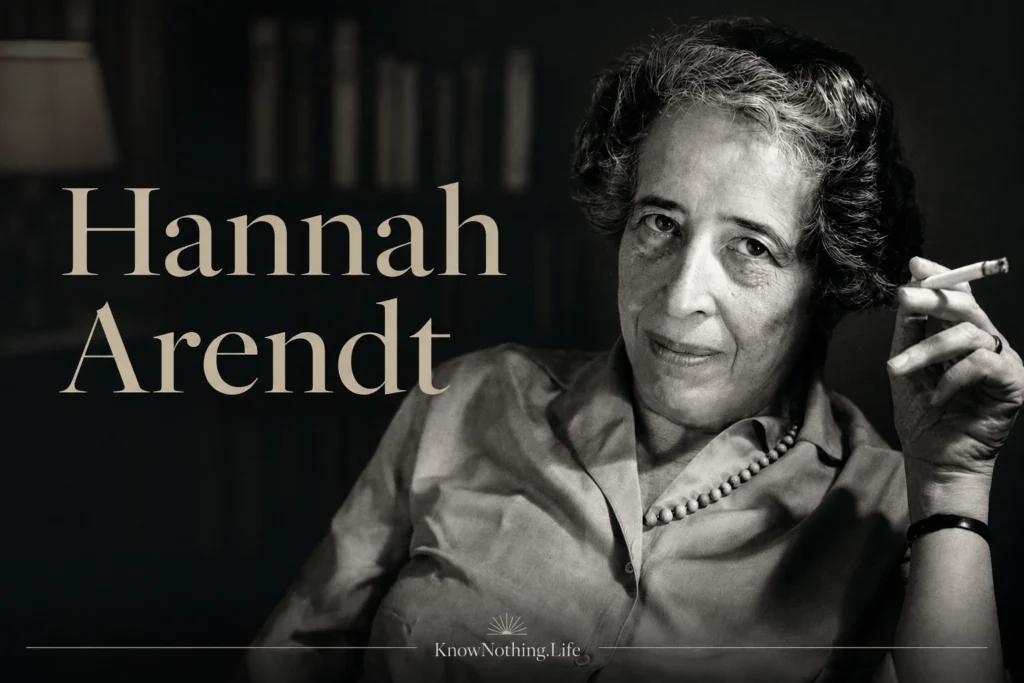
Hannah Arendt was born on October 14, 1906, in Hannover, Germany, and was raised in Königsberg in a secular German Jewish family. She grew up in a cultivated household marked by books, politics, and the shocks of twentieth-century history. Her father died when she was young, and her mother encouraged independence, education, and intellectual seriousness. Arendt came of age during the aftermath of World War I, the instability of the Weimar Republic, and the rise of antisemitism that would eventually force her out of Germany.
Arendt studied philosophy, theology, and classics at Marburg, Freiburg, and Heidelberg. At Marburg she studied with Martin Heidegger, whose influence on her thinking was deep and complicated. At Heidelberg she completed her doctorate under Karl Jaspers in 1928, writing on the concept of love in Saint Augustine. That first book, Love and Saint Augustine, already showed themes that would remain important: worldliness, human relation, beginning, and the tension between inward life and shared public existence. Arendt was trained as a philosopher, but she later resisted being called one in the ordinary academic sense. Her real subject became political experience: what happens when human beings act together, destroy one another, judge one another, and try to build a common world.
Exile, Statelessness, and Political Awakening
The rise of Adolf Hitler transformed Arendt’s life and thought. In 1933, she was arrested briefly by the Gestapo for gathering evidence of antisemitic propaganda. After her release, she fled Germany and settled in Paris, where she worked with Jewish refugee and youth organizations. In 1940, after the German invasion of France, she was interned at the Gurs camp as an enemy alien, then escaped. In 1941, she and her second husband, Heinrich Blücher, reached the United States and settled in New York.
These experiences made exile, statelessness, and rights central to Arendt’s political thought. She had seen how quickly legal identity could be stripped away and how fragile human rights become when no political community guarantees them. Her later phrase “the right to have rights” came from this insight. It meant that abstract human dignity is not enough if a person has no place in the world where their speech, action, and claims are recognized. Arendt’s political theory was therefore not built from theory alone. It came from the experience of refugees, camps, destroyed citizenship, and the collapse of ordinary moral categories under totalitarian rule.
The Origins of Totalitarianism
Arendt’s first major political work, The Origins of Totalitarianism, was published in 1951. It examined antisemitism, imperialism, racism, statelessness, ideology, terror, and the emergence of Nazi and Stalinist rule. The book was not simply a history of dictatorship. Arendt argued that totalitarianism was a new form of domination, different from ordinary tyranny because it sought to transform human beings themselves. It did not merely demand obedience; it tried to make people superfluous, isolated, and unable to distinguish truth from ideological fiction.
One of Arendt’s most disturbing insights was that totalitarian movements attack the human capacity for independent judgment. “The aim of totalitarian education,” she wrote, was not to create convictions but “to destroy the capacity to form any.” This line captures her belief that totalitarianism does not only rule bodies; it ruins the space in which thinking and responsibility can occur. Her analysis remains influential because it shows that political evil depends not only on violence, but on loneliness, propaganda, bureaucracy, ideology, and the erosion of shared reality.
The Human Condition
In 1958, Arendt published The Human Condition, her most ambitious philosophical book. In it, she analyzed the “vita activa,” the active life, through three basic activities: labor, work, and action. Labor corresponds to biological necessity and survival. Work creates the durable human world of objects, institutions, and artifacts. Action is the activity through which people appear before one another in speech and deed, revealing who they are and beginning something new. For Arendt, politics at its best belongs to action, not mere administration or social management.
Arendt’s famous claim that “men, not Man, live on the earth” expresses her central idea of plurality. Human beings are equal enough to understand one another, but distinct enough that each person brings a new perspective into the world. Politics exists because humans are plural, not because they are identical. Freedom, for Arendt, is not mainly private choice or inner will. It appears when people speak, act, deliberate, promise, forgive, and begin together in a public space. This made her one of the great defenders of political action against both totalitarian control and modern passivity.
Eichmann in Jerusalem and the Banality of Evil
Arendt became internationally famous and fiercely controversial after covering the 1961 trial of Adolf Eichmann in Jerusalem for The New Yorker. Her reports became the 1963 book Eichmann in Jerusalem: A Report on the Banality of Evil. Eichmann had been a major organizer of Nazi deportations, yet Arendt did not describe him as a demonic monster. She saw in him something more frightening: a shallow, career-minded bureaucrat who spoke in clichés and seemed unable to think from the standpoint of others.
Her phrase “the banality of evil” was widely misunderstood. Arendt did not mean that evil acts are trivial or that Nazi crimes were ordinary in moral weight. She meant that enormous crimes can be committed by people who are not grand villains, but thoughtless functionaries who surrender judgment to rules, systems, and career obedience. Later, in The Life of the Mind, she returned to the moral importance of thinking, writing that much evil is done by people who never decide whether they are good or evil. For Arendt, thinking was not an academic luxury. It was a defense against moral collapse.
Revolution, Violence, and Public Freedom
Arendt continued to write about political action, authority, freedom, and revolution in works such as Between Past and Future, On Revolution, Men in Dark Times, On Violence, and Crises of the Republic. In On Revolution, she compared the American and French revolutions, arguing that the most precious revolutionary achievement is not simply liberation from oppression, but the founding of spaces where public freedom can endure. She admired councils, assemblies, and forms of civic participation in which people could act together rather than merely be governed.
Her essay On Violence made another influential distinction. “Power and violence are opposites,” she wrote. Power arises when people act together; violence relies on instruments of force. A government may use violence, but if it depends on violence alone, it has already lost real power. This distinction remains one of Arendt’s most important contributions to political theory. It challenges the assumption that power is simply command backed by force. For Arendt, authentic power is collective, relational, and rooted in consent, speech, and shared action.
Thinking Without a Banister
In her later years, Arendt became increasingly concerned with thinking, willing, and judging. Her unfinished final work, The Life of the Mind, was published after her death in 1978. She wanted to understand how thinking relates to moral responsibility, especially after the experience of totalitarianism and the Eichmann trial. She famously described her own method as “thinking without a banister,” meaning thought without guaranteed support from inherited tradition, fixed doctrine, or automatic moral rules.
This phrase captures Arendt’s intellectual courage. She distrusted systems that explained everything too neatly. She preferred judgment, attention, and the difficult work of understanding events in their particularity. Her works do not offer a single ideology or program. They offer a way of thinking politically after catastrophe: remain alert to the fragility of truth, the danger of loneliness, the importance of public freedom, and the moral necessity of judgment.
Legacy and Lasting Importance
Hannah Arendt died on December 4, 1975, in New York City. By then, she had become one of the most original political thinkers of the twentieth century. Her major works include Love and Saint Augustine, The Origins of Totalitarianism, The Human Condition, Rahel Varnhagen, Between Past and Future, On Revolution, Eichmann in Jerusalem, Men in Dark Times, On Violence, Crises of the Republic, and The Life of the Mind. Across those works, she wrote about terror, freedom, public action, evil, judgment, revolution, and the conditions that make human life political.
Arendt’s lasting importance lies in her refusal to simplify moral and political reality. She understood that evil can be monstrous in consequence and ordinary in personality. She saw that rights need political belonging, that freedom needs public space, and that truth needs a shared world in which facts can still matter. Her thought remains urgent because she asked what happens when people stop thinking, stop judging, stop acting together, and surrender the world to systems. Hannah Arendt’s legacy is a warning and an invitation: politics is dangerous, but without it, human beings lose the space where freedom can appear.