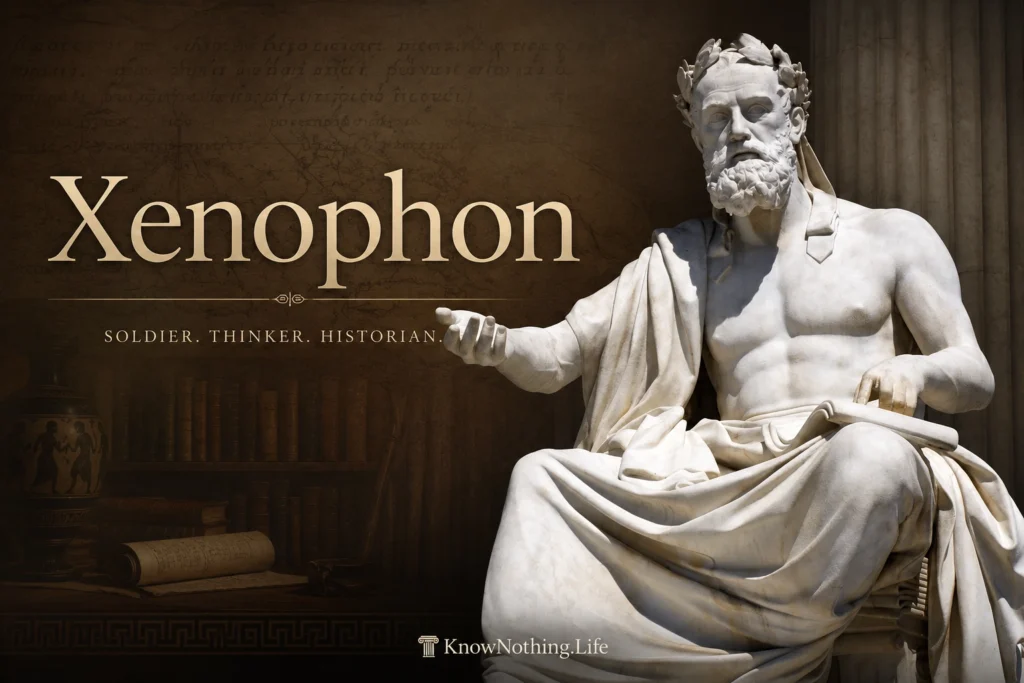
Xenophon was born in Athens around 430 BCE, into a world shaped by the Peloponnesian War, civic instability, and the decline of Athenian imperial power. He belonged to a relatively comfortable family, often associated with the equestrian class, and he came of age during one of the most dramatic periods in Greek history. Athens had produced tragedy, democracy, philosophy, empire, and naval power, but Xenophon’s youth also witnessed plague, defeat, oligarchic coups, and moral uncertainty. This political background mattered deeply. Xenophon’s writings repeatedly ask how human beings should govern themselves, how leaders should command, and how communities survive disorder.
As a young man, Xenophon became associated with Socrates, whose influence shaped his moral imagination. Unlike Plato, Xenophon did not present Socrates as a metaphysical genius ascending toward eternal Forms. His Socrates is practical, pious, disciplined, and useful in ordinary life. In the Memorabilia, Xenophon defended Socrates against the charge that he corrupted the young, portraying him instead as a teacher of self-control, household management, friendship, leadership, and reverence for the gods. Xenophon’s Socratic inheritance was therefore moral and practical: philosophy was not an escape from action, but training for living well.
The Expedition of Cyrus and the Ten Thousand
The turning point in Xenophon’s life came in 401 BCE, when he joined a Greek mercenary expedition organized by Cyrus the Younger, who secretly intended to challenge his brother Artaxerxes II for the Persian throne. Xenophon had been invited by his friend Proxenus and appears not to have understood the full political stakes at first. The campaign carried thousands of Greek soldiers deep into Persian territory. At the Battle of Cunaxa, Cyrus was killed, and the Greek army suddenly found itself stranded far from home, surrounded by hostile forces, and deprived of its original purpose.
The crisis became the subject of Xenophon’s most famous book, the Anabasis, a first-person military narrative of survival, leadership, and endurance. After Persian forces treacherously killed several Greek generals, Xenophon emerged as one of the leaders who helped guide the army northward through mountains, snow, hunger, ambushes, and fear. The book’s most famous cry comes when the exhausted Greeks finally see the Black Sea: “The sea! The sea!” The scene became one of the great moments in ancient literature because it condenses relief, homesickness, and collective survival into a single shout.
Exile, Sparta, and a Life Between Cities
Xenophon’s participation in the expedition changed his standing in Athens. He later became closely associated with Sparta, especially with the Spartan king Agesilaus II, and he was eventually exiled from Athens. He lived for a time at Scillus, near Olympia, on an estate granted through Spartan influence. There he hunted, sacrificed, wrote, entertained friends, and reflected on politics and leadership from the position of a man no longer fully at home in his native city. His life after the Anabasis was marked by this unusual in-between status: Athenian by birth, Socratic by formation, Spartan by admiration, and cosmopolitan by experience.
His admiration for Sparta appears in works such as Agesilaus and the Constitution of the Lacedaemonians. Xenophon valued discipline, obedience, courage, austerity, and civic training, even if his picture of Sparta was selective and idealized. He was not simply a propagandist, however. His writings show a constant concern with the conditions that make command legitimate and effective. Leaders must not merely hold office; they must earn trust, understand human motivation, reward loyalty, and govern themselves before governing others. Xenophon’s military life made leadership more than an abstract theory. He had seen men obey, panic, betray, endure, and recover under pressure.
Xenophon as a Historian
Xenophon’s Hellenica continues the history of Greece where Thucydides’ account breaks off, covering events from 411 to 362 BCE. It is an indispensable source for the final years of the Peloponnesian War, the Spartan hegemony, Persian involvement in Greek politics, the rise of Thebes, and the changing balance of power in the Greek world. Xenophon is not Thucydides. He is less analytical in some places, more selective, more personal, and often more interested in character and divine signs than in impersonal structural causes. Yet his work preserves events and perspectives without which the history of fourth-century Greece would be far poorer.
His historical writing often turns on moral judgment. Commanders are tested by success, cities by power, and individuals by temptation. Xenophon believed character reveals itself in action. This is why his histories are also studies of prudence and failure. He was fascinated by the question of why some leaders inspire obedience while others create fear, resentment, or collapse. His history is never merely a record of what happened. It is an education in judgment.
Socrates, Memory, and Moral Defense
Xenophon’s Socratic works include the Memorabilia, Apology, Symposium, and Oeconomicus. Together with Plato’s dialogues, they form one of the main surviving bodies of evidence about Socrates, though the two portraits differ sharply. Xenophon’s Socrates is less ironic, less speculative, and more straightforwardly concerned with virtue in daily life. He asks whether people can manage their appetites, serve friends, honor parents, govern households, command armies, and become useful citizens. In the Memorabilia, Xenophon’s purpose is defensive: Socrates was not dangerous to Athens, but beneficial to those who listened.
The Oeconomicus is especially revealing because it presents Socrates discussing household management with Critobulus and then recounting the teachings of Ischomachus. The work ranges over farming, marriage, estate management, discipline, and the education of a wife within the assumptions of Greek household life. Modern readers may find parts of it limited by ancient gender roles, but it remains important as one of the earliest surviving works on economics in the older sense of household management. Xenophon’s practical mind appears everywhere: wisdom must show itself in order, stewardship, restraint, and useful action.
Cyrus, Kingship, and Political Imagination
Xenophon’s Cyropaedia, or Education of Cyrus, is one of his most ambitious works. It is not straightforward history in the modern sense, but a philosophical and political portrait of Cyrus the Great as an exemplary ruler. Through Cyrus, Xenophon explores education, empire, persuasion, justice, friendship, luxury, military command, and the fragility of political order. The book became influential in later traditions of political thought, including the “mirror for princes” genre, because it asks what forms a ruler and how power can be maintained without mere brutality.
Xenophon’s shorter dialogue Hiero also examines tyranny, happiness, fear, and the burdens of power. In it, the tyrant Hiero explains that rulers often possess outward luxury but inward insecurity. The conversation suggests that political power without trust becomes a prison. This insight connects Xenophon’s works across genres. Whether writing about Cyrus, Agesilaus, Socrates, or the Ten Thousand, he returns to the same problem: human beings are governed by desire, fear, honor, advantage, and hope. The art of leadership is the art of directing those forces without being destroyed by them.
Practical Treatises and the Range of His Mind
Xenophon’s range is astonishing. In addition to history, biography, Socratic dialogue, and political fiction, he wrote practical treatises such as On Horsemanship, Hipparchicus on cavalry command, Hunting with Dogs, and Ways and Means on improving Athenian revenues. These works show a writer who took practical knowledge seriously. Horses, hunting, estates, armies, taxes, and cities all required skill, observation, and disciplined care. Xenophon did not separate thought from technique. To know something meant knowing how to act well within it.
This is one reason he is sometimes considered an early economic thinker. Oeconomicus and Ways and Means show interest in labor, land, mining, trade, public finance, and the relation between prosperity and civic order. He did not create economics as a modern science, but he helped preserve an older view in which economic life was tied to ethics, household order, and political stability. For Xenophon, wealth was not merely accumulation. It was a test of management, moderation, and usefulness.
Legacy and Lasting Importance
Xenophon probably died sometime around 355 BCE, though the exact date is uncertain. His reputation has shifted over time. Ancient and early modern readers admired him greatly for his clear style, moral seriousness, military narrative, and practical wisdom. Later scholars sometimes ranked him below Thucydides as a historian and below Plato as a philosopher. Yet that comparison can obscure what makes him valuable. Xenophon was not trying to be either Thucydides or Plato. He was a soldier-writer whose philosophy emerged through action, memory, command, and lived experience.
Xenophon’s lasting importance lies in the unity of his life and work. He knew Socrates, marched through Persia, lived in exile, admired Sparta, wrote history, defended philosophy, studied leadership, and treated practical affairs as worthy of serious thought. His writings remind us that wisdom is not only found in abstract theory. It is found in how people endure danger, manage households, lead followers, obey laws, speak truth, and govern desire. Xenophon remains essential because he brings philosophy down from the clouds and places it on the road, in the camp, in the city, and in the difficult choices of human life.