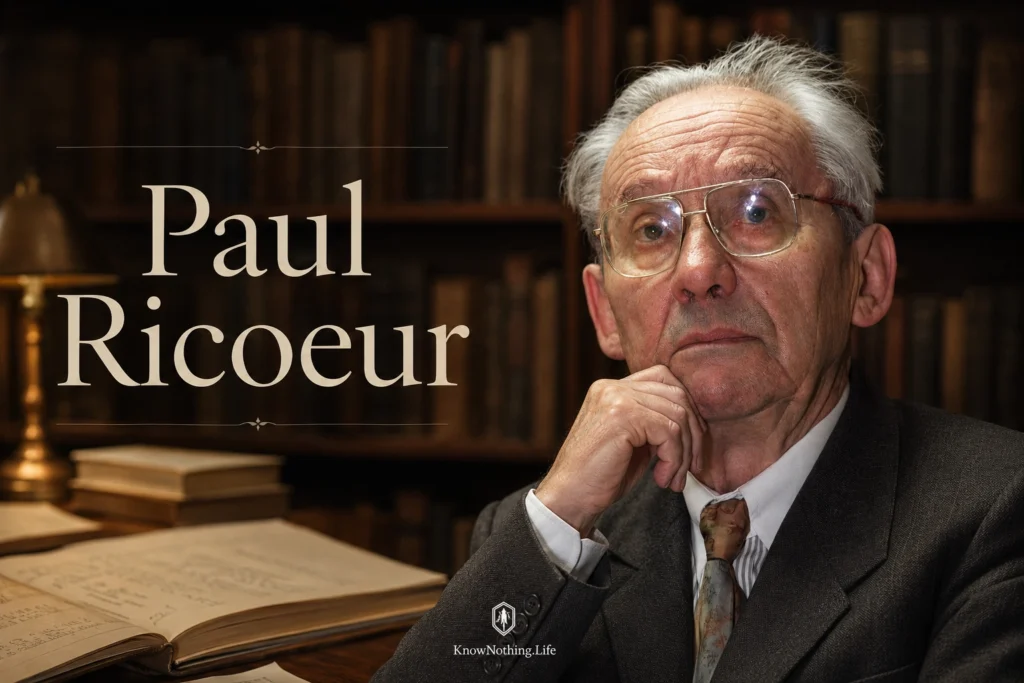
Paul Ricoeur was born on February 27, 1913, in Valence, France, into a Protestant family marked early by loss. His mother died when he was still an infant, and his father was killed during the First World War in 1915. Ricoeur and his sister were raised by their paternal grandparents in Rennes, where a serious religious, moral, and educational environment shaped his character. This early experience of orphanhood did not produce a philosophy of bitterness. Instead, it helped form a thinker deeply attentive to vulnerability, memory, responsibility, and the fragile ways human beings make sense of suffering.
Ricoeur studied philosophy at the University of Rennes and later at the Sorbonne, where he encountered the major currents of French and German thought. He was influenced by phenomenology, existentialism, biblical interpretation, psychoanalysis, structuralism, analytic philosophy, and political theory, but he never belonged completely to any single school. His work became famous for mediation: between faith and criticism, explanation and understanding, self and other, memory and history, action and text. Ricoeur’s gift was not to simplify conflict, but to think through it patiently.
War, Captivity, and the Discipline of Thought
During the Second World War, Ricoeur served in the French army and was captured by German forces in 1940. He spent much of the war as a prisoner in Germany, where he continued to study and teach with other imprisoned intellectuals. This period was decisive. In captivity, Ricoeur read Edmund Husserl and translated Husserl’s Ideas I into French. The experience of imprisonment also deepened his concern with freedom, the will, evil, guilt, hope, and the moral endurance of persons under constraint.
After the war, Ricoeur began teaching and writing with extraordinary discipline. His early work developed a philosophy of the will, beginning with Freedom and Nature: The Voluntary and the Involuntary in 1950. He wanted to understand human action without reducing it either to pure freedom or mechanical necessity. Human beings are capable of decision, promise, effort, and responsibility, but they are also embodied, finite, needy, and exposed to forces they do not command. This balance between capacity and fragility became one of Ricoeur’s lifelong themes.
The Philosophy of the Will and the Problem of Evil
Ricoeur’s project on the will continued with Fallible Man and The Symbolism of Evil, both published in 1960 as parts of Finitude and Culpability. These works turned from human action to the experience of fault, guilt, stain, sin, and moral failure. Ricoeur rejected simple explanations of evil. He did not treat evil merely as ignorance, social malfunction, or metaphysical accident. He explored how human beings experience themselves as responsible for what they do, yet also entangled in symbols, myths, inherited meanings, and structures larger than individual choice.
In The Symbolism of Evil, Ricoeur gave one of his most famous formulas: “The symbol gives rise to thought.” The phrase captures his entire method. Symbols are not irrational leftovers to be discarded once philosophy becomes scientific. They are dense forms of meaning that awaken reflection. Myths, religious language, metaphors, and narratives do not merely hide truth; they can disclose it indirectly. Ricoeur’s philosophy therefore moved beyond both naïve belief and flat skepticism. Interpretation must criticize, but it must also listen.
Hermeneutics and the Conflict of Interpretations
Ricoeur became one of the twentieth century’s most important philosophers of hermeneutics, the art and theory of interpretation. His book Freud and Philosophy: An Essay on Interpretation, published in French in 1965, helped define his mature direction. In it, he studied Freud alongside Nietzsche and Marx as masters of suspicion, thinkers who taught modern readers to look beneath conscious meaning for desire, power, repression, and illusion. Ricoeur accepted the necessity of suspicion but refused to let suspicion become the final word.
This balance appeared again in The Conflict of Interpretations, published in 1969. Ricoeur believed interpretation is not a mechanical decoding of one fixed meaning. Texts, symbols, actions, and historical memories generate multiple legitimate questions. Yet he also resisted the idea that interpretation is arbitrary. Meaning is disciplined by language, context, structure, and the world opened by the text. His hermeneutics stood between reduction and relativism: neither simple certainty nor endless play, but responsible interpretation.
Metaphor, Narrative, and Time
In the 1970s and 1980s, Ricoeur turned to language, metaphor, and narrative with remarkable influence. The Rule of Metaphor, published in 1975, argued that metaphor is not merely decorative language. A living metaphor creates new meaning by bringing together terms that normally remain apart. It redescribes reality. Poetry, religious language, and philosophical imagination can therefore expand what can be seen and said. Ricoeur treated language as creative, not merely representational.
His three-volume Time and Narrative, published in the 1980s, became one of his major achievements. Ricoeur argued that narrative gives human shape to time. His famous claim that “time becomes human time” through narrative expresses the heart of the work. Human beings do not experience time only as clocks, sequences, or physical duration. We understand time through stories: beginnings, promises, interruptions, memory, expectation, regret, and hope. Narrative makes temporal life intelligible without freezing it into a formula.
The Self, Otherness, and Ethical Life
Ricoeur’s Oneself as Another, published in 1990, is one of his greatest philosophical works. It develops a hermeneutics of the self, rejecting both the absolute self-certainty of the Cartesian ego and the total dissolution of the self in suspicion. For Ricoeur, the self is not immediately transparent to itself. It comes to understand itself through language, action, memory, narrative, promise, responsibility, and relation to others. Selfhood is not simple sameness. It includes the ability to keep one’s word across time.
The title Oneself as Another expresses a central insight: the self is never isolated from otherness. Ricoeur wrote that selfhood implies otherness “to such an intimate degree” that one cannot be thought without the other. His ethical formula is equally famous: the aim of ethics is “the good life, with and for others, in just institutions.” This sentence shows why Ricoeur’s philosophy matters beyond literary theory or textual interpretation. He connected selfhood to responsibility, friendship, justice, law, political life, and the institutions that make human dignity possible.
Memory, History, Forgetting
Late in life, Ricoeur produced another major work, Memory, History, Forgetting, published in French in 2000. The book examined the relationship between personal memory, collective memory, historical writing, testimony, archives, forgiveness, and the danger of forgetting. Ricoeur was deeply aware that memory can heal, but also deceive; history can preserve truth, but also be manipulated; forgetting can be destructive, but sometimes necessary for reconciliation. He treated memory not as a simple storehouse of facts but as a moral and political problem.
This work made Ricoeur especially important for discussions of trauma, public history, genocide, political violence, and historical responsibility. He asked how societies remember the dead, how testimony becomes history, and how forgiveness can be imagined without erasing justice. His concern was not merely academic. The twentieth century had produced war, occupation, ideology, and mass suffering. Ricoeur’s late philosophy tried to think honestly about how human beings inherit painful pasts without becoming imprisoned by them.
Later Years and Lasting Legacy
Ricoeur taught at several institutions, including the University of Strasbourg, the Sorbonne, the University of Paris-Nanterre, and the University of Chicago. His work crossed national and disciplinary borders, influencing philosophy, theology, literary theory, history, law, psychology, ethics, political thought, and biblical studies. In 2004, he received the John W. Kluge Prize for Lifetime Achievement in the Human Sciences. He died on May 20, 2005, in Châtenay-Malabry, France, leaving behind one of the most wide-ranging philosophical legacies of the twentieth century.
Paul Ricoeur remains essential because he gave modern thought a disciplined way to interpret without cynicism and to believe without naïveté. He understood that human beings are wounded interpreters: capable of truth, yet vulnerable to illusion; capable of promise, yet marked by failure; capable of memory, yet exposed to forgetting. His philosophy teaches that the self is not found by looking inward alone. It is discovered through texts, actions, stories, others, and the difficult labor of understanding. Ricoeur’s lasting message is that interpretation is not an escape from life. It is one of the deepest ways human beings learn to live responsibly.