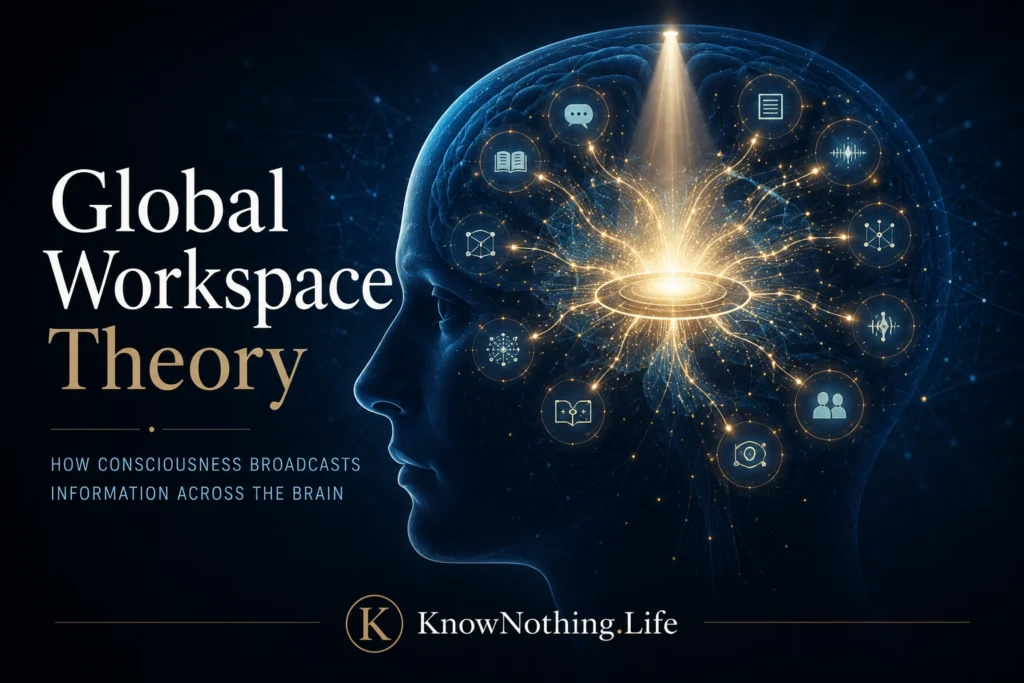
Global Workspace Theory is one of the most influential scientific theories of consciousness. It tries to explain why some information in the brain becomes conscious while most information remains unconscious. At any moment, the nervous system processes an enormous amount of data: sounds, bodily sensations, memories, emotions, visual details, words, expectations, motor plans, and background signals. Most of this processing never enters awareness. Yet some information becomes vividly present. A face is noticed. A pain becomes urgent. A thought becomes clear. A decision becomes deliberate. Global Workspace Theory asks what changes when information crosses that threshold.
The theory was developed most famously by cognitive scientist Bernard Baars in A Cognitive Theory of Consciousness and later explained through his “theater” metaphor in In the Theater of Consciousness. Baars suggested that consciousness functions like a global broadcasting system. Many unconscious processes compete for access to a limited-capacity workspace. When one piece of information wins that competition, it is broadcast widely to other systems: memory, language, emotion, decision-making, planning, and action. Consciousness, in this view, is not located in one tiny place. It is a functional event: information becomes globally available.
The Theater of Consciousness
Baars’s theater metaphor remains one of the clearest ways to understand the theory. Imagine the mind as a theater. The stage represents conscious awareness. A spotlight illuminates whatever is currently in consciousness: a sound, image, thought, memory, problem, or emotion. Behind the scenes, many unconscious processes work in darkness. They prepare interpretations, generate associations, regulate the body, retrieve memories, and detect patterns. The audience represents specialized systems throughout the brain that receive the broadcast from the conscious stage.
This metaphor helps explain why consciousness is both narrow and powerful. It is narrow because only a small amount of information can occupy the spotlight at once. A person cannot consciously attend to every sound, memory, bodily sensation, and visual detail simultaneously. But consciousness is powerful because what enters the spotlight becomes available to many systems at once. Once a problem becomes conscious, it can be talked about, remembered, evaluated, imagined, and acted upon. Consciousness creates integration.
Conscious and Unconscious Processing
Global Workspace Theory does not claim that unconscious processing is weak or unimportant. In fact, it assumes the opposite. Most mental work is unconscious. The brain recognizes familiar objects, interprets grammar, regulates balance, prepares movements, detects emotional cues, and predicts outcomes before conscious awareness fully appears. Consciousness is not needed for every operation. It is needed when information must be shared across many systems, especially when the situation is novel, difficult, uncertain, or requires flexible response.
For example, a skilled driver can perform many actions automatically: steering, braking, checking mirrors, and staying in lane. But if a child runs into the road, consciousness suddenly sharpens. The event becomes globally available because it requires rapid coordination among perception, attention, emotion, memory, and action. The conscious spotlight is called when routine processing is not enough. This is why consciousness often feels strongest during surprise, conflict, danger, decision, or learning.
Global Neuronal Workspace Theory
A major development of Baars’s idea is Global Neuronal Workspace Theory, associated with Stanislas Dehaene, Jean-Pierre Changeux, Lionel Naccache, and colleagues. While Baars proposed a cognitive architecture, Dehaene and others developed a neuroscientific version. In this model, consciousness occurs when information is amplified and broadcast through a large-scale network of brain regions, especially long-range connections linking sensory areas, parietal regions, and prefrontal systems.
Dehaene’s book Consciousness and the Brain presents this view in accessible form. He argues that conscious access involves a kind of ignition. A stimulus may be processed unconsciously at first, but if it becomes strong, relevant, or attended, it can trigger widespread neural activity. This ignition makes the information stable and shareable. It is no longer trapped in a local sensory system. It becomes available to reasoning, speech, memory, and intentional action.
Attention and Access
Global Workspace Theory is closely related to attention, but the two are not identical. Attention selects information for deeper processing. Consciousness makes information available for report, flexible use, and integration. Sometimes attention can operate without full awareness, as when the brain is biased toward a location or stimulus that the person does not consciously notice. Sometimes something may be briefly conscious without sustained attention. Still, in many ordinary cases, attention helps determine what enters the global workspace.
Philosopher Ned Block famously distinguished between phenomenal consciousness and access consciousness. Phenomenal consciousness refers to what experience feels like from the inside. Access consciousness refers to information being available for reasoning, reporting, and action. Global Workspace Theory is strongest as a theory of access consciousness. It explains why some information becomes reportable and usable across the mind. Critics argue that it may not fully explain why experience feels like something. Supporters respond that global availability may be exactly what makes subjective experience scientifically tractable.
Evidence From Masking and Blindness
Many experiments supporting Global Workspace Theory involve comparing conscious and unconscious perception. In visual masking, a stimulus is shown so briefly and followed so quickly by another image that the person does not consciously see it. The brain may still process aspects of the hidden stimulus, but the information remains limited. When the person consciously sees the stimulus, brain activity becomes stronger, more sustained, and more widely distributed.
Related phenomena include inattentional blindness and change blindness. People may fail to notice obvious changes when attention is elsewhere. These cases show that sensory information can be present without becoming conscious in a usable way. The eyes may receive the information, and early visual systems may process it, but it does not necessarily reach the global workspace. Consciousness is not simply raw input. It is selected, stabilized, and integrated access.
Why the Theory Matters
Global Workspace Theory matters because it explains consciousness as a functional solution to a real biological problem: how can a brain made of many specialized systems coordinate itself? The brain is not a single simple machine. It contains multiple processes handling vision, sound, memory, emotion, movement, language, planning, and social understanding. Without some form of integration, these systems would remain fragmented. Consciousness may be the brain’s way of making important information available to the whole organism.
This view also helps explain why conscious thought is useful but limited. Consciousness is not designed to process everything. It is designed to prioritize what matters. It allows flexible problem-solving, deliberate control, verbal report, imagination, and planning. But because the workspace is limited, attention is selective. Human beings are conscious, but not conscious of everything their minds are doing.
Clinical and Medical Relevance
Global Workspace Theory has influenced the study of coma, anesthesia, sleep, vegetative states, and disorders of consciousness. If consciousness depends on widespread broadcasting and integration, then loss of consciousness may involve a breakdown in global communication. Under anesthesia, for example, brain regions may still show local activity, but long-range integration is disrupted. In coma or unresponsive states, researchers look for signs that information may still be processed and integrated even when the person cannot communicate.
This has serious ethical importance. Some patients who appear unresponsive may retain covert consciousness. A theory of consciousness that connects awareness with global brain dynamics can help guide medical research into diagnosis and treatment. Consciousness is not only a philosophical puzzle. It affects decisions about care, pain, communication, and personhood.
Criticisms and Competing Theories
Global Workspace Theory is influential, but it is not universally accepted. One criticism is that it may explain reportability rather than consciousness itself. If a person can verbally report an experience, the information has clearly become globally available. But does global availability cause the experience, or does it merely allow the person to describe it? Critics argue that the theory may confuse consciousness with the ability to use or report conscious information.
Another challenge comes from competing theories such as Integrated Information Theory, associated with Giulio Tononi, and higher-order theories of consciousness, associated with thinkers such as David Rosenthal. Integrated Information Theory focuses on the structure and integration of experience itself. Higher-order theories argue that a mental state becomes conscious when the mind represents itself as being in that state. Global Workspace Theory, by contrast, emphasizes broadcasting and functional access. Each theory captures something important, but none has solved consciousness completely.
Global Workspace Theory and Artificial Intelligence
Global Workspace Theory has also influenced discussions about artificial intelligence. If consciousness depends on a global workspace that integrates information across specialized systems, then some researchers ask whether an artificial system could become conscious if it had a similar architecture. A machine might have separate systems for perception, memory, language, planning, and action, connected by a central workspace that broadcasts selected information.
This does not mean current AI systems are conscious. It means Global Workspace Theory provides one framework for asking what functional architecture consciousness might require. The theory shifts the question from “Does the machine act intelligent?” to “Does the system integrate, broadcast, and use information in a way resembling conscious access?” The debate remains speculative, but it shows the theory’s broad influence beyond neuroscience.
Final Thoughts
Global Workspace Theory explains consciousness as global availability. Information becomes conscious when it is selected from many competing unconscious processes and broadcast widely across the mind or brain. Bernard Baars gave the theory its original cognitive form through the theater metaphor. Stanislas Dehaene, Jean-Pierre Changeux, Lionel Naccache, and others developed the global neuronal workspace as a brain-based model of conscious access. Together, these ideas offer one of the strongest modern attempts to connect psychology, neuroscience, and philosophy.
The theory’s appeal lies in its clarity. Consciousness is not treated as a magical substance or a mysterious light separate from the brain. It is treated as a functional workspace that allows information to be shared, stabilized, remembered, reported, and used. Yet the theory also leaves deep questions open. Does global broadcasting fully explain subjective experience, or only access to information? Can consciousness exist without report? How much integration is enough?
Even with these questions, Global Workspace Theory remains powerful because it explains why consciousness feels both limited and central. We are not aware of everything. But what we are aware of can organize the whole mind. Consciousness is the stage where the brain’s most important information becomes available to the self, to action, and to the wider theater of thought.