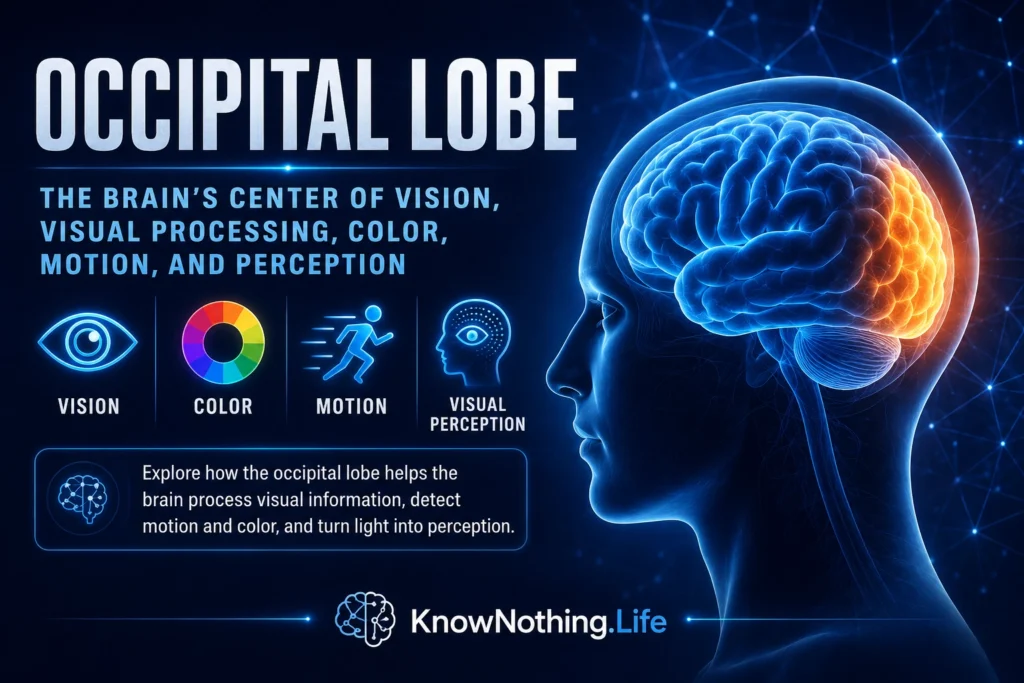
The occipital lobe is the major visual-processing region of the cerebral cortex, located at the back of the brain behind the parietal and temporal lobes. It is the smallest of the four classical brain lobes, but its importance is enormous because vision is one of the dominant ways humans understand the world. The occipital lobe receives, organizes, and interprets visual information arriving from the eyes through the optic nerves, thalamus, and visual pathways. It helps the brain detect shape, color, motion, contrast, depth, edges, orientation, and spatial patterns. The occipital lobe is primarily responsible for visual processing and notes that it contains both primary and association visual cortex.
The occipital lobe does not work like a camera. The eyes collect light, but the brain constructs vision. What a person sees is not simply a picture projected into the skull; it is an active interpretation created by neural circuits. When someone reads a word, recognizes a road sign, follows a moving object, judges distance, notices a face, or sees color in a sunset, the occipital lobe is helping transform raw visual input into meaningful perception. It works closely with the temporal lobe, parietal lobe, frontal eye fields, thalamus, brainstem, and attention systems. Vision begins with light, but perception is a brain-built experience.
Anatomy and Major Visual Areas
The primary visual cortex, also called V1 or striate cortex, is located in the occipital lobe around the calcarine sulcus. It is the first major cortical destination for visual information coming from the retina through the lateral geniculate nucleus of the thalamus. Each hemisphere processes information from the opposite side of the visual field: the right visual cortex processes the left visual field, while the left visual cortex processes the right visual field. The visual cortex is the cortical region that receives, segments, integrates, and processes visual information relayed from the retinas.
Beyond V1 are visual association areas that continue processing different features of the visual world. These areas are often described as V2, V3, V4, V5/MT, and additional extrastriate regions, though the actual organization of the visual system is more complex than a simple numbered ladder. Some areas are especially involved in color, others in motion, others in depth, form, object boundaries, or spatial relationships. The occipital lobe therefore begins the cortical process of breaking visual information into specialized components. The world appears unified, but the brain analyzes it through multiple partly specialized systems before binding perception back into a coherent scene.
How the Occipital Lobe Builds Vision
Visual processing begins when light strikes photoreceptors in the retina, but the occipital lobe is where vision becomes cortical. The primary visual cortex analyzes basic features such as edges, contrast, orientation, and location. This may sound simple, but it is foundational. The brain must detect lines before it can recognize letters, identify borders before it can recognize objects, and process contrast before it can create stable visual form. The occipital lobe helps turn scattered signals into structured perception.
The classic work of David Hubel and Torsten Wiesel transformed modern neuroscience by showing that neurons in the visual cortex respond selectively to specific visual features. Their experiments demonstrated that some cells are tuned to features such as line orientation, helping explain how the brain begins to organize visual form. The Nobel Prize press release for their 1981 award noted that Hubel and Wiesel found visual cortex cells arranged in columns, with cells within those columns sharing functions in interpreting visual input. Eric Kandel later described their work as opening the study of primary visual cortex and laying the foundation for what followed in all sensory systems.
Color, Motion, and Functional Specialization
One of the most important ideas in visual neuroscience is functional specialization: different parts of the visual system contribute to different aspects of seeing. Semir Zeki was especially influential in developing this view. His research emphasized that the visual brain contains specialized systems for processing attributes such as color and motion. A 1991 study by Zeki and colleagues provided direct evidence for functional specialization in human visual cortex, using different visual stimuli to study regions responsive to color and visual motion.
Color and motion show why visual perception cannot be reduced to one simple image. Color helps the brain distinguish surfaces, objects, ripeness, warning signals, emotional cues, and environmental details. Motion helps the brain detect danger, track living beings, guide eye movements, and understand action. A still photograph and a moving scene may contain related information, but they are processed differently by the nervous system. The occipital lobe and surrounding visual regions allow the brain to separate and recombine these features, creating the rich visual world people experience as immediate and effortless.
The Dorsal and Ventral Visual Streams
After early visual processing in the occipital lobe, information flows into broader cortical pathways. One of the most influential models is the two-stream theory of vision. The ventral stream travels from occipital visual areas toward the temporal lobe and is often associated with object identification, recognition, and visual meaning. The dorsal stream travels toward the parietal lobe and is associated with spatial processing and visually guided action. Melvyn Goodale and David Milner’s 1992 paper proposed that the ventral stream plays the major role in perceptual identification of objects, while the dorsal stream supports the sensorimotor transformations needed for visually guided action.
This means the occipital lobe is not the final destination of vision. It is the starting point of cortical seeing. One pathway helps answer “What is it?” while another helps answer “Where is it, and how should I move in relation to it?” Reading a word, recognizing a face, catching a ball, driving a car, and walking down stairs all require visual information to leave the occipital lobe and become integrated with memory, attention, movement, and decision-making. The occipital lobe provides the foundation, but vision becomes useful only when it connects with the rest of the brain.
Visual Damage and Clinical Importance
Occipital-lobe damage can produce serious visual problems, even when the eyes themselves are healthy. Depending on the location and extent of injury, a person may experience blind spots, loss of vision in part of the visual field, difficulty recognizing visual stimuli, visual hallucinations, impaired motion perception, or cortical blindness. Because each side of the occipital lobe processes the opposite visual field, damage to one occipital lobe can affect vision on the opposite side of space. This is why neurological visual loss can follow patterns that differ from eye disease.
The occipital lobe is clinically important because it shows that seeing depends on the brain as much as the eyes. A person may have functioning eyes but still be unable to consciously perceive parts of the visual world if visual cortex is damaged. In some cases, patients with cortical visual impairment may report that they cannot see, yet still respond unconsciously to certain visual cues, a phenomenon often discussed under the term blindsight. These conditions challenge common assumptions about perception. Vision is not all-or-nothing. It includes multiple levels, from unconscious detection to conscious recognition, and the occipital lobe is central to that layered process.
Vision, Attention, and Conscious Perception
The occipital lobe is deeply connected to attention. The brain receives far more visual information than it can consciously process in detail, so attention helps select what becomes clear, relevant, and actionable. This is why people can miss obvious visual events when attention is elsewhere, and why the same scene can look different depending on the viewer’s goals. Looking for a friend in a crowd, scanning a shelf for a book title, or driving through traffic requires visual attention to organize the field of perception.
Conscious vision depends on more than early visual cortex alone. The occipital lobe helps create the first cortical representation of visual information, but awareness involves interaction among visual regions, parietal attention networks, temporal recognition systems, frontal control regions, and thalamic pathways. Seeing is therefore both sensory and cognitive. The occipital lobe supplies the visual structure, while the wider brain determines what is noticed, recognized, remembered, and acted upon. This is why perception feels immediate even though it is built through many stages of neural processing.
Why the Occipital Lobe Matters
The occipital lobe matters because it gives the brain its primary gateway into the visible world. It allows light to become form, color, motion, depth, pattern, and visual meaning. Without it, the world would not simply look dimmer; it could lose structure, orientation, coherence, and conscious visual presence. The occipital lobe helps make reading, navigation, art, facial expression, danger detection, tool use, and everyday recognition possible.
The occipital lobe also reminds us that perception is an achievement, not a passive recording. The visual world feels obvious because the brain makes it feel obvious. Behind every effortless glance is a sophisticated network of cells detecting edges, comparing contrast, tracking motion, separating color, mapping space, and sending information into systems for memory and action. To understand the occipital lobe is to understand that seeing is not merely opening the eyes. It is the brain turning light into a world.