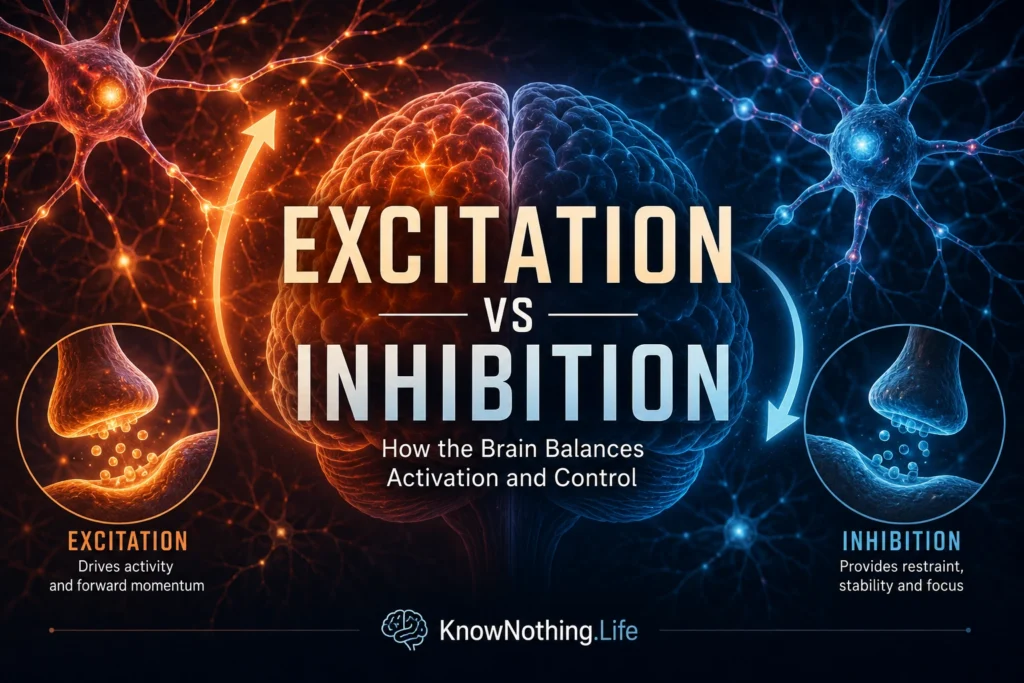
Excitation and inhibition are two fundamental forces in the nervous system. Excitation makes neurons more likely to fire, while inhibition makes neurons less likely to fire. These processes allow the brain to activate useful signals, suppress irrelevant ones, coordinate movement, sharpen perception, regulate emotion, stabilize attention, and prevent runaway activity. The brain is not designed to be active everywhere at once. It works by carefully balancing signals that push neurons toward firing with signals that hold them back. Glutamate is the principal excitatory neurotransmitter in the brain, while GABA and glycine serve as major inhibitory neurotransmitters.
This balance is often called the excitation-inhibition balance, or E/I balance. It is one of the most important principles in neurophysiology because healthy brain activity depends on controlled activation, not maximum activation. A neuron must be able to respond when information matters, but it must also avoid firing constantly or chaotically. Networks must be flexible enough to learn, but stable enough to preserve function. Sensation, memory, language, attention, sleep, emotion, and movement all depend on this dynamic relationship between neural “go” signals and neural “stop” signals.
Excitation: Making Neurons More Likely to Fire
Excitation occurs when a signal moves a neuron closer to firing an action potential. At the synaptic level, this often happens when an excitatory neurotransmitter binds to receptors on the postsynaptic neuron and causes positive ions to enter the cell. This depolarizes the membrane, making the inside of the neuron less negative and bringing it closer to threshold. If enough excitatory input arrives at the right time and place, the neuron fires an action potential and sends a signal down its axon.
Glutamate is the main excitatory neurotransmitter in the brain. It is involved in perception, movement, learning, memory, and synaptic plasticity. Glutamate signaling helps activate circuits, strengthen connections, and transmit information rapidly across neural networks. However, excitation is powerful precisely because it must be controlled. Too little excitation can make circuits underactive and unresponsive. Too much excitation can overstimulate neurons, destabilize networks, and contribute to seizures or excitotoxic damage. Excitation is therefore not simply “good” activity. It is necessary activation that must be balanced by restraint.
Inhibition: Making Neurons Less Likely to Fire
Inhibition occurs when a signal makes a neuron less likely to fire. In the brain, this usually involves GABA, the primary inhibitory neurotransmitter. GABA can bind to postsynaptic receptors and increase chloride conductance or activate other mechanisms that reduce excitability. StatPearls describes GABA as the primary inhibitory neurotransmitter in the brain and explains that it modulates ion channels in ways that hyperpolarize the postsynaptic cell and inhibit action-potential transmission.
Inhibition is sometimes misunderstood as a shutdown mechanism, but it is actually one of the brain’s main tools for precision. It allows the nervous system to silence background noise, prevent excessive firing, regulate timing, coordinate rhythms, and shape the boundaries of perception and action. Inhibitory interneurons, especially GABAergic interneurons, can rapidly control local circuits. Reviews of GABA neurons describe fast synaptic inhibition as occurring when interneurons fire, release GABA, and activate GABA-A receptor channels on postsynaptic cells. Without inhibition, the brain would not become more creative or more alive. It would become unstable.
Excitatory and Inhibitory Postsynaptic Potentials
At the synaptic level, excitation and inhibition are often described through postsynaptic potentials. An excitatory postsynaptic potential, or EPSP, makes the receiving neuron more likely to fire. An inhibitory postsynaptic potential, or IPSP, makes it less likely to fire. A StatPearls overview of GABA explains this contrast directly: glutamate usually causes depolarization and EPSPs, while GABA usually causes hyperpolarization and IPSPs. EPSPs increase the likelihood of an action potential, while IPSPs decrease it.
A neuron may receive thousands of excitatory and inhibitory inputs across its dendrites and cell body. These inputs are integrated over time and space. If excitatory signals dominate strongly enough near the axon initial segment, the neuron may fire. If inhibitory signals dominate or arrive at strategically important locations, they may prevent firing even when excitation is present. This process is not a simple tug-of-war with one winner. It is a living calculation. The neuron’s output depends on timing, location, receptor type, synaptic strength, membrane state, and the ongoing activity of the larger circuit.
The History of Inhibition and Neural Integration
The importance of inhibition became central to neuroscience through the work of figures such as Charles Sherrington, whose 1906 book The Integrative Action of the Nervous System helped establish the nervous system as a coordinated network of interacting reflexes and synapses. Later reviews of Sherrington’s work emphasize that he introduced the synapse as a site where elementary reflexes interact to produce more complex, unified behavior. His work helped move neuroscience away from the idea of isolated nerve lines and toward the idea of integration.
This was important because inhibition makes integration possible. If the nervous system only excited muscles and neurons, movement would be chaotic. To flex one muscle group, the nervous system often needs to inhibit an opposing group. To focus attention, it must suppress distractions. To perceive a visual edge, it must enhance contrast and limit neighboring signals. To produce speech, it must activate some motor patterns and inhibit others. Sherrington’s concept of integrative nervous action remains relevant because the brain works through coordinated patterns of excitation and inhibition, not simple one-way activation.
E/I Balance in Cortical Circuits
The cerebral cortex depends heavily on a balance between excitatory pyramidal neurons and inhibitory interneurons. Pyramidal neurons are the major excitatory projection neurons of the cortex, sending signals locally and to distant brain regions. Inhibitory interneurons regulate those excitatory cells and help shape cortical rhythm, timing, gain, and synchrony. A review on cortical E/I balance explains that healthy cortical circuits integrate excitatory and inhibitory inputs, and that shifts in this balance may relate to pathological phenotypes.
This balance is dynamic rather than fixed. It changes with attention, sleep, arousal, development, sensory experience, learning, and neuromodulation. A visual scene, a remembered sound, a difficult decision, or a sudden threat may all change the relationship between excitation and inhibition in specific circuits. The brain does not maintain one universal E/I setting. It adjusts local balances depending on task and state. In this sense, E/I balance is not just a safety mechanism. It is part of how the brain computes.
Plasticity and Learning
Excitation and inhibition also change with experience. Learning requires plasticity, but plasticity must be controlled. If excitatory synapses strengthened without restraint, circuits could become unstable. If inhibition were too strong, learning could be blocked. A review by Robert Froemke on cortical excitatory-inhibitory balance emphasizes that neuromodulation and synaptic plasticity can produce long-term changes that improve perception and behavior by adjusting E/I relationships.
This matters for skill learning, sensory refinement, emotional regulation, and memory. When a person practices a musical instrument, learns a language, adapts to a new environment, or recovers after injury, circuits must strengthen useful pathways while preventing uncontrolled spread of activity. Inhibitory systems help refine the map. Excitatory systems help drive change. Learning is not simply “more firing.” It is better-patterned firing. The brain improves by changing which signals are amplified, which are suppressed, and how circuits coordinate over time.
Excitation, Inhibition, and Brain Rhythms
Brain rhythms also depend on excitation and inhibition. Oscillations such as gamma, beta, alpha, theta, and slow-wave activity emerge from interactions among excitatory cells, inhibitory interneurons, thalamic circuits, and neuromodulatory systems. Inhibitory interneurons are especially important for timing because they can synchronize groups of neurons and control when firing is allowed. This rhythmic control supports attention, sensory binding, working memory, sleep, and motor coordination.
A cortex without inhibition would not simply become more alert. It would lose timing. Signals would become noisy, poorly separated, or excessive. A cortex without excitation would lack the activity needed for processing and response. Neural rhythms show that the brain’s power comes from patterned alternation: activation and suppression, signal and silence, firing and recovery. Inhibition helps create the pauses that make meaningful activity possible.
Clinical Importance of E/I Balance
Disruptions in excitation and inhibition are linked to many neurological and psychiatric conditions. Epilepsy is one of the clearest examples, because seizures can involve excessive synchronized excitation, insufficient inhibition, or disturbed network regulation. E/I imbalance has also been discussed in relation to autism spectrum conditions, schizophrenia, anxiety, mood disorders, intellectual disability, migraine, chronic pain, and neurodevelopmental disorders. Reviews of E/I balance describe it as an organizing framework for investigating pathophysiology and possible treatments, especially in conditions involving cortical and hippocampal function.
This does not mean every disorder is caused by a simple formula of “too much excitation” or “too little inhibition.” Real brain disorders involve genes, development, receptors, circuits, glial cells, inflammation, experience, stress, sleep, environment, and body physiology. But E/I balance remains useful because it connects molecular events to network behavior. A small change in receptor function, ion-channel activity, interneuron development, or synaptic plasticity can shift how whole circuits behave. Clinical neuroscience often depends on understanding how local changes alter global function.
Medications and E/I Signaling
Many medications affect excitation and inhibition. Benzodiazepines and barbiturates enhance GABA-related inhibition and are used in contexts such as anxiety, seizures, anesthesia, and sleep, though their risks and uses vary by drug and patient. Antiseizure medications may reduce excessive excitation, enhance inhibition, affect ion channels, or alter neurotransmitter release. Some anesthetics work partly by shifting the balance of neural signaling toward reduced excitability. Stimulants, antidepressants, antipsychotics, and pain medications can also indirectly affect E/I balance through dopamine, serotonin, norepinephrine, glutamate, GABA, and other systems.
These medications show that excitation and inhibition are not abstract textbook categories. They are practical medical targets. Changing synaptic signaling can change consciousness, movement, pain, mood, attention, and seizure risk. At the same time, the brain’s balance is delicate. A drug that helps one circuit may cause side effects in another because the same neurotransmitter systems are used across many regions. This is why E/I balance must be understood as a network principle, not a single switch.
Why Excitation vs Inhibition Matters
Excitation and inhibition matter because they explain how the nervous system controls itself. Excitation allows neurons to activate, transmit signals, and drive behavior. Inhibition allows circuits to filter, stabilize, time, and refine activity. One without the other would not produce a healthy mind. Too much excitation can become chaos. Too much inhibition can become silence. Functional brain activity depends on the relationship between the two.
The deeper lesson is that the brain’s intelligence depends on balance. Perception requires signal and contrast. Movement requires activation and restraint. Memory requires plasticity and stability. Attention requires focus and suppression. Emotion requires response and regulation. Excitation and inhibition are not enemies. They are complementary forces that allow the brain to be active without being overwhelmed, flexible without being unstable, and responsive without losing control. To understand excitation vs inhibition is to understand one of the central principles of neural life.