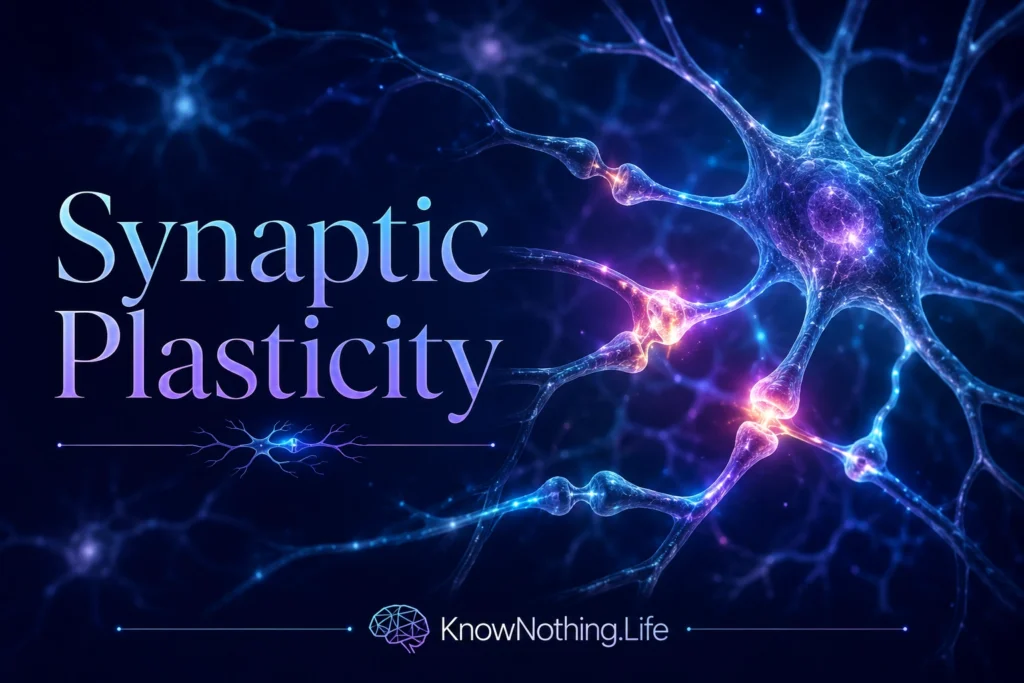
Synaptic plasticity is the ability of synapses to change their strength, efficiency, structure, or responsiveness over time. A synapse is the communication point between neurons, where one neuron influences another through neurotransmitter release, receptor activation, and electrical changes in the receiving cell. When a synapse becomes stronger, the same presynaptic signal produces a larger or more reliable postsynaptic response. When a synapse becomes weaker, the same signal has less influence. This adjustability is one of the main reasons the nervous system can learn from experience rather than merely repeat fixed patterns. Synaptic plasticity helps explain how practice improves skill, how memories form, how habits develop, how sensory systems adapt, and how the brain reorganizes after injury.
The basic idea is simple but powerful: neural connections are not static. They are living biological relationships. A synapse can become more sensitive, release more neurotransmitter, add receptors, remove receptors, grow new structural elements, or shrink over time. Donald Hebb’s 1949 book The Organization of Behavior helped formalize one of the most famous principles in neuroscience: when neurons are repeatedly active together in a meaningful sequence, their connection can become stronger. Later writers often summarized this as “neurons that fire together wire together,” though the real Hebbian idea is more precise than the slogan. It emphasized that coordinated activity can alter the functional relationship between cells.
Long-Term Potentiation
The most famous form of synaptic plasticity is long-term potentiation, usually called LTP. LTP is a long-lasting strengthening of synaptic transmission after particular patterns of neural activity. It was first described in a landmark 1973 paper by Tim Bliss and Terje Lømo, who studied the perforant path input to the dentate area of the rabbit hippocampus. Their results suggested that repeated stimulation could produce a lasting increase in synaptic efficiency and excitability. This discovery became one of the most important experimental foundations for the idea that memory could involve lasting synaptic change.
LTP is especially important because it offers a cellular model for learning and memory. It does not prove that every memory is stored only as LTP, but it shows that synapses can retain a trace of past activity. A synapse that has been strongly activated can respond differently in the future. Robert Nicoll’s review of the history of LTP describes it as a compelling cellular model for learning and memory and notes how extensively the phenomenon has shaped neuroscience since its discovery. In many forms of hippocampal LTP, glutamate receptors, calcium entry, NMDA receptor activation, AMPA receptor trafficking, intracellular signaling, and structural synaptic changes all help convert brief neural activity into longer-lasting functional change.
Long-Term Depression
Synaptic plasticity is not only about strengthening. Long-term depression, or LTD, is a long-lasting weakening of synaptic transmission. If LTP helps certain connections become more influential, LTD helps other connections become less influential. This weakening is not a failure of the nervous system. It is essential for refinement. The brain cannot learn effectively by strengthening every active connection. It must also reduce noise, remove outdated associations, refine maps, and prevent runaway excitation. Mark Bear’s work helped establish LTD as a major partner to LTP, and his 1994 review described LTP and LTD as central forms of synaptic modification in the hippocampus and neocortex.
LTD is important for forgetting, flexibility, sensory adaptation, motor learning, and circuit stability. A child learning language, an adult correcting a bad habit, or a musician refining finger movement all require the nervous system to adjust which pathways matter. Weakening can be just as meaningful as strengthening. Robert Malenka and Mark Bear’s influential 2004 review described the field of LTP and LTD as an “embarrassment of riches,” reflecting how many mechanisms and forms of synaptic plasticity had been discovered. The larger lesson is that plasticity is diverse. Different brain regions use different molecular tools, time courses, and rules depending on the circuit and function.
Hebbian Learning and Synaptic Timing
Hebbian plasticity is often explained as the strengthening of connections between neurons that are active together, but timing matters. A presynaptic neuron that helps drive a postsynaptic neuron may strengthen its connection. A presynaptic neuron that fires at the wrong time may not. This timing-based logic is seen in spike-timing-dependent plasticity, where the order and interval between presynaptic and postsynaptic firing can influence whether a synapse strengthens or weakens. The brain is not merely counting activity. It is detecting causal relationships.
This makes synaptic plasticity a biological mechanism for association. If a sound reliably predicts danger, circuits linking that sound to defensive behavior may strengthen. If a movement reliably produces success, motor circuits may become more efficient. If a fact is repeatedly recalled in a meaningful context, the pathways supporting that memory may become easier to activate. Plasticity allows the nervous system to convert repeated structure in the world into repeated structure in the brain. Learning is not just information entering the mind; it is the physical reweighting of neural connections.
Synaptic Plasticity and Memory
Memory is one of the clearest reasons synaptic plasticity matters. Short-term memory can involve temporary changes in neural activity and synaptic function, but long-term memory often requires more durable molecular and structural change. Eric Kandel’s Nobel lecture, The Molecular Biology of Memory Storage: A Dialog Between Genes and Synapses, helped show how memory can involve changes at synapses, intracellular signaling pathways, protein synthesis, and gene expression. His work on the sea slug Aplysia became famous because it connected learning with measurable changes in synaptic strength.
This does not mean a memory is stored in one synapse or that synaptic plasticity alone explains all memory. Memories are distributed across circuits involving the hippocampus, cortex, amygdala, basal ganglia, cerebellum, and other systems depending on the kind of memory involved. Still, synaptic change is one of the strongest biological candidates for how experience leaves a trace in the nervous system. When memories consolidate, synapses may change receptor composition, spine shape, neurotransmitter release probability, and responsiveness to future input. The remembered past becomes partly embedded in the altered behavior of neural connections.
Structural Plasticity
Synaptic plasticity can be functional, structural, or both. Functional plasticity changes how strongly a synapse transmits signals. Structural plasticity changes the physical form of the connection. Dendritic spines may grow, shrink, appear, disappear, or change shape. Synaptic terminals may alter vesicle release machinery. Receptor density may increase or decrease. These structural changes matter because the shape and composition of a synapse influence how it performs. A stronger memory, a practiced skill, or a refined sensory map may involve not only different firing patterns, but also physical remodeling of synaptic architecture.
The structure of synapses also helps explain why plasticity must be regulated. If every repeated experience produced permanent growth, the brain would become overloaded. If every weak connection disappeared too easily, memory and skill would become unstable. Healthy plasticity requires balance between change and stability. The brain must be flexible enough to learn and stable enough to preserve identity, knowledge, and function. Synaptic plasticity is therefore not endless malleability. It is controlled biological change.
Development, Experience, and Critical Periods
Synaptic plasticity is especially powerful during development. Early brain development involves the formation of many synapses, followed by refinement, pruning, strengthening, and weakening based on genes, activity, and experience. Sensory systems, language systems, motor systems, and emotional regulation all depend on plasticity during childhood. Critical periods are developmental windows when experience has especially strong effects on circuit organization. Vision, for example, depends on patterned visual input during early life for normal development of visual cortex circuits.
Plasticity continues in adulthood, but it often becomes more constrained. Adults can learn languages, skills, habits, emotional responses, and new knowledge, but the rules and ease of change differ from early development. This is not a defect. A mature brain must preserve learned structure while remaining adaptable. Adult plasticity supports rehabilitation after injury, therapy for fear and anxiety, skill improvement, memory formation, and adaptation to new environments. The brain remains changeable because synapses remain biologically responsive.
Plasticity, Disease, and Recovery
Synaptic plasticity is central to both health and disease. In healthy learning, plasticity helps circuits become better organized. In chronic pain, addiction, trauma, epilepsy, depression, and neurodegenerative disease, plasticity may become maladaptive. The same capacity that allows learning can also reinforce harmful patterns. Addiction, for example, involves long-lasting changes in reward, motivation, and habit circuits. Trauma can strengthen associations between cues and threat. Chronic pain can involve sensitized pathways that continue signaling danger after tissue damage has healed.
Plasticity also makes recovery possible. After stroke, injury, or sensory loss, surviving circuits may reorganize. Rehabilitation works partly because repeated practice can strengthen alternative pathways, refine remaining connections, and help the nervous system relearn function. Recovery is not simply “the brain healing itself” in a vague way; it depends on activity, timing, motivation, feedback, sleep, attention, and biological limits. Synaptic plasticity gives the nervous system room to adapt, but adaptation requires the right conditions.
Why Synaptic Plasticity Matters
Synaptic plasticity matters because it explains how experience can change the brain. Without it, learning would be shallow, memory would be fleeting, habits would not form, skills would not improve, and recovery would be far more limited. Synapses are not fixed switches. They are adjustable biological interfaces that record, filter, refine, and reshape the flow of information through the nervous system.
The deeper lesson is that the brain is neither rigidly hardwired nor infinitely flexible. It is structured but changeable. Genes help build circuits, but experience helps tune them. Neural activity changes synapses, and changed synapses alter future neural activity. This circular process is one of the foundations of learning, memory, development, and adaptation. To understand synaptic plasticity is to understand one of neuroscience’s most important truths: the mind is shaped not only by the neurons it has, but by the changing strength of the connections between them.