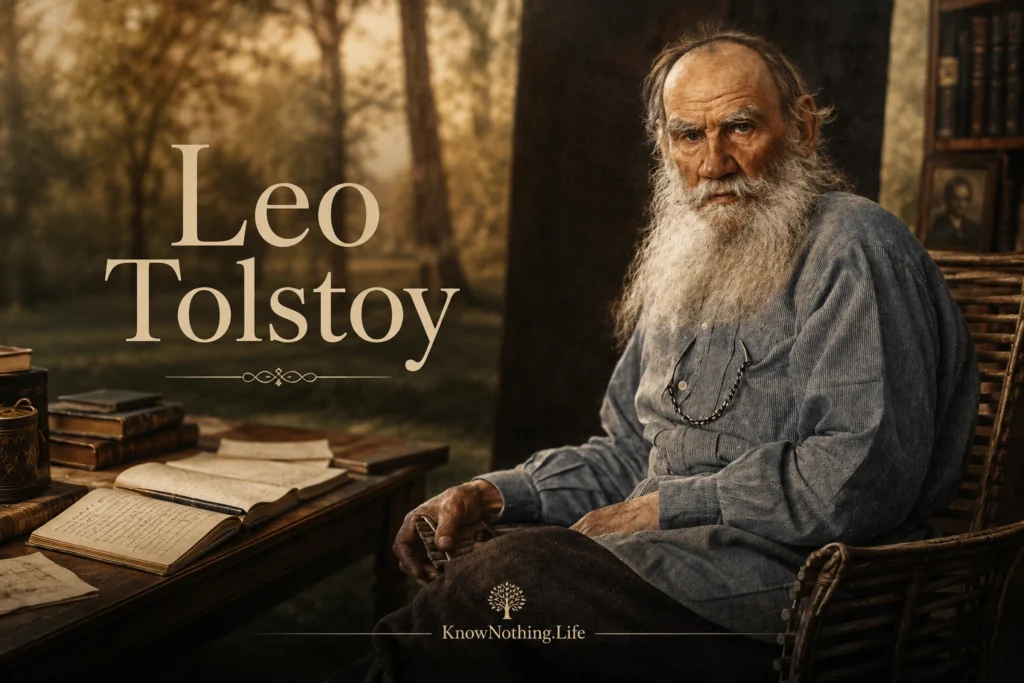
Leo Tolstoy was born Lev Nikolayevich Tolstoy on September 9, 1828, at Yasnaya Polyana, his family’s estate in Tula Province, Russia. He was born into an aristocratic world of land, servants, privilege, and inherited rank, but his childhood was marked early by loss. His mother died when he was very young, and his father died several years later, leaving Tolstoy and his siblings to be raised by relatives. That mixture of privilege and orphanhood shaped one of the central tensions of his life: he belonged to the Russian nobility, yet he spent decades judging the moral emptiness of noble society.
Tolstoy studied at Kazan University but left without completing a degree. In youth, he was restless, ambitious, self-critical, and often divided against himself. He gambled, kept diaries of moral failure and self-improvement, experimented with reforming his estate, and searched for a vocation worthy of his energies. This habit of radical self-examination never left him. Tolstoy’s greatness as a writer came partly from his refusal to let any human motive remain simple. Pride, shame, desire, pity, faith, vanity, and love all appear in his work as mixed, unstable forces inside living persons.
Military Service and First Literary Success
In the early 1850s, Tolstoy joined the army and served in the Caucasus, a region that gave him both adventure and literary material. His early stories, including “The Raid” and “The Cossacks,” drew on military life, frontier landscapes, and the contrast between aristocratic self-consciousness and supposedly simpler forms of existence. He later served during the Crimean War and witnessed the siege of Sevastopol, an experience that produced his famous Sevastopol Sketches. These works brought him recognition in Russian literary circles and revealed a writer already skeptical of patriotic romanticism.
Tolstoy’s war writing was unusual because it stripped battle of false grandeur. He did not deny courage, but he distrusted the rhetoric by which societies turn violence into glory. His soldiers are afraid, confused, brave, vain, loyal, wounded, and mortal. War appears not as a clean stage for heroism, but as a human catastrophe organized by institutions and myth. This early realism became essential to War and Peace, where Tolstoy would later attack the idea that history is made by great men alone.
Marriage, Family, and the Making of a Major Novelist
In 1862, Tolstoy married Sophia Behrs, often called Sonya. Their marriage was intellectually and practically important to his career. She copied and recopied his manuscripts, managed household affairs, bore many children, and lived under the immense pressure of being married to a genius whose moral demands could become severe and contradictory. Their relationship contained love, collaboration, conflict, jealousy, resentment, dependence, and suffering. Tolstoy’s own experience of family life gave him deep material for fiction, but it also exposed the painful gap between moral ideals and domestic reality.
The years after his marriage produced his greatest fiction. Tolstoy worked with astonishing patience, revising scenes, expanding characters, and building fictional worlds with historical, psychological, and philosophical depth. He was not merely telling stories. He was asking how people live inside time, society, memory, desire, and moral blindness. His fiction became powerful because it joined vast social vision to minute inward detail: a glance at a ball, a hesitation before death, a child’s feeling, a soldier’s terror, a husband’s suspicion, a woman’s loneliness.
War and Peace
War and Peace, published in final book form in 1869 after serialization, is one of the largest achievements in world literature. Set during the Napoleonic wars, it follows families such as the Rostovs, Bolkonskys, and Bezukhovs through love, battle, inheritance, marriage, disillusionment, and spiritual awakening. Its scale is enormous, yet its power often lies in small moments: Pierre’s confusion, Natasha’s vitality, Prince Andrei’s disillusionment under the sky at Austerlitz, Nikolai’s impulses, and the ordinary rhythms of family life.
The novel is also a philosophy of history. Tolstoy rejected the idea that history is mainly the work of exceptional individuals such as Napoleon. He saw historical events as the result of countless human actions, conditions, accidents, and necessities that no single ruler controls. One of the novel’s memorable sayings is that “the strongest of all warriors are these two — Time and Patience.” The line fits Tolstoy’s historical imagination: reality is larger than ambition, and human pride repeatedly misreads the forces that shape events.
Anna Karenina and the Tragedy of Desire
Anna Karenina, serialized in the 1870s and published in book form in 1878, begins with one of the most famous sentences in fiction: “All happy families are alike; each unhappy family is unhappy in its own way.” That opening announces Tolstoy’s central subject: the moral, emotional, and social structures that hold families together or tear them apart. The novel follows Anna’s adulterous love for Vronsky, Levin’s search for meaning, Kitty’s growth, Karenin’s wounded dignity, and the suffocating judgments of aristocratic society.
What makes Anna Karenina great is that Tolstoy refuses to flatten anyone into a moral example. Anna is passionate, trapped, proud, loving, desperate, and increasingly isolated. Levin, often treated as Tolstoy’s self-portrait, struggles with farming, marriage, faith, mortality, and the meaning of work. The novel is not simply a condemnation of adultery or society. It is an inquiry into what happens when love becomes detached from truth, when social judgment replaces compassion, and when a person cannot find a livable place between desire and conscience.
Spiritual Crisis and A Confession
After Anna Karenina, Tolstoy entered a profound spiritual crisis. Fame, family, property, art, and social success no longer satisfied him. In A Confession, he described this collapse with terrifying clarity: “My life came to a standstill.” He could eat, sleep, breathe, and continue outwardly, but inwardly he felt that no desire could be justified if death erased everything. This was not a fashionable melancholy. It was a philosophical and religious emergency.
Tolstoy’s crisis led him toward a radical reading of Christianity centered on the Sermon on the Mount, nonviolence, simplicity, chastity, manual labor, and resistance to institutional hypocrisy. He rejected the authority of the Russian Orthodox Church, criticized state violence, condemned wealth, and tried to reshape his life around moral truth. Yet his own life remained full of contradiction. He was a count who denounced property, a husband who preached chastity, a literary genius who distrusted art, and a public moralist whose household suffered under the strain of his ideals.
Later Works and Moral Radicalism
Tolstoy’s later fiction includes The Death of Ivan Ilyich, The Kreutzer Sonata, Master and Man, Hadji Murat, and Resurrection. These works are shorter than his great novels but often more severe. The Death of Ivan Ilyich is one of the most powerful literary examinations of mortality ever written. Ivan’s respectable life is exposed as false when death approaches, and Tolstoy forces the reader to ask whether social success can hide a wasted soul. At the end, Ivan’s terror gives way to a revelation: “Death is finished,” and “It is no more.”
His later nonfiction includes What I Believe, The Kingdom of God Is Within You, What Is Art?, and many essays on nonviolence, labor, religion, education, and social reform. In What Is Art?, Tolstoy defined art as the transmission of feeling from one person to another. He turned against elite aestheticism and demanded moral seriousness from art. This position alienated many admirers of his fiction, but it shows the unity of his later thought. For Tolstoy, nothing was innocent if it separated beauty from moral responsibility.
Nonviolence, Church Conflict, and Global Influence
Tolstoy’s later religious and political writings made him one of the most influential moral radicals of the modern age. He rejected war, capital punishment, coercive government, private luxury, and organized religion when it served power rather than love. His interpretation of Christianity emphasized nonresistance to evil by violence, a doctrine that shaped later movements of nonviolent resistance. The Kingdom of God Is Within You deeply affected Mohandas Gandhi, who corresponded with Tolstoy near the end of Tolstoy’s life.
The Russian Orthodox Church excommunicated Tolstoy in 1901, but his moral authority continued to grow. Visitors, disciples, reformers, journalists, and seekers came to Yasnaya Polyana to see the writer who had become a kind of prophet. Yet Tolstoy was never at peace with his own role. He distrusted fame, but lived surrounded by it. He preached simplicity, but remained entangled in estate, family, copyright, and reputation. His life became a public drama about whether absolute moral demands can be lived within ordinary human bonds.
Final Days and Lasting Legacy
In 1910, at the age of eighty-two, Tolstoy left Yasnaya Polyana in the middle of a domestic and spiritual crisis, seeking a final escape from the contradictions of his life. He became ill during the journey and died on November 20, 1910, at the railway station of Astapovo. His death was followed internationally, as if the world understood that a literary age had ended. He was buried at Yasnaya Polyana in a simple grave, without a cross, in keeping with his late religious convictions.
Leo Tolstoy’s legacy is immense. As a novelist, he created some of the most complete human beings in literature. As a moral thinker, he challenged violence, hypocrisy, privilege, institutional religion, and the false comforts of modern life. As a spiritual seeker, he forced readers to confront death, conscience, love, family, labor, and truth. Tolstoy remains essential because he did not let art remain separate from life. His greatest works ask the hardest question a writer can ask: not only how do people live, but how should they live?