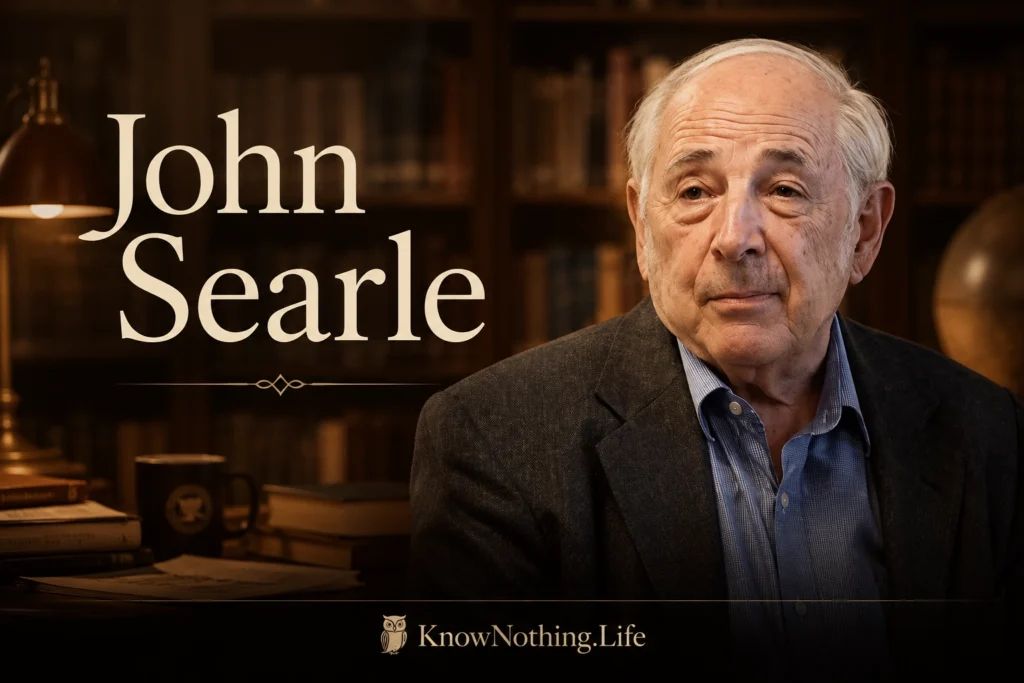
John Rogers Searle was born on July 31, 1932, in Denver, Colorado, and became one of the most influential analytic philosophers of the late twentieth and early twenty-first centuries. His father worked in electrical engineering and business, and his mother was a physician. The family later lived in New York and then in Wisconsin, where Searle’s intellectual confidence and political interests developed early. As a student at the University of Wisconsin–Madison, he was involved in anti-McCarthy politics, an early sign of the public and combative style that would later mark both his teaching and his philosophical persona.
Searle won a Rhodes Scholarship and went to Oxford, where he studied philosophy, politics, and economics and completed his doctorate in 1959. Oxford was then one of the centers of ordinary language philosophy, shaped by figures such as J. L. Austin, Gilbert Ryle, and P. F. Strawson. Austin’s analysis of how language does things in ordinary life became especially important for Searle. What began as an Oxford concern with speech, rules, promises, commands, and meaning would become the foundation of Searle’s first major philosophical achievement.
Oxford, Austin, and the Philosophy of Language
Searle’s early philosophy grew from the insight that language is not merely a system for describing facts. In ordinary life, people use words to promise, command, warn, apologize, appoint, declare, ask, forgive, accuse, and commit themselves. A sentence is not only a string of symbols with a meaning; in the right circumstances, it can be an action. This idea had been developed powerfully by J. L. Austin, but Searle gave it a more systematic form.
His 1969 book Speech Acts: An Essay in the Philosophy of Language became one of the central works in twentieth-century philosophy of language. Near the beginning of the book, Searle writes, “Speaking a language is engaging in a highly complex rule-governed form of behavior.” The sentence captures his project. Speech acts are not random expressions of inner feeling. They occur within systems of rules, intentions, conventions, and social expectations. To make a promise, for example, is not simply to utter words about the future. It is to place oneself under an obligation within a rule-governed practice.
Speech Acts and Constitutive Rules
Searle distinguished between regulative rules and constitutive rules, a distinction that became central to much of his later philosophy. Regulative rules govern activities that can exist independently of the rules, such as rules of traffic regulating driving. Constitutive rules help create the very activity they regulate, as the rules of chess create the possibility of checkmate, legal moves, and winning. Many speech acts, Searle argued, depend on constitutive rules. Without such rules, there would be no promises, declarations, institutional permissions, legal obligations, or official appointments in the relevant sense.
This theory helped explain why language is so deeply connected to society. A judge saying “guilty,” a couple saying “I do,” a president signing a bill, a citizen casting a vote, or a person saying “I promise” can create new social facts when the right rules and contexts are in place. Searle’s philosophy of language therefore pointed beyond language narrowly understood. It opened into the philosophy of mind, action, institutions, and collective life. The question became not only how words mean, but how words help make the human social world.
Berkeley and Public Philosophy
In 1959, Searle joined the philosophy department at the University of California, Berkeley, where he spent almost his entire academic career. He became known as a powerful lecturer, a sharp debater, and a philosopher who favored direct argument over technical obscurity. Berkeley in the 1960s also placed him near political upheaval. He supported the Free Speech Movement early on, then later broke with student radicals over tactics and campus politics. His 1971 book The Campus War reflected that complicated involvement with university conflict.
Searle’s public style mattered to his philosophical reputation. He was not a quiet system-builder hidden from debate. He relished controversy and often criticized views he regarded as confused, fashionable, or evasive. He argued against behaviorism, strong artificial intelligence, deconstruction, eliminative materialism, and certain forms of social constructionism. His tone could be blunt, but his larger aim was consistent: to defend realism, objectivity, common sense, and the possibility of philosophical clarity.
Intentionality and the Mind
After speech-act theory, Searle turned more fully to the philosophy of mind. His 1983 book Intentionality: An Essay in the Philosophy of Mind examined the “aboutness” of mental states: beliefs are about the world, desires are directed toward possible states of affairs, fears have objects, and intentions aim at actions. Searle connected this mental intentionality with linguistic meaning. Words have meaning partly because speakers with minds use them intentionally; language depends on more basic capacities of consciousness and representation.
Searle’s view rejected both dualism and reductionist materialism as he understood them. He did not think the mind was a ghostly substance separate from the body, but he also rejected theories that tried to explain away consciousness as mere behavior, computation, or third-person functional role. Mental states, for Searle, are real biological phenomena. They are caused by brain processes and realized in the brain, but they have first-person subjective features that cannot be eliminated from an adequate account of reality.
The Chinese Room and Artificial Intelligence
Searle’s most famous argument appeared in his 1980 article “Minds, Brains, and Programs.” The Chinese Room thought experiment imagines a person who does not understand Chinese sitting in a room and following English instructions for manipulating Chinese symbols. To people outside the room, the answers may look fluent and intelligent. But the person inside does not understand Chinese; he is manipulating symbols by form alone. Searle used the example to challenge “strong AI,” the claim that the right computer program literally understands or has a mind.
The slogan often associated with the argument is that syntax is not sufficient for semantics. A computer program manipulates symbols according to formal rules, but Searle argued that formal symbol manipulation alone cannot produce understanding, meaning, or consciousness. He did not deny that machines can simulate intelligence, assist psychology, or perform astonishing tasks. His claim was narrower and deeper: simulation is not duplication. A program that behaves as if it understands is not, for that reason alone, a mind that understands.
Biological Naturalism
Searle called his own view of mind biological naturalism. Consciousness, on this view, is a higher-level biological feature of the brain, rather as digestion is a biological feature of the stomach and related organs. The analogy is imperfect, but the point is clear. Consciousness is not outside nature; it is part of the natural world. At the same time, it is irreducibly subjective in its mode of existence. Pain, perception, anxiety, and visual experience exist as they are experienced by a subject.
This position made Searle controversial on all sides. Some physicalists thought he had not explained how subjective consciousness fits into a scientific worldview. Some dualists thought he conceded too much to physical biology. Some AI theorists thought the Chinese Room misunderstood computation, functional organization, or systems-level understanding. Yet the force of Searle’s contribution lies in the clarity of the problem he pressed. If consciousness is real, subjective, and biological, then philosophy must explain how a first-person reality belongs within the same world described by third-person science.
Social Reality and Institutional Facts
Searle’s later work moved from mind and language into social ontology. In The Construction of Social Reality, published in 1995, and Making the Social World, published in 2010, he asked how there can be objective social facts such as money, property, marriage, universities, governments, borders, corporations, elections, and laws. These things are not brute physical facts in the same way that mountains and molecules are, yet they are not mere private fantasies. They shape human life with extraordinary force.
His famous formula for institutional reality is “X counts as Y in context C.” A piece of paper counts as money in a certain institutional setting. A person counts as president under certain constitutional procedures. A move counts as checkmate inside the rules of chess. These status functions depend on collective intentionality and language. Searle’s social ontology thus extended his earliest insight about speech acts: human beings create a world of obligations, powers, offices, rights, duties, and institutions by collectively accepting rule-governed meanings.
Controversy and Later Reputation
Searle’s intellectual influence was accompanied by serious controversy late in life. In 2017, a lawsuit alleged sexual harassment at UC Berkeley. The university later found that Searle had violated its policies, and in 2019 his emeritus status was revoked. Any responsible account of his biography must include this part of the record. It altered how many readers and institutions understood his public legacy, even while his philosophical work remained deeply influential.
This tension is now part of Searle’s historical position. He helped reshape debates about speech acts, mind, AI, intentionality, and social reality, but his final reputation is not only intellectual. Like many major figures, he must be read with both seriousness and moral clarity. The value of his arguments does not erase the controversy surrounding his conduct; the controversy does not make the central questions he raised disappear. A mature assessment has to hold both truths at once.
Death and Lasting Legacy
John Searle died on September 17, 2025, at the age of ninety-three. His major works include Speech Acts, Expression and Meaning, Intentionality, Minds, Brains and Science, The Rediscovery of the Mind, The Construction of Social Reality, Mind, Language and Society, Rationality in Action, Making the Social World, and Seeing Things as They Are. He received major honors, including the National Humanities Medal, and his books helped define several central debates in contemporary philosophy.
Searle’s lasting importance lies in the unity of his philosophical ambition. He wanted to show how language, mind, and society fit into one natural world. Speech acts explain how words become actions. Intentionality explains how minds are directed toward the world. Biological naturalism explains consciousness as real and natural. Social ontology explains how institutions arise from collective recognition and language. Whether one agrees with him or not, Searle remains essential because he forced philosophy to confront one large question again and again: how can meaning, mind, and social reality exist in a world of matter?