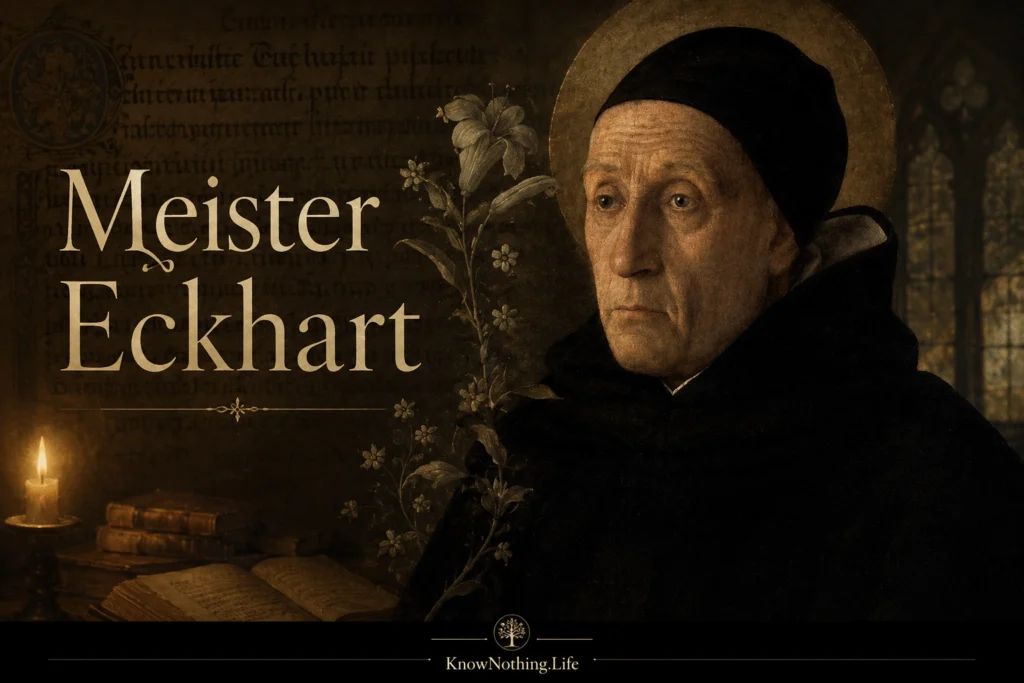
Meister Eckhart was born around 1260 in Hochheim, near Gotha in Thuringia, in what is now Germany. His birth name was Johannes Eckhart, and the title “Meister” reflects his later status as a master of theology. Very little is known about his childhood, but his intellectual and spiritual formation unfolded inside the Dominican Order, one of the great teaching and preaching orders of medieval Christianity. The Dominicans were committed to study, argument, preaching, and the defense of Christian doctrine, and Eckhart would become one of the most daring minds the order ever produced.
Eckhart was educated in the Dominican studium at Cologne, a center associated with the legacy of Albert the Great. He later studied in Paris, the leading university center of Latin Christendom, where theology, Aristotelian philosophy, biblical interpretation, and scholastic debate converged. This training matters because Eckhart was not merely a spontaneous visionary or private mystic. He was a learned theologian, administrator, preacher, and philosopher whose most radical spiritual language was grounded in the technical world of medieval thought.
Paris, Erfurt, and Dominican Leadership
By the 1290s, Eckhart had become prior of the Dominican convent at Erfurt and vicar of Thuringia. During this period, he composed the Instructional Talks, a work addressed to younger members of the order and concerned with obedience, detachment, intention, and the inward life. These early teachings already show the direction of his spirituality. Eckhart was not interested in outward piety alone. He wanted to know what kind of interior freedom makes a person available to God.
In 1302, Eckhart was promoted to Master of Theology at Paris, a distinction of enormous prestige. He taught there as professor in 1302–1303 and later returned for a second period of teaching. He was also elected provincial of the Dominican province of Saxony in 1303 and served in administrative roles over a wide territory. His life was therefore not spent in withdrawal from institutional responsibility. He governed, taught, preached, traveled, wrote, and advised religious communities. The tension between his speculative daring and his official responsibilities would later become one of the central dramas of his life.
Latin Works and Scholastic Ambition
Eckhart’s Latin writings reveal him as a serious scholastic theologian and philosopher. His major unfinished project was the Opus tripartitum, or “Three-Part Work,” which was designed to include a work of propositions, a work of questions, and a work of biblical interpretations. Much of it remained incomplete, but surviving prologues and commentaries show the scale of his ambition. He wanted to interpret Christian doctrine with philosophical rigor, especially through questions about being, intellect, divine causality, creation, and the relationship between God and creatures.
One of his important surviving Latin works is the Commentary on the Gospel of John. In these writings, Eckhart often presses inherited theological language to its limits. He explores God as the source of being, but also speaks of God beyond being; he treats divine intellect as prior to created reality; and he interprets Scripture not merely as devotional text but as a field of metaphysical insight. His scholastic works are essential because they correct the simplified picture of Eckhart as only a mystical preacher. He was also a philosopher of remarkable difficulty and originality.
German Sermons and the Vernacular Voice
Eckhart is best remembered for his German sermons and treatises, where his thought became more direct, poetic, and dangerous. Preaching in the vernacular gave him access to audiences beyond the university, including religious women, lay listeners, and Dominican communities. In these sermons, he spoke about detachment, poverty of spirit, the birth of the Word in the soul, the ground of the soul, and union with God. His German language could be startlingly bold because he was trying to speak about realities that ordinary religious vocabulary often concealed.
The German sermons are filled with paradox. Eckhart tells the listener to become empty, free, poor, and detached, not because creation is worthless in a crude sense, but because the soul cannot receive God while clinging to possession, self-will, image, or spiritual pride. In one famous line, he declares, “The eye with which I see God is the same eye with which God sees me.” The statement expresses the heart of his mystical theology: the deepest knowledge of God is not external observation, but a unity in which divine knowing and human knowing meet at the soul’s ground.
Detachment and Poverty of Spirit
One of Eckhart’s most important teachings is detachment, often connected with the German term Gelassenheit, meaning letting-go, releasement, or abandonment. Detachment does not mean emotional numbness or indifference to moral life. It means freedom from possessiveness, self-importance, and the demand that reality conform to one’s ego. The detached person is not empty because life has no meaning; he is empty because only an unpossessive soul can receive the divine without turning God into another object of desire.
His most radical sermon on poverty of spirit pushes this idea to the edge of paradox. Eckhart speaks not only of being free from creatures, but of being free even from “God” when God is imagined as an object possessed by the soul. In the famous line, “I pray to God to make me free of God,” he is not rejecting divinity. He is rejecting every limited image of God that keeps the soul from the Godhead beyond images. This is the difficult center of Eckhart’s thought: the soul must pass beyond clinging, even religious clinging, into a freedom where God works without obstruction.
God, Godhead, and the Ground of the Soul
Eckhart is famous for distinguishing between God and the Godhead. “God” can refer to God as known in relation to creatures: creator, lord, giver, judge, and source of grace. The “Godhead” points beyond all names and relations to the simple divine ground that no concept can fully grasp. This distinction belongs to the tradition of negative theology, where God is approached not by piling up descriptions but by unsaying every inadequate description. For Eckhart, the highest truth is not captured by images, categories, or even ordinary theological speech.
The soul has a corresponding depth, sometimes called the ground or spark of the soul. Eckhart teaches that at this deepest level the soul is open to God beyond time, place, possession, and created distinction. He does not mean that the ordinary human ego is identical with God. He means that the soul’s deepest ground is where divine life can be born within the human person. His mystical language is daring because it refuses to leave God at a safe distance. Salvation is not merely external reward; it is the birth of divine life within the soul.
Trial and Condemnation
Eckhart’s bold language eventually brought him under suspicion. In Cologne, charges were brought against him, and in 1326 an inquisitorial process began. Eckhart defended himself and appealed to the papal court at Avignon. He insisted that he did not intend heresy and that any error in his works should be corrected by the judgment of the Church. The case was unusual because Eckhart was not an obscure enthusiast but a Dominican master of theology and a major intellectual figure.
In 1329, after Eckhart’s death, Pope John XXII issued the bull In agro dominico, condemning a group of propositions drawn from Eckhart’s writings, some as heretical and others as suspect. Eckhart himself did not live to see the bull. The condemnation damaged his official reputation, but it did not erase his influence. Later readers have often argued that the condemned propositions were isolated from the full logic of his thought, where paradox served spiritual instruction rather than doctrinal rebellion. Still, the trial remains essential to his biography because it shows the danger of speaking too boldly about unity with God inside a church anxious about mystical excess.
Influence and Modern Reception
Eckhart’s influence moved through complex channels. His students and later readers preserved his sermons, while figures such as Johannes Tauler and Henry Suso belonged to the broader Rhineland mystical tradition that continued after him. Over time, Eckhart became important not only to Christian spirituality but also to philosophers, theologians, poets, psychologists, and scholars of comparative religion. He has been read alongside Neoplatonism, negative theology, German Idealism, phenomenology, Buddhism, Vedanta, and modern existential thought.
This wide reception can distort him if he is made into whatever later readers want: a Zen master, a Protestant before Protestantism, a pantheist, a rebel, a pure mystic, or a modern philosopher in medieval clothes. The real Eckhart is more interesting than any simple label. He was a Dominican theologian shaped by Scripture, liturgy, scholastic argument, and ecclesial obedience, but he also used language that broke ordinary religious categories open from within. His greatness lies in that tension.
Death and Lasting Legacy
Meister Eckhart died sometime before April 30, 1328, probably in Avignon, while his case was still under review. His exact death date remains uncertain, though January 1328 is often suggested. He left behind no single finished masterpiece comparable to Aquinas’s Summa Theologiae. Instead, his legacy survives through Latin commentaries, scholastic questions, German sermons, treatises, trial records, and a tradition of interpretation that has never stopped wrestling with him.
Eckhart remains essential because he gave Christian thought one of its most powerful languages of inward freedom. He taught that the soul must let go of possession, self-image, spiritual ambition, and even inadequate ideas of God in order to receive the divine ground. His work is difficult because it speaks where language begins to fail. Yet that difficulty is also his enduring power. Meister Eckhart’s question is still alive: what would remain of the self if everything false, anxious, possessive, and merely imagined were released?