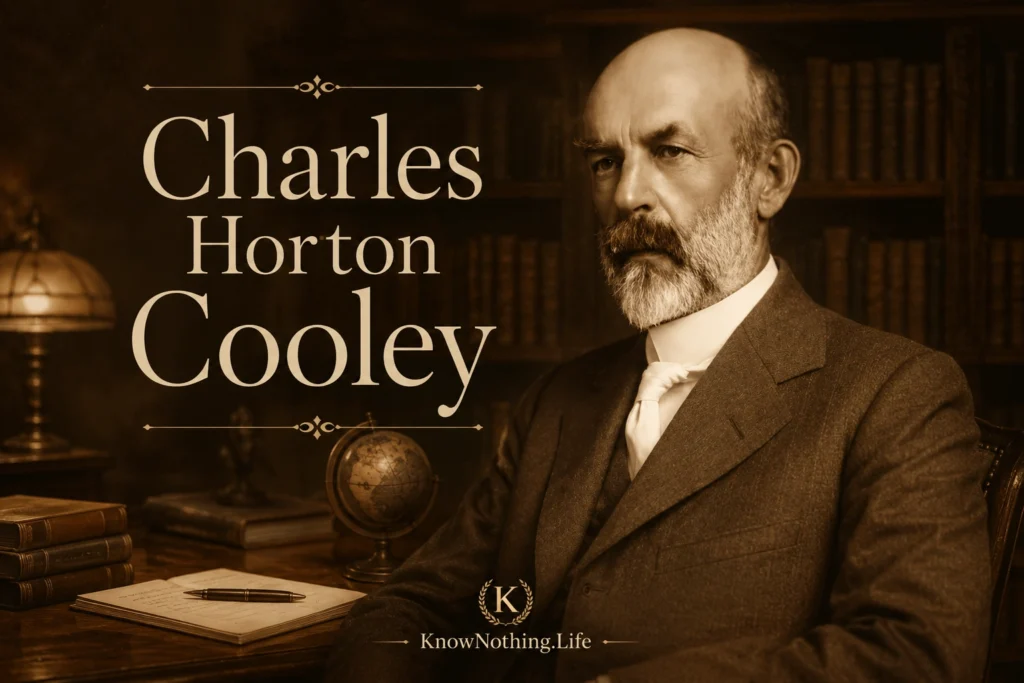
Charles Horton Cooley was born on August 17, 1864, in Ann Arbor, Michigan, into a family closely tied to law, education, and public life. His father, Thomas M. Cooley, was a respected judge, legal scholar, and dean of the University of Michigan Law School. Growing up under the shadow of such a forceful father shaped Charles in complicated ways. He was known as shy, reflective, and physically delicate, more suited to observation than public competition. That inward temperament would later become one of his intellectual strengths, because Cooley’s sociology began with close attention to feeling, imagination, family life, and the subtle ways people form their sense of self.
Cooley studied at the University of Michigan, where his path was not immediate or straightforward. He first earned a degree in mechanical engineering, then turned toward economics, political economy, and social theory. His doctoral dissertation, The Theory of Transportation, reflected an early interest in how economic and social organization grow through systems of movement, communication, and connection. Even before he became known as a sociologist of the self, Cooley was already thinking about society as a network of relationships rather than a collection of isolated individuals.
From Economics to Sociology
Cooley remained at the University of Michigan for almost his entire academic life, teaching economics and sociology and helping shape American social thought during the formative years of the discipline. Unlike some early sociologists who treated society as a large external structure pressing down on individuals, Cooley wanted to understand the living connection between personal experience and social life. He believed that society was not simply “out there” in institutions, laws, markets, and governments. Society also existed in imagination, sympathy, conversation, memory, and the expectations people carry inside themselves.
This made Cooley a bridge between sociology, psychology, and philosophy. He wrote before symbolic interactionism had become a named school, but his ideas helped prepare the way for it. George Herbert Mead, Herbert Blumer, and later social psychologists would develop more systematic accounts of the self as a social process, but Cooley gave that tradition one of its most memorable images. His sociology asked a deceptively simple question: how do we become ourselves through other people?
Human Nature and the Social Order
Cooley’s most influential book, Human Nature and the Social Order, appeared in 1902. It is the work in which he introduced the idea that made him famous: the looking-glass self. The theory begins with the claim that the self is not formed in isolation. People imagine how they appear to others, imagine how others judge that appearance, and then experience some form of self-feeling, such as confidence, shame, pride, embarrassment, or aspiration. The self is social because it develops through reflected meanings.
Cooley’s image was poetic as well as scientific. “Each to each a looking-glass,” he wrote, “Reflects the other that doth pass.” The point is not that we simply copy other people’s opinions of us. Rather, we respond to what we imagine those opinions to be. We may be wrong about how others see us, but the imagined judgment still affects us. A child praised by a parent, a student embarrassed in a classroom, a worker respected by peers, or a teenager anxious about reputation is living inside the social mirror Cooley described.
The Looking-Glass Self
The looking-glass self remains one of the most durable concepts in sociology because it explains something ordinary and profound. Human beings do not merely possess identities; they negotiate them. We learn who we are partly by watching faces, tones, silences, approvals, exclusions, and gestures. Even private self-esteem often carries the traces of public interaction. To feel successful, foolish, lovable, rejected, impressive, or invisible is often to feel oneself reflected through real or imagined audiences.
Cooley’s theory also helps explain why shame and pride are social emotions. He wrote that the reflected self includes feelings such as “pride or mortification.” These emotions arise because the self is exposed to judgment. The mirror is not mechanical; it is moral and emotional. We care about how we appear because we seek a place in the minds of others. For Cooley, the self is therefore neither a fixed inner substance nor a mask imposed by society. It is an ongoing social achievement.
Primary Groups and Social Formation
In Social Organization: A Study of the Larger Mind, published in 1909, Cooley developed another major concept: the primary group. By primary groups, he meant small, intimate forms of association such as the family, the childhood play group, and the neighborhood. He defined them as forms of “intimate face-to-face association and cooperation.” These groups are primary because they are among the earliest and most powerful settings in which people develop sympathy, loyalty, fairness, ambition, belonging, and moral imagination.
Cooley believed primary groups were the nursery of human nature. The family teaches affection and dependence. The play group teaches cooperation, rivalry, rules, and loyalty. The neighborhood teaches mutual recognition and shared life. Larger institutions may be formal, impersonal, and bureaucratic, but they draw much of their emotional meaning from these earlier forms of association. A nation, church, school, union, profession, or political movement often becomes powerful when it can awaken the feeling of “we” first learned in intimate groups.
Society as a Larger Mind
Cooley’s subtitle, A Study of the Larger Mind, reveals the ambition behind his sociology. He did not mean that society literally has one brain. He meant that social life is made of interdependent minds. Public opinion, institutions, customs, reputations, ideals, and moral standards exist because people imagine one another, respond to one another, and organize their actions around shared meanings. Society is mental without being merely private. It is carried by persons, but it is larger than any one person.
This view allowed Cooley to avoid a crude opposition between individual and society. The individual is not swallowed by the group, but neither is the individual fully intelligible apart from social life. Personality grows through communication. Conscience develops through imagined judgment. Ambition seeks recognition. Even rebellion depends on an audience, a moral standard, or a community against which one defines oneself. Cooley’s sociology is powerful because it shows that the social world is not just around us. It is within the structure of selfhood.
Social Process and Democracy
Cooley continued his mature thought in Social Process, published in 1918. The book explored communication, public opinion, social change, conflict, institutions, and democratic life. He was interested in how societies adjust, how values circulate, and how large-scale organization can either nourish or weaken human personality. His approach was reform-minded but cautious. He did not believe society could be fixed by abstract schemes alone. Reform had to understand the actual web of relations in which people live.
His democratic ideal depended on communication and sympathy. Democracy, for Cooley, was not just voting or constitutional machinery. It required habits of mutual understanding, public discussion, and the enlargement of sympathy beyond narrow circles. Primary groups gave people their first experience of moral unity, but modern life required wider forms of identification. The challenge was to build institutions large enough for complex society while preserving the human meanings first formed in face-to-face life.
Method, Style, and Criticism
Cooley’s method has often been described as introspective, interpretive, and humanistic. He observed children, family interactions, conversation, social emotions, and ordinary experience. This made his work unusually sensitive, but it also made it vulnerable to criticism from later sociologists who wanted more statistical rigor, institutional analysis, or empirical distance. Cooley’s writing can feel more like philosophical reflection than modern social science, and some of his assumptions reflect the limitations of his time.
Yet those limitations do not erase his originality. Cooley saw that sociology cannot understand society if it ignores imagination. Laws, markets, classes, and institutions matter, but they operate through persons who interpret, feel, judge, remember, and seek recognition. In an age of social media, online identity, reputation systems, and constant visibility, Cooley can seem surprisingly modern. The looking-glass self has become even more vivid in a world where people watch themselves being watched.
Death and Lasting Legacy
Charles Horton Cooley died on May 7, 1929, in Ann Arbor. His major works include The Theory of Transportation, Human Nature and the Social Order, Social Organization, Social Process, Life and the Student, and the posthumous collection Sociological Theory and Social Research. He also served as president of the American Sociological Association in 1918, a sign of his standing in the early American discipline.
Cooley’s lasting importance lies in his insight that the self is social from the beginning. He gave sociology a language for understanding identity, shame, pride, intimacy, group life, and the moral imagination. He showed that people are formed not only by economic forces or political structures, but by reflected meanings and the felt presence of others. Charles Horton Cooley remains essential because he explained one of the deepest truths of social life: we discover ourselves, in part, by imagining how we appear in another mind.