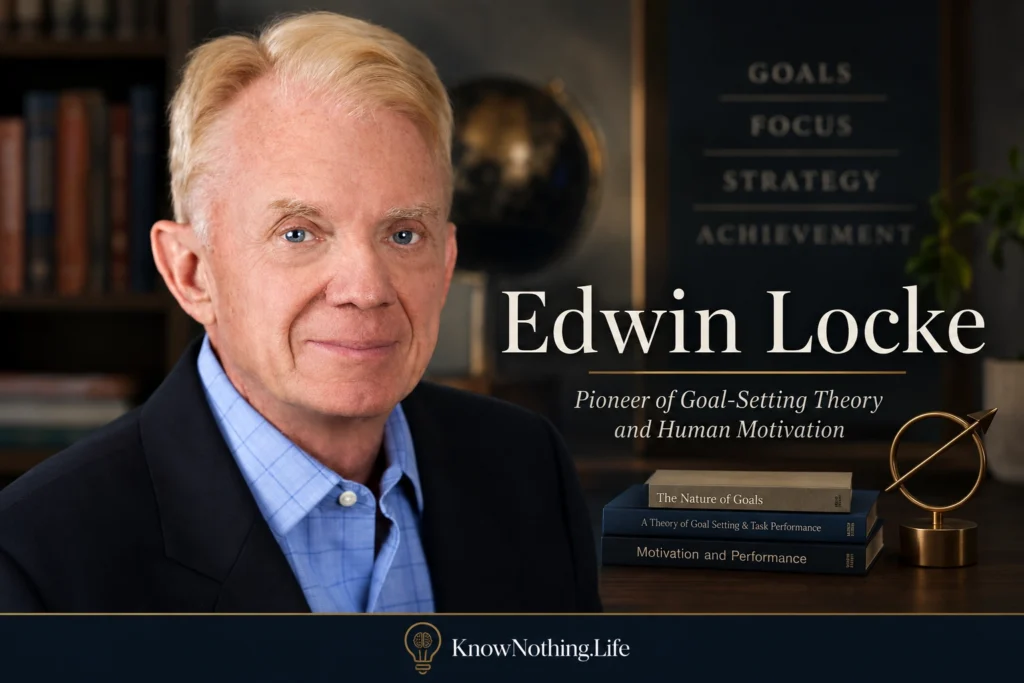
Edwin A. Locke is an American industrial and organizational psychologist whose research changed the scientific understanding of motivation at work. He is best known for developing goal-setting theory, a framework showing that performance is strongly influenced by the goals people consciously accept and pursue. Before Locke’s work, many theories emphasized rewards, needs, drives, or environmental reinforcement while treating intentions as secondary. Locke instead placed purposeful thought at the center of action, arguing that people regulate effort by deciding what they are trying to accomplish and comparing their progress with chosen standards.
Working first through laboratory experiments and later with Gary P. Latham, Locke built one of organizational psychology’s most extensively studied theories. His scholarship also addressed job satisfaction, incentives, self-efficacy, leadership, entrepreneurship, study methods, free will, and scientific method. Major works include Goal Setting: A Motivational Technique That Works, A Theory of Goal Setting and Task Performance, New Developments in Goal Setting and Task Performance, The Prime Movers, Handbook of Principles of Organizational Behavior, and The Illusion of Determinism. Across these subjects, his recurring claim is that people are active agents capable of directing behavior through thought, values, and choice.
Education and Academic Career
Locke was born in 1938 and grew up in New York City. He earned a bachelor’s degree in psychology from Harvard University in 1960, followed by a master’s degree in 1962 and a doctorate in industrial psychology from Cornell University in 1964. His additional graduate fields included industrial sociology and experimental psychology. His dissertation, “The Relationship of Intentions to Motivation and Affect,” already contained the problem that would define his career: how consciously adopted purposes influence effort, achievement, and emotional response.
After Cornell, Locke worked at the American Institutes for Research before joining the University of Maryland as an assistant professor of psychology in 1967. He moved into business administration, became a professor of business and management and psychology, chaired the management and organization faculty, and was appointed Dean’s Professor of Leadership and Motivation. He retired in 2001 and remains Professor Emeritus at Maryland’s Robert H. Smith School of Business. His position across psychology and management allowed him to test basic motivational ideas while studying their consequences for employees, students, managers, and organizations.
The Origins of Goal-Setting Theory
Locke’s early experiments investigated how intentions, standards, and knowledge of results affected task behavior. His influential 1968 article “Toward a Theory of Task Motivation and Incentives” organized these findings into a coherent account. The starting point was simple but consequential: conscious action is ordinarily directed toward an anticipated outcome. Locke and Latham later summarized this view by writing that “conscious human behavior is purposeful.” A worker aiming to complete a defined quantity, a student seeking a particular grade, or an athlete pursuing a measurable time approaches a task differently from someone given no clear standard.
The studies repeatedly showed that specific, difficult goals generally produce stronger performance than easy goals, vague goals, or instructions to “do your best,” assuming that people have sufficient ability and accept the objective. Specificity identifies the required result, while difficulty encourages greater effort and persistence. Locke observed that “best is not defined” when organizations merely ask people to do their best. A precise target gives attention a direction and creates a standard for evaluating progress, strategy, success, and satisfaction.
How Goals Shape Performance
Goal-setting theory does not claim that declaring an ambition guarantees achievement. Locke and Latham identified several mechanisms through which goals influence action. Goals direct attention toward relevant activities, difficult goals mobilize greater effort, accepted goals increase persistence, and challenging objectives encourage the search for useful strategies. A production target may focus attention on output, but results will improve only when the worker possesses or discovers effective methods. Goals organize motivation; they do not substitute for knowledge or competence.
Their effects also depend on important boundary conditions. People need feedback so they can compare their current position with the desired result and adjust effort or strategy. Commitment becomes stronger when a goal is important and seems achievable, while skill, time, equipment, and organizational support determine whether effort can produce success. On unfamiliar or complex tasks, learning goals may be more useful than immediate performance targets. Asking a novice to discover several effective strategies can build the knowledge required before demanding a high outcome.
Collaboration, Job Satisfaction, and Leadership
Gary Latham’s workplace studies complemented Locke’s laboratory research, beginning a collaboration that connected experimental control with organizational application. Together they reviewed evidence involving employees, students, teams, and many kinds of tasks. Their 1990 book A Theory of Goal Setting and Task Performance presented a formal model covering goal difficulty, specificity, commitment, feedback, self-efficacy, task complexity, and strategy. Later, New Developments in Goal Setting and Task Performance assessed new findings and limitations. The theory gained strength because its predictions were tested across countries, occupations, time spans, and research methods.
Locke also made major contributions to the study of job satisfaction. He argued that satisfaction reflects the relationship between what people value and what they perceive their jobs to provide. Pay, autonomy, recognition, security, challenge, and working conditions do not carry identical importance for everyone. His later work examined entrepreneurial vision, leadership, incentives, study behavior, and high achievement. In The Prime Movers, he emphasized independent judgment, competence, persistence, productive ambition, and love of work as qualities found among major business creators.
Ethics, Philosophy, and Human Agency
Locke has been an outspoken advocate of Objectivism, the philosophy associated with Ayn Rand, and has applied its emphasis on reason, agency, productive achievement, and rational self-interest to psychology and management. This commitment informed his criticism of strict behaviorism and determinism. In The Illusion of Determinism: Why Free Will Is Real and Causal, he defended the view that human beings exercise volitional control over attention, judgment, and action. Goal-setting theory therefore represents more than a management technique; it rests on a conception of people as choosing, future-oriented beings.
He has also warned that goals can be misused. Extreme targets may encourage concealment, shortcuts, or unethical behavior when failure is punished and methods are ignored. Goals can narrow attention until unmeasured responsibilities disappear from view. Locke and Latham therefore stress honest leadership, ethical standards, accurate feedback, adequate resources, and systems capable of detecting cheating. Stretch goals may stimulate creativity when people are rewarded for learning and progress, but they become dangerous when impossible outcomes are treated as obligations. The power of goals makes responsible goal selection essential.
Major Works and Lasting Influence
Locke has published hundreds of articles, chapters, and scholarly notes and has authored, coauthored, or edited numerous books. His foundational publications include “The Relationship of Intentions to Level of Performance,” “Toward a Theory of Task Motivation and Incentives,” “The Nature and Causes of Job Satisfaction,” and “Goal Setting and Task Performance: 1969–1980.” His books range from practical guides to comprehensive theoretical works, demonstrating his commitment to connecting controlled research with problems encountered in education, management, leadership, and personal development.
His honors include the Society for Industrial and Organizational Psychology’s Distinguished Scientific Contribution Award, career and lifetime awards from the Academy of Management, and the Association for Psychological Science’s James McKeen Cattell Fellow Award. APS has described Locke as the most published organizational psychologist in the field’s history and goal-setting theory as one of its most respected frameworks. His enduring achievement was to show that motivation is not merely something that happens to people. Individuals organize action by selecting purposes, measuring progress, revising strategies, and persisting toward valued outcomes.