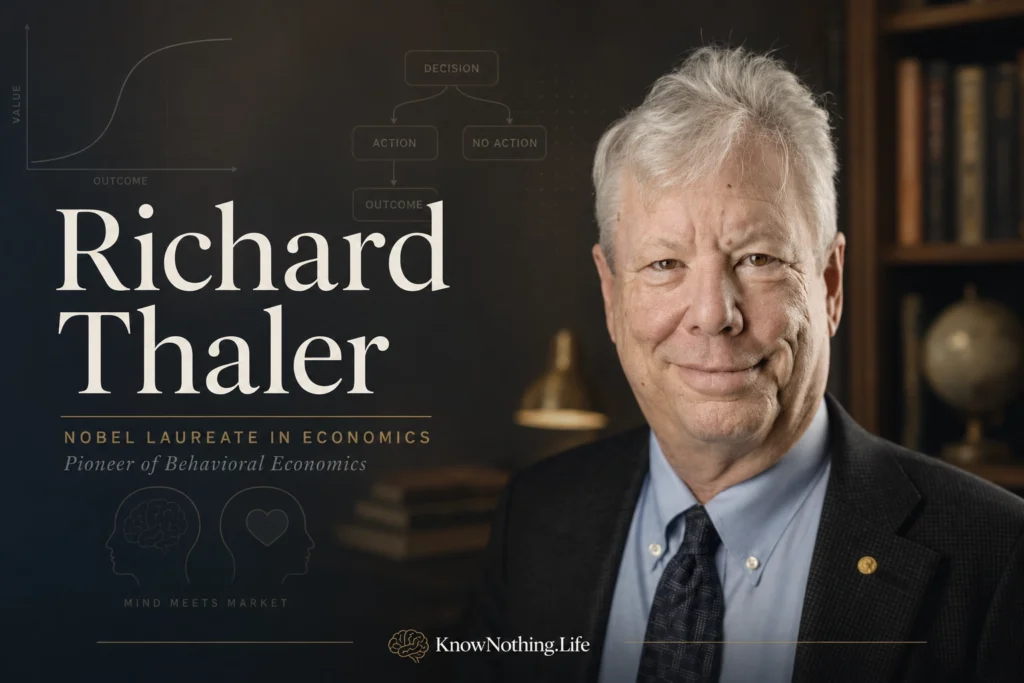
Richard H. Thaler is an American economist whose research helped establish behavioral economics as a major field. Traditional models often describe decision-makers as consistently rational, forward-looking, and self-interested. Thaler did not reject economic theory; he asked what happens when models make room for ordinary people who procrastinate, divide money into mental categories, resist losses, care about fairness, and struggle with temptation. His work showed that these departures from ideal rationality are patterned tendencies that can be studied and incorporated into economic explanations.
His most influential contributions include mental accounting, the endowment effect, the planner-doer model of self-control, behavioral finance, and the design of nudges. His major books include Quasi-Rational Economics, The Winner’s Curse: Paradoxes and Anomalies of Economic Life, Advances in Behavioral Finance, Nudge, and Misbehaving: The Making of Behavioral Economics. In 2017, he received the Sveriges Riksbank Prize in Economic Sciences in Memory of Alfred Nobel for his contributions to behavioral economics. The award recognized a career devoted to making economic decision-makers resemble actual human beings.
Early Life and Academic Formation
Richard H. Thaler was born on September 12, 1945, in East Orange, New Jersey, and grew up mainly in Chatham. Thaler later described himself as an undistinguished student. He studied economics at Case Western Reserve University, earning his bachelor’s degree in 1967, and continued at the University of Rochester, where he received a master’s degree in 1970 and a doctorate in 1974. His dissertation examined the economic value assigned to reducing mortality risk, but his enduring intellectual concern soon became the gap between formal models and observed behavior.
Thaler began his academic career at the University of Rochester and later taught at Cornell University. During a formative period at Stanford in 1977 and 1978, he spent time with psychologists Daniel Kahneman and Amos Tversky, whose work on judgment, heuristics, and loss aversion gave him a psychological vocabulary for irregularities he had begun collecting. He joined the University of Chicago Booth School of Business in 1995 and is now the Charles R. Walgreen Distinguished Service Professor of Behavioral Science and Economics Emeritus.
From Economic Anomalies to Behavioral Economics
Thaler’s approach began with observations that standard theory treated as irrelevant or inexplicable. People drove through dangerous weather to attend events only when they had paid for the tickets, kept expensive wine they would never purchase at its current price, and ate too many cashews until a host removed the bowl. These examples suggested that sunk costs, ownership, framing, and weak self-control affected choices predictably. Looking back, Thaler explained that he noticed people doing things “inconsistent with the theories” he was learning. Instead of dismissing those actions as noise, he treated them as evidence that the models needed revision.
In the late 1980s and 1990s, Thaler wrote a celebrated series of “Anomalies” columns for the Journal of Economic Perspectives. The essays examined results that conflicted with conventional predictions, including the winner’s curse and unusual patterns in financial markets. The series helped legitimize behavioral economics by showing that departures from standard models appeared across laboratories, households, businesses, and markets. Thaler’s purpose was not to prove that people are irrational in every decision, but to identify the conditions under which psychology produces systematic and economically important behavior.
Mental Accounting and the Endowment Effect
One of Thaler’s central ideas is mental accounting, the cognitive system through which people organize and evaluate financial activity. Economic theory generally treats money as fungible: one dollar should be equivalent to any other. In ordinary life, people create separate budgets for housing, entertainment, savings, gifts, or unexpected income. They may refuse to use vacation savings to pay a credit-card balance or spend a tax refund more freely than wages. These categories simplify choices, but they can also narrow attention and produce inconsistent decisions.
Thaler also introduced the term endowment effect for the tendency to value an object more highly once it becomes one’s property. Research conducted with Daniel Kahneman and Jack Knetsch showed that people randomly given mugs demanded more to sell them than others were willing to pay to acquire them. Thaler connected the effect to loss aversion: giving up a possession feels like a loss, and losses often carry more psychological weight than equivalent gains. The idea has implications for consumer behavior, bargaining, and resistance to change.
Self-Control, Fairness, and Behavioral Finance
Thaler’s work with Hersh Shefrin modeled self-control as a conflict between a farsighted planner and an impulsive doer. The planner values long-term health, savings, and stability, while the doer responds to immediate pleasure or convenience. People create rules, deadlines, and automatic deductions because they anticipate their future weakness. As Thaler observed in his Nobel lecture, “We plan to start diets next month, not tonight at dinner.” The framework helped economists analyze procrastination and temptation without assuming that individuals possess one perfectly consistent set of preferences across time.
He also examined fairness and financial markets. Experiments showed that people sometimes reject profitable transactions they consider unfair and sacrifice money to punish unfair behavior. In finance, Thaler and collaborators studied overreaction, underreaction, narrow framing, and frequent evaluation of investments. His work helped establish behavioral finance by challenging the belief that competition automatically removes every psychologically driven anomaly. Professional investors can make errors, and arbitrage may be too risky or costly to correct mispricing immediately.
Save More Tomorrow and the Idea of a Nudge
With Shlomo Benartzi, Thaler created Save More Tomorrow, a program allowing employees to commit in advance to increasing retirement contributions when they received future raises. The design addressed three barriers: future sacrifices feel easier than immediate ones, workers dislike reductions in take-home pay, and existing arrangements persist through inertia. In the first implementation, participants’ average savings rates rose substantially over several pay increases. The program demonstrated that institutions could help people act on long-term intentions without forcing participation.
With legal scholar Cass Sunstein, Thaler developed these ideas for a broad audience in Nudge: Improving Decisions About Health, Wealth, and Happiness. A nudge changes the environment in which choices are made while preserving freedom to choose. Defaults, reminders, simplified forms, warnings, and organized menus can influence behavior without banning alternatives or imposing large financial incentives. Thaler explained that a nudge can “point somebody in a helpful direction without forcing them.” The approach inspired policy experiments while provoking debate about transparency, consent, and who defines a better choice.
Major Works, Nobel Prize, and Lasting Influence
Thaler’s books chart behavioral economics from academic challenge to established research program. Quasi-Rational Economics collected early papers on consumer choice, mental accounting, and self-control. The Winner’s Curse presented anomalies in accessible form, while the two volumes of Advances in Behavioral Finance gathered research on markets and investor psychology. Nudge showed how choice architecture could improve decisions, and Misbehaving combined intellectual history with memoir, describing the resistance behavioral economists faced and the collaborations that allowed the field to grow.
The Nobel committee highlighted three dimensions of Thaler’s work: limited rationality, social preferences, and lack of self-control. He also served as president of the American Economic Association and was elected to the National Academy of Sciences. His deepest contribution is not the claim that people are hopelessly irrational. It is the demonstration that human limitations can be studied with the same seriousness as prices, incentives, and institutions. By allowing economics to consider agents who are “sometimes human,” Thaler made the discipline more realistic and gave policymakers new tools for helping people pursue their own goals.