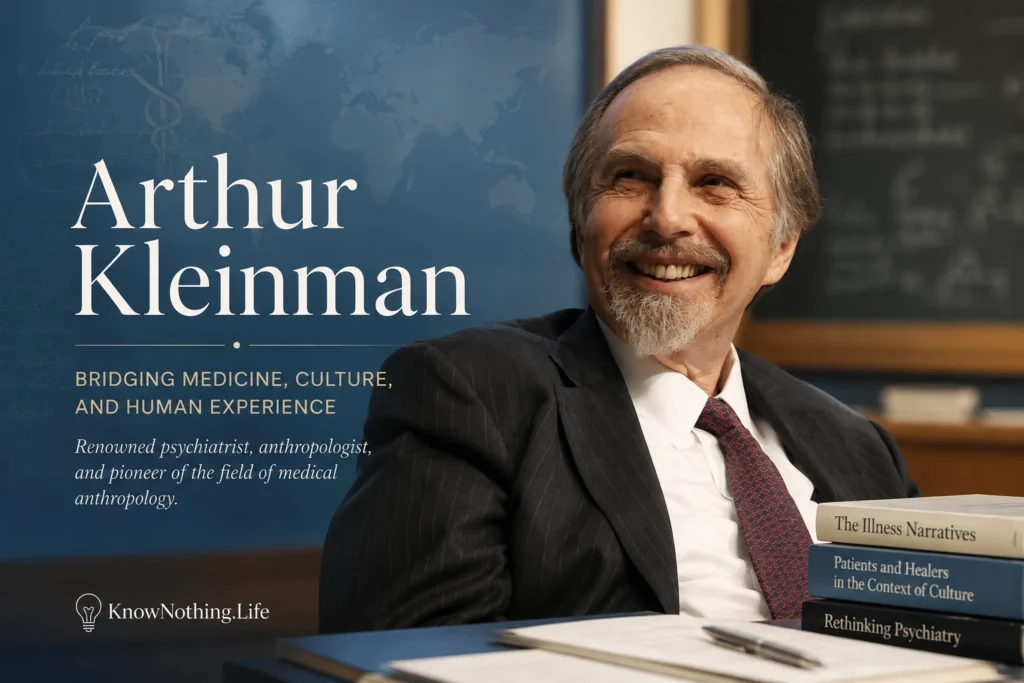
Arthur Kleinman is an American psychiatrist and anthropologist whose work reshaped the study of illness, caregiving, culture, and moral life. He argued that medicine cannot fully understand suffering through laboratory findings, diagnostic labels, and treatment protocols alone. Disease occurs within a body, but illness unfolds within a life, changing relationships, work, identity, hope, and everyday routines. By bringing clinical medicine into conversation with anthropology, he helped establish medical anthropology, cultural psychiatry, global health, and the medical humanities as influential fields.
His major books include Patients and Healers in the Context of Culture, The Illness Narratives, Social Origins of Distress and Disease, Rethinking Psychiatry, Writing at the Margin, What Really Matters, and The Soul of Care. He also coauthored or coedited Culture and Depression, Social Suffering, Deep China, and Reimagining Global Health. Across these works, patient and caregiver experience is not a secondary detail surrounding medical fact; it is essential knowledge about what sickness means and what responsible care requires.
Early Life, Education, and Harvard
Arthur Michael Kleinman was born in New York City on March 11, 1941. He graduated from Stanford University and Stanford Medical School, trained in psychiatry at Massachusetts General Hospital, and earned a master’s degree in social anthropology from Harvard. Psychiatry gave him methods for diagnosing and treating distress, while anthropology examined how language, institutions, family life, and history shape experience. Kleinman concluded that neither discipline could adequately explain illness without the insights of the other.
He arrived at Harvard with his wife, Joan, in 1970 to conduct a comparative study of medical systems and taught the university’s first medical anthropology course in 1973. After accepting an associate professorship at the University of Washington, he returned to Harvard in 1982. He later chaired departments in social medicine and anthropology and directed the Harvard Asia Center. Following nearly five decades of teaching, he formally became professor emeritus in 2026 while continuing as a research professor of medical anthropology.
Taiwan, China, and Medical Systems
Kleinman began fieldwork in Taiwan in 1969 and in mainland China in 1978. In clinics, hospitals, homes, and communities, he studied how people moved among biomedical physicians, traditional practitioners, religious healers, and family networks. These encounters challenged the idea that Western medicine possesses knowledge while patients merely possess beliefs. Every medical system contains assumptions about evidence, responsibility, normality, the body, and the proper relationship between healer and patient.
In Patients and Healers in the Context of Culture, Kleinman described healthcare as a cultural system and developed the influential concept of explanatory models. Patients and practitioners form ideas about what caused an illness, why it began, how serious it is, what treatment should accomplish, and what course it may take. Clinical conflict often develops because the participants are answering different questions. His practical recommendation was direct: ask patients what they believe is happening, then listen carefully enough to negotiate treatment rather than merely impose it.
Disease, Illness, and Lived Experience
One of Kleinman’s most influential distinctions separates disease from illness. Disease refers to the biological or physiological process recognized by medical professionals. Illness describes the lived experience of symptoms and suffering, including pain, fear, stigma, disability, disrupted relationships, financial pressure, and uncertainty. A physician may correctly identify a disease while misunderstanding the patient’s illness. A person may also suffer profoundly even when tests fail to produce a definitive pathological explanation.
The distinction explained why technically competent treatment can still feel inadequate. Medication may improve a measurable condition while leaving someone unable to work, care for children, preserve dignity, or understand what has happened. Explanatory models help reveal these concerns without reducing culture to ethnicity or stereotype. They are personal and changeable, shaped by family, class, religion, politics, and previous encounters with medicine. Kleinman urged clinicians to negotiate meaning rather than assume professional categories automatically capture the patient’s reality.
The Illness Narratives
Published in 1988, The Illness Narratives: Suffering, Healing, and the Human Condition became Kleinman’s most influential book. It argued that chronic illness is not merely a technical problem awaiting repair. People interpret sickness through stories about cause, responsibility, loss, endurance, and hope. “The illness narrative is a story the patient tells,” Kleinman wrote, to give coherence to suffering. Such stories reveal what symptoms threaten, what treatments demand, and what outcomes matter most to patients and families.
The book helped shape narrative medicine and patient-centered care, although Kleinman did not romanticize storytelling. Suffering may resist language, and accounts can be incomplete, contradictory, or altered by context. Listening is not a technique for extracting a tidy lesson; it is a disciplined attempt to enter another person’s social and moral world. Kleinman later observed, “Medicine brings you into people’s stories.” For him, the privilege of hearing those stories carried an obligation to respond through better clinical judgment and more humane care.
Social Suffering and Moral Experience
Kleinman expanded his analysis from clinical encounters to the social production of suffering. In Social Origins of Distress and Disease, he examined depression, neurasthenia, and pain in China, demonstrating how political history and culturally available diagnoses shape distress. His warning against the “category fallacy” challenged the uncritical export of psychiatric classifications developed in one society to another. Human vulnerability may be universal, but symptoms acquire meaning through local language, institutions, political conditions, and moral expectations.
Works such as Writing at the Margin, Social Suffering, What Really Matters, and Deep China explored how poverty, violence, migration, political upheaval, and institutional neglect enter intimate life. Kleinman used moral experience to describe what is most at stake for people—the relationships, commitments, and values they struggle to preserve. This perspective influenced global health by insisting that interventions be judged not only by efficiency or disease reduction, but also by their effects on dignity, trust, obligation, and meaningful existence.
Joan Kleinman and The Soul of Care
Kleinman’s scholarship became personal when Joan developed early-onset Alzheimer’s disease. For more than ten years, he helped care for her through progressive visual impairment, dementia, and dependence. Despite a career spent studying illness, the daily work of bathing, feeding, comforting, arranging assistance, and enduring repeated losses exposed the limits of professional knowledge. “I thought I knew everything about illness and care,” he later admitted. “I realized that I had a hell of a lot to learn.”
In The Soul of Care: The Moral Education of a Husband and a Doctor, Kleinman combined memoir, love story, and criticism of healthcare. Caregiving became sustained presence and practical labor under exhaustion and uncertainty, not simply a compassionate attitude. His experience exposed systems well organized for acute intervention but poorly equipped for chronic illness and family support. Joan’s illness deepened his understanding of vulnerability, reciprocity, and the need to evaluate medicine through human relationships rather than institutional speed alone.
Major Works and Lasting Influence
Kleinman published seven single-authored books, several coauthored works, numerous edited volumes, and more than 350 articles and chapters. He was the founding editor of Culture, Medicine and Psychiatry and mentored generations of anthropologists, psychiatrists, physicians, and global-health leaders. His honors include the Franz Boas Award, the Wellcome Medal, election to the National Academy of Medicine, and membership in the American Academy of Arts and Sciences.
At his final Harvard seminar in 2025, Kleinman summarized his life’s work: “Care, critically understood and practiced, matters most.” The statement unites his central ideas. Culture shapes illness; narratives disclose what is at stake; institutions can intensify or relieve suffering; and caregiving is a moral practice grounded in attention and responsibility. Kleinman’s lasting achievement was to show that medicine becomes more rigorous, not less, when it takes human experience seriously and restores the patient’s world to clinical knowledge.