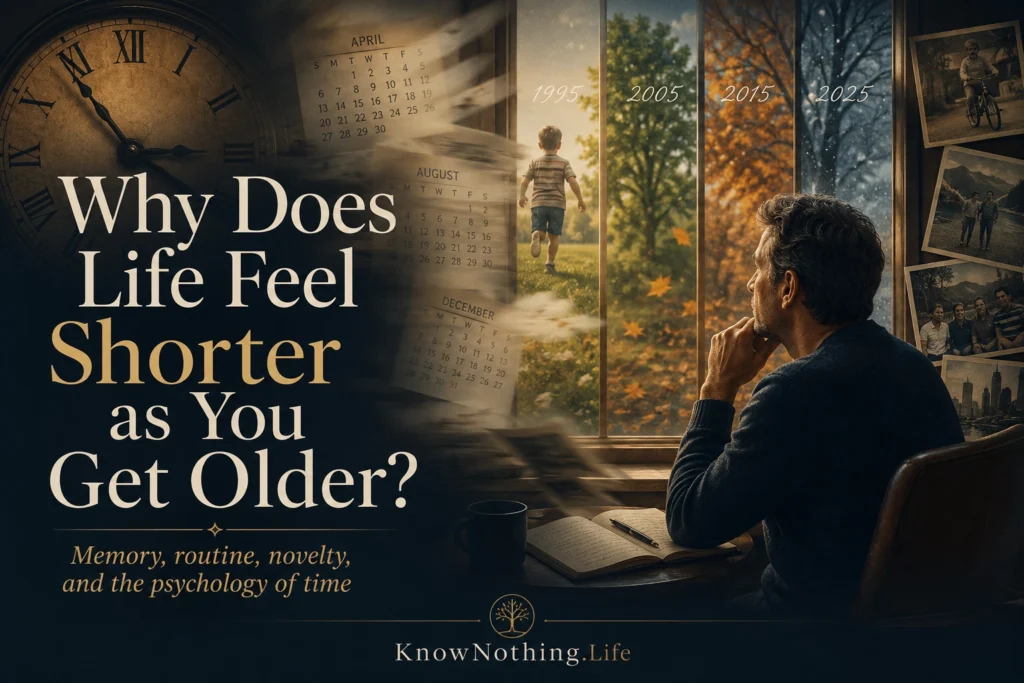
Childhood summers can seem almost endless, while adult years appear to vanish between birthdays, holidays, and unfinished plans. The calendar has not changed, yet many people feel that time moves faster with age. A month that once seemed like a significant stretch of life becomes a small interval, and an entire decade can appear compressed into a handful of major memories. This experience is so common that it is often treated as an unavoidable feature of aging.
Psychological research generally supports the idea that older adults are more likely to describe long periods of their lives as having passed quickly, but the effect is more complicated than the familiar saying suggests. In a study of 499 participants between the ages of 14 and 94, Marc Wittmann and Sandra Lehnhoff found age-related differences in judgments about the speed of time. However, age explained no more than about 10 percent of the variation, meaning that lifestyle, attention, memory, personality, and emotional state also matter. The feeling that life is speeding up is real, but age alone does not determine it.
Experienced Time and Remembered Time
One reason time is confusing is that people experience it from two different perspectives. Prospective time is the passage of time while an event is happening, especially when a person is actively monitoring the clock. Retrospective time is the duration assigned to an experience after it has ended. These two forms of judgment can produce opposite impressions. A dull meeting may feel extremely long while it is happening because attention repeatedly returns to time, yet the same meeting may later occupy almost no space in memory.
A busy vacation can produce the reverse effect. Each day may seem to pass quickly because attention is absorbed by activities rather than the clock. Looking back, however, the vacation may feel long because it contains many distinct experiences. Research distinguishes estimates of duration from judgments about how quickly time seems to pass, showing that they depend on partially different cognitive processes. Studies of cognitive load, memory, and event density demonstrate that the amount of information being processed can alter both the experienced duration of an interval and its remembered place in time.
Each Year Becomes a Smaller Part of Life
One popular explanation is sometimes called the proportional theory of psychological time. At five years old, one year represents one-fifth of a person’s entire remembered life. At fifty, a year represents only one-fiftieth. Each new year therefore seems proportionally smaller when compared with the growing amount of life that has already been experienced. The idea is commonly associated with nineteenth-century French psychologist Pierre Janet, although it is better understood as an intuitive model than as a complete scientific explanation.
The theory captures something important about comparison. Human beings rarely evaluate time in absolute isolation; they judge it relative to familiar scales. A summer feels enormous to a child who has experienced only a few summers, while another year may seem less distinctive to an adult who has lived through many similar annual cycles. Yet proportionality cannot explain why some weeks feel expansive and others disappear, or why two people of the same age can experience a decade very differently. Psychological time is shaped not only by how much life has passed, but also by what fills it.
Novelty Creates Temporal Landmarks
Childhood contains an unusually high concentration of first experiences. The first day of school, first close friendship, first trip away from home, first performance, first romantic attraction, and first major failure all create distinct memory markers. Because unfamiliar situations demand attention, the brain records more details about them. A period containing many memorable events can later appear broader and more substantial than an equally long period dominated by repetition.
Adult life frequently becomes more predictable. The same commute, workplace, household tasks, stores, and seasonal rituals may recur with only minor changes. Dinah Avni-Babad and Ilana Ritov examined this effect in four experiments and two field studies reported in “Routine and the Perception of Time.” Participants tended to remember routine periods as shorter than comparable periods containing less predictable activity. Familiar actions can be mentally grouped together, leaving fewer distinctive boundaries with which the mind can reconstruct the passage of time.
Novelty does not literally slow the clock. It increases the number of changes, events, and details available to memory. Recent research using naturalistic video scenes found that event density influenced both subjective duration and the felt speed of time, although these experiences were not identical. A high rate of change could make time feel fast while it was passing, yet the greater number of events also expanded judgments of duration. A full day of unfamiliar experiences may therefore fly by in the moment but feel satisfyingly long when remembered.
Routine Compresses Life Into Larger Categories
Memory does not preserve everyday life as an uninterrupted recording. It organizes events into meaningful units. A child may remember individual school days because each contains unfamiliar rules, people, and discoveries. An adult may reduce hundreds of similar workdays to a single mental category called “that year at the office.” Once repeated experiences are grouped together, the period can feel shorter because fewer separate episodes remain available for recall.
Researchers Mark Landau and colleagues have described this process as autobiographical chunking. When many actions are represented under broad labels—working, parenting, commuting, running errands—the individual episodes become less visible in memory. The mind recalls the general pattern rather than each occurrence. This helps people manage large amounts of information, but it also compresses the apparent length of the past. The years may feel short not because nothing happened, but because many events were encoded as variations of the same thing.
More recent research complicates the claim that older people simply possess fewer meaningful memories. A 2026 study led by Alice Teghil examined 120 adults between the ages of 20 and 91. Older participants did perceive the previous decade as having passed more quickly, but the effect was not explained by having fewer or less meaningful autobiographical memories. In fact, older adults reported vivid and significant recollections. The findings suggest that the acceleration of time cannot be reduced to a simple shortage of remembered events.
Attention, Busyness, and Time Pressure
Time also appears to accelerate when attention is directed away from its passage. During absorbing work, conversation, play, or creative activity, people monitor the clock less frequently. This is one reason enjoyable experiences often seem to end quickly. Boredom has the opposite effect: when little captures attention, awareness turns toward waiting itself, making minutes feel prolonged. William James observed in The Principles of Psychology that a time filled with varied and interesting experiences can feel brief while occurring yet extensive in memory.
Adult life often combines absorption with persistent time pressure. Careers, caregiving, household management, appointments, and digital communication compete for limited attention. Days become sequences of tasks aimed at the next deadline. A study of 423 people between ages 17 and 81 found that age predicted faster judgments of the previous decade, while time perspective, routine, emotional regulation, and a sense of time pressure were also related to how quickly time seemed to pass. A strong future orientation was associated with a faster typical passage of time, possibly because attention remained focused on what had to happen next rather than on the present experience.
Busyness can make the present feel fast without necessarily producing a rich past. Constant activity is not the same as memorable experience. A person may complete dozens of tasks in a day yet remember little because attention was fragmented and each task resembled those of the previous week. Time pressure can therefore create a paradox: life feels crowded while it is happening but empty when reviewed.
Aging, Memory Encoding, and the Brain
Normal aging can affect attention, processing speed, and episodic memory, all of which contribute to temporal experience. Laboratory studies of short intervals do not always show a simple acceleration of time among older adults, and reviews warn that experimental timing tasks may not closely resemble judgments about years or decades. The perception of a ten-second tone and the feeling that the previous ten years disappeared are related to different cognitive demands.
The 2026 study by Teghil and colleagues found that faster judgments of the previous decade were associated with lower cognitive efficiency, particularly a reduced ability to encode and later recall new information. This does not mean that ordinary time acceleration is evidence of dementia or severe impairment. The study was cross-sectional and cannot prove causation. It does, however, suggest that the ability to form distinct new memories may influence how densely the past is represented. When fewer details from new experiences become firmly encoded, a period may appear more compressed in retrospect.
The relationship between memory and time is therefore more subtle than the popular claim that adults merely stop doing new things. Older adults may possess many rich autobiographical memories while still experiencing changes in how efficiently new information is encoded. Routine, divided attention, and cognitive change can interact, producing fewer sharply defined markers even when life remains active and meaningful.
Milestones Become Less Frequent
Early life is structured by frequent transitions. Children move through school grades, changing classrooms, teachers, abilities, and social roles almost every year. Young adults may leave home, begin careers, form long-term relationships, relocate, or become parents. These transitions divide the past into clear chapters. Later adulthood can contain long periods in which work, relationships, and residence remain relatively stable, making the boundaries between years less obvious.
Milestones act as temporal landmarks because they give memories an organizing structure. People may remember an event as occurring before graduation, after moving, during a particular job, or when a child was young. Without such transitions, several years can merge into one extended phase. Research on long-term time judgments suggests that routine, memory structure, personal growth, nostalgia, cultural expectations, and the way people divide life into chapters all contribute to whether a period is remembered as fast or slow. No single explanation fully accounts for the phenomenon.
Cultural beliefs may reinforce the effect. People repeatedly hear that time speeds up with age, so they may interpret ordinary surprise at a passing anniversary as confirmation of the rule. Research has found that familiarity with this popular belief can influence personal reports about the speed of time. The experience is genuine, but the story people tell about it is shaped partly by expectations.
Can Life Be Made to Feel Longer?
Chronological time cannot be slowed, but the remembered density of life can be changed. New experiences create stronger boundaries when they require attention and differ meaningfully from routine. This does not require constant travel or dramatic risk. Learning a skill, visiting an unfamiliar neighborhood, changing a weekly ritual, meeting new people, reading outside one’s usual interests, or deliberately marking the beginning and end of important periods can create additional temporal landmarks.
Attention matters as much as novelty. Mindfulness does not make a minute objectively longer, but careful awareness can increase the amount of experience noticed and remembered. Photographs, journals, conversations, and periodic reflection can prevent months from collapsing into a vague summary. The goal is not to eliminate routine, which provides stability and reduces cognitive strain, but to prevent routine from becoming the only structure of life.
Life feels shorter with age because time is reconstructed through memory, attention, comparison, and meaning. Years shrink when they contain few distinct boundaries, when attention is continually aimed at the next obligation, and when repeated experiences are compressed into broad categories. Aging contributes to the pattern, but it does not make acceleration inevitable. A life containing engagement, variation, reflection, and memorable transitions may still pass quickly in the moment, yet it can feel much larger when viewed from the future.