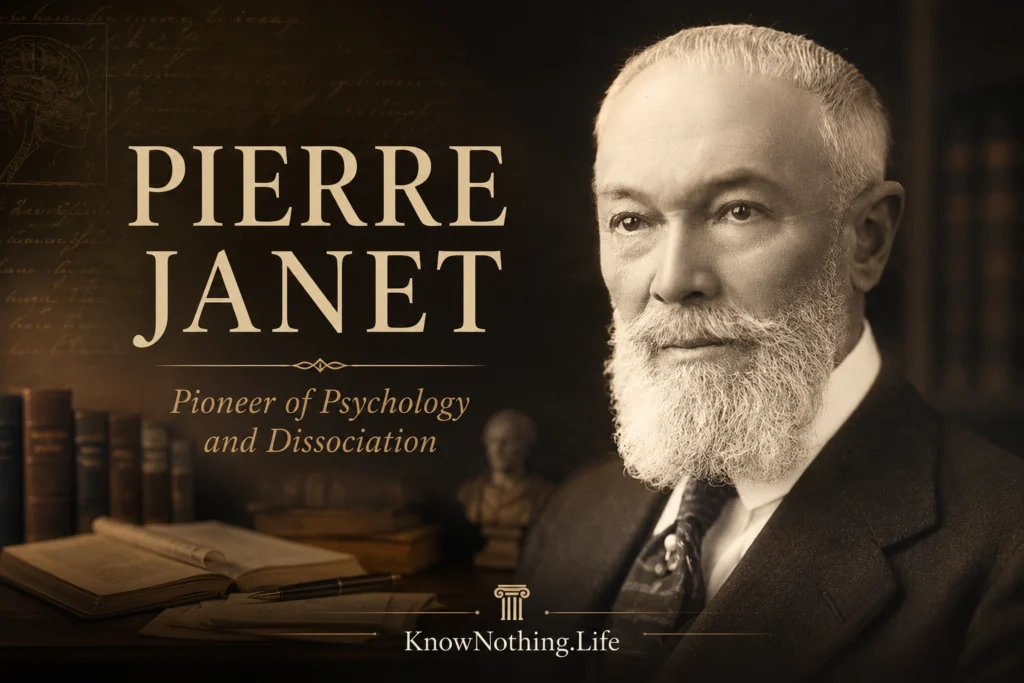
Pierre Janet was a French philosopher, physician, psychologist, and psychotherapist whose research helped establish the modern study of dissociation, traumatic memory, subconscious activity, and psychological treatment. Before psychoanalysis became internationally dominant, he examined how overwhelming experiences could disrupt memory, perception, emotion, and voluntary action. He regarded symptoms not as random defects but as organized processes continuing outside ordinary awareness. His combination of clinical observation, experimentation, and philosophical theory made him a formative figure in scientific psychology.
Janet’s reputation was later overshadowed by Sigmund Freud, yet many subjects now central to trauma psychology were already present in his work: fixed ideas, narrowed consciousness, altered states, amnesia, behavioral reenactment, and failures to integrate frightening experiences into personal memory. His major books include Psychological Automatism, The Mental State of Hystericals, Neuroses and Fixed Ideas, Obsessions and Psychasthenia, The Major Symptoms of Hysteria, Psychological Healing, and Principles of Psychotherapy. Together, they form a broad psychology of consciousness, action, personality, and recovery.
Early Life and Philosophical Education
Pierre Marie Félix Janet was born in Paris on May 30, 1859. He entered the École Normale Supérieure, qualified as a philosophy teacher, and began his career in French secondary schools. Psychology did not yet exist as an independent university discipline, so Janet trained through philosophy while pursuing medicine. This dual education defined his work. He sought to understand both the structure of consciousness and the symptoms presented by patients, refusing to separate abstract questions about the mind from clinical observation.
While teaching in Le Havre, Janet investigated hypnosis, somnambulism, automatic writing, and divided consciousness. Physician Joseph Gibert introduced him to Léonie, a woman who displayed striking changes under hypnosis. Janet later recalled, “At my request Gibert had the celebrated Léonie brought to Havre.” His observations suggested that complex perceptions and actions could occur without entering ordinary awareness. These studies supplied evidence for his doctoral thesis and directed his career toward the hidden organization of mental life.
Psychological Automatism and Dissociation
Janet’s 1889 doctoral thesis, published as Psychological Automatism, offered a systematic theory of subconscious psychological activity. He argued that consciousness was not necessarily unified. Sensations, memories, movements, and ideas could become separated from the main personality while continuing to influence behavior. He called these processes psychological automatisms because they operated with limited voluntary control. The result was not an absence of mind but partially independent systems appearing through hypnosis, amnesia, paralysis, automatic writing, or alternate states of consciousness.
Dissociation, in Janet’s account, involved a failure of psychological synthesis: the mind could no longer combine experience within one personal consciousness. He connected this vulnerability to a narrowing of the field of consciousness, in which fewer sensations, ideas, memories, and actions could be integrated simultaneously. Later scholarship credits him with the first systematic account of dissociation as a response to overwhelming experience and with showing that traumatic memories may persist through bodily sensations, emotions, and repeated actions rather than through ordinary narrative recollection.
Charcot, the Salpêtrière, and Hysteria
Janet’s research attracted neurologist Jean-Martin Charcot, who placed him in charge of a psychological laboratory at the Salpêtrière Hospital in Paris. Janet also completed medical training, studying patients then diagnosed with hysteria. He attempted to unite seemingly disconnected symptoms, including anesthesia, paralysis, convulsions, amnesia, fugues, and personality changes. He treated these conditions as psychologically meaningful alterations of function rather than as malingering or inexplicable neurological defects. This approach joined academic psychology with the direct clinical investigation of mental illness.
The Harvard lectures collected in The Major Symptoms of Hysteria presented these ideas to an American audience. Janet explained that “the study of the mental state of the patient can sometimes be useful” in understanding discordant symptoms. He emphasized fixed ideas—emotionally charged memories or convictions isolated from normal awareness—that could appear through attacks, bodily symptoms, and altered behavior. Although the historical diagnosis of hysteria has changed, his attempt to connect symptoms with dissociated experience anticipated later approaches to trauma and conversion disorders.
Psychasthenia and the Function of Reality
Janet did not limit his research to hysteria. In Obsessions and Psychasthenia, written with Fulgence Raymond, he described obsessive doubt, phobias, repetitive acts, feelings of incompleteness, depersonalization, and difficulty acting decisively. He introduced psychasthenia as a broad clinical category involving reduced psychological tension and impaired engagement with present reality. Unlike dissociative symptoms, which involved separated mental functions, psychasthenic problems often appeared as chronic uncertainty, endless reflection, compulsive checking, and an inability to turn thought into effective action.
Central to this theory was the “function of reality,” the capacity to respond to immediate circumstances, make decisions, and complete appropriate actions. Janet understood mental life through different levels of action: automatic habits demanded relatively little psychological energy, while social decisions, sustained attention, and creative adaptation required greater force and tension. Symptoms emerged when a person could not maintain the level of organization demanded by a situation. This model connected cognition, emotion, behavior, and social functioning without reducing psychological illness to one hidden cause.
Psychotherapy and the Integration of Experience
Janet’s therapeutic approach was practical and flexible. He used hypnosis and suggestion but did not regard them as universal cures. Treatment could involve reconstructing traumatic memories, reducing overwhelming demands, changing routines, strengthening useful habits, restoring confidence in action, and placing isolated experiences within a comprehensible personal history. In Principles of Psychotherapy, he defined psychotherapy broadly as “a group of therapeutic processes,” refusing to restrict psychological treatment to a single school or technique. The method had to fit the patient’s actual capacities and difficulties.
For Janet, recovery required more than temporarily removing a symptom. “It is not enough to ‘get out of a hole,’” he wrote; treatment must also prevent the person from becoming trapped again. He therefore emphasized education, environmental change, graded activity, and the development of new patterns of conduct. Traumatic experience ceased to dominate when it could be remembered and expressed without recreating the original crisis. This approach resembles later ideas of memory integration, stabilization, rehabilitation, and the rebuilding of everyday functioning after psychological injury.
Academic Leadership and Major Works
Janet taught at the Sorbonne and became professor of experimental and comparative psychology at the Collège de France in 1902, holding the chair for more than three decades. He helped found the Société de Psychologie, which later became the French Psychological Society, and with Georges Dumas established the Journal de psychologie normale et pathologique. His lectures carried his ideas beyond France, while his election to the Académie des sciences morales et politiques confirmed his standing within French intellectual life.
His later writings expanded into memory, belief, emotion, personality, love, hate, intelligence, and development. Important works included Psychological Healing, Psychological Medicine, From Anguish to Ecstasy, The Evolution of Memory and the Notion of Time, The Psychological Evolution of Personality, and Psychological Strength and Weakness. This range shows that Janet was not only a theorist of mental illness. He was constructing a general psychology of conduct in which consciousness develops through increasingly complex forms of action, reflection, communication, and social adaptation.
Neglect, Rediscovery, and Lasting Influence
Janet retired during the 1930s and died in Paris on February 24, 1947. By then, psychoanalysis had achieved far greater cultural influence, while much of his work remained untranslated or scattered across large French volumes. Differences with Freud and disputes over intellectual priority contributed to a historical narrative that often treated Janet as a secondary figure. Yet researchers studying dissociation, obsessive-compulsive phenomena, trauma, memory, and psychotherapy continued to recover the originality and breadth of his clinical system.
Janet’s enduring contribution is the idea that psychological suffering often reflects disrupted integration rather than vanished mental content. Experiences excluded from ordinary awareness may continue through emotion, perception, bodily response, and action. Healing therefore requires more than locating a hidden memory; it involves increasing the person’s capacity to organize experience, act effectively in the present, and build a coherent life. Modern trauma theory does not simply reproduce Janet’s system, but its renewed attention to dissociation and traumatic memory confirms why his work remains foundational.