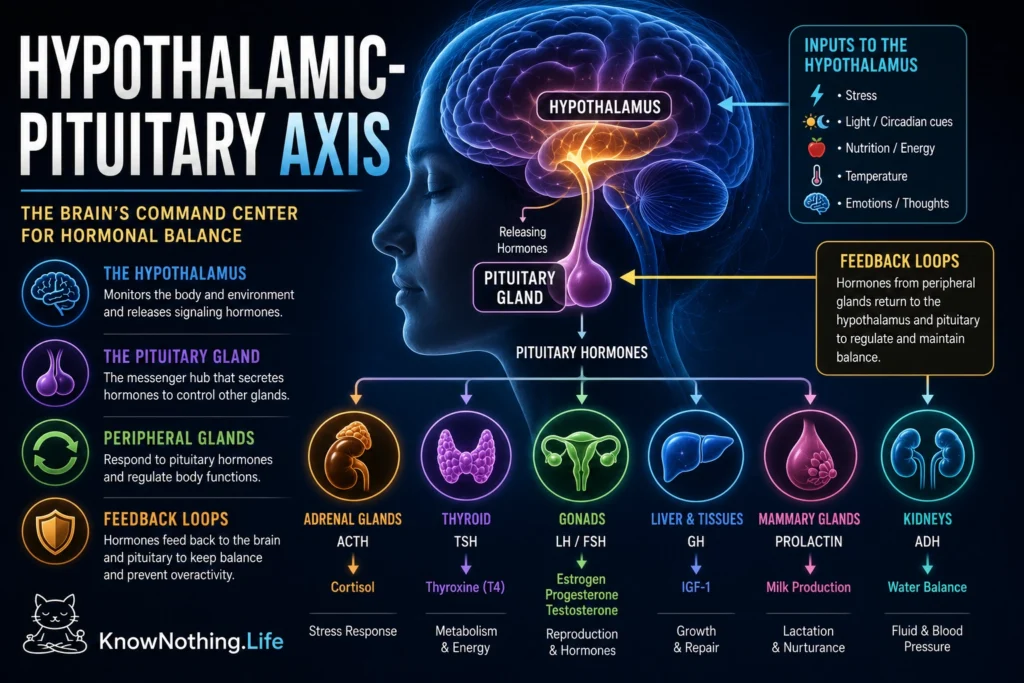
The hypothalamic-pituitary axis is the principal communication system linking the brain with the endocrine organs of the body. It converts neural information about stress, light, temperature, nutrition, emotion, reproduction, and internal chemistry into hormonal instructions. The hypothalamus receives signals from the nervous system and releases specialized neurohormones that regulate the pituitary gland. The pituitary then secretes hormones that influence the adrenal glands, thyroid, ovaries, testes, liver, mammary glands, bones, and many other tissues. Hormones released by these organs return signals to the brain and pituitary, creating feedback loops that prevent endocrine activity from increasing or decreasing without control.
The phrase “hypothalamic-pituitary axis” is an umbrella term rather than the name of one isolated pathway. Scientists commonly distinguish the hypothalamic-pituitary-adrenal axis involved in stress, the hypothalamic-pituitary-thyroid axis regulating metabolism, the hypothalamic-pituitary-gonadal axis controlling reproduction, and the growth hormone and prolactin systems. Each pathway uses different signaling molecules, yet all share the same organizational principle: the hypothalamus interprets biological conditions, the pituitary amplifies the message, peripheral tissues respond, and feedback adjusts future secretion.
The Discovery of Hypothalamic Control
For much of the early twentieth century, the pituitary gland was described as the body’s “master gland.” Although its hormones clearly controlled other endocrine organs, the mechanism directing pituitary secretion remained uncertain. Geoffrey Harris argued that the anterior pituitary was regulated by chemical messengers transported from the hypothalamus through a specialized network of blood vessels. His experimental work on the pituitary stalk and hypophysial portal circulation helped establish that the brain controls anterior pituitary function through neurohumoral signals rather than through ordinary motor nerves alone. Harris presented this model in works including Pituitary-Hypothalamic Mechanisms and The Function of the Pituitary Stalk.
The theory gained powerful support when researchers isolated specific hypothalamic releasing hormones. Roger Guillemin’s group and Andrew Schally’s group independently determined the structure of thyrotropin-releasing hormone, a three-amino-acid peptide that stimulates pituitary secretion of thyroid-stimulating hormone. Studies published in 1969 demonstrated that a chemically identifiable substance extracted from the hypothalamus could directly control the pituitary. This discovery transformed the releasing-factor hypothesis from a physiological model into a molecular science and opened the way for the identification of other hypothalamic hormones.
The Anterior and Posterior Pituitary
The anterior pituitary is connected to the hypothalamus primarily through the hypophysial portal circulation. Hypothalamic neurons release regulatory molecules near the median eminence, where they enter small blood vessels and travel directly to pituitary cells. Corticotropin-releasing hormone stimulates adrenocorticotropic hormone, thyrotropin-releasing hormone stimulates thyroid-stimulating hormone, and gonadotropin-releasing hormone controls luteinizing hormone and follicle-stimulating hormone. Growth hormone secretion is balanced by growth hormone-releasing hormone and the inhibitory peptide somatostatin, while hypothalamic dopamine normally restrains prolactin secretion. The portal system allows tiny quantities of neurohormones to reach the pituitary at effective concentrations without first circulating throughout the body.
The posterior pituitary operates differently. Oxytocin and vasopressin are synthesized in hypothalamic neurons, transported down long axons, and stored in nerve terminals within the posterior pituitary. Electrical activity in these neurons releases the hormones directly into the bloodstream. Vasopressin helps maintain fluid balance and blood pressure, while oxytocin contributes to uterine contractions and milk ejection. Vincent du Vigneaud and colleagues determined the amino-acid sequence of oxytocin in 1953 and later synthesized biologically active oxytocin, providing one of the earliest demonstrations that a peptide hormone could be structurally identified and reproduced.
The Hypothalamic-Pituitary-Adrenal Axis
The hypothalamic-pituitary-adrenal axis, commonly abbreviated HPA axis, coordinates the hormonal response to physical and psychological demands. When stress-related neural circuits activate the hypothalamic paraventricular nucleus, corticotropin-releasing hormone enters the portal circulation and stimulates pituitary corticotroph cells. The pituitary releases adrenocorticotropic hormone, or ACTH, which travels to the adrenal cortex and promotes cortisol secretion. Cortisol mobilizes energy, alters immune activity, and influences cardiovascular and cognitive processes that help the organism respond to challenge.
A landmark step came in 1981, when Wylie Vale, Joachim Spiess, Catherine Rivier, and Jean Rivier characterized a 41-amino-acid hypothalamic peptide that stimulated the secretion of ACTH and beta-endorphin. Their paper, Characterization of a 41-Residue Ovine Hypothalamic Peptide That Stimulates Secretion of Corticotropin and β-Endorphin, identified the principal releasing hormone of the stress axis. Cortisol subsequently feeds back to the pituitary, hypothalamus, hippocampus, and other brain regions, helping reduce further activation once the demand has passed. Problems can arise when the axis is persistently activated, insufficiently activated, or unable to regulate feedback effectively.
Thyroid and Reproductive Regulation
The hypothalamic-pituitary-thyroid axis begins when the hypothalamus releases thyrotropin-releasing hormone. TRH stimulates the pituitary to release thyroid-stimulating hormone, which promotes thyroid production of thyroxine and triiodothyronine. Thyroid hormones influence metabolic rate, temperature regulation, cardiovascular activity, and nervous-system development. Their concentrations are controlled through negative feedback: rising thyroid hormone levels reduce further stimulation at the pituitary and hypothalamic levels. Experiments in rhesus monkeys showed that placing triiodothyronine directly into particular hypothalamic regions could lower circulating thyroid-stimulating hormone, providing evidence that feedback acts partly within the brain.
The hypothalamic-pituitary-gonadal axis regulates puberty, fertility, reproductive cycles, and gonadal hormone secretion. Gonadotropin-releasing hormone stimulates pituitary release of luteinizing hormone and follicle-stimulating hormone, which act on the ovaries and testes. Crucially, GnRH must usually arrive in pulses. Peter Belchetz, Tony Plant, Yasuhiro Nakai, Edward Keogh, and Ernst Knobil demonstrated in 1978 that intermittent GnRH maintained gonadotropin secretion in monkeys, whereas continuous delivery eventually suppressed pituitary responsiveness. The study showed that endocrine information is encoded not only by hormone concentration but also by the rhythm and timing of its release.
Growth Hormone and Prolactin
Growth hormone regulation illustrates how hypothalamic control can involve opposing signals. Growth hormone-releasing hormone stimulates pituitary somatotroph cells, while somatostatin inhibits them. In 1973, Paul Brazeau and colleagues isolated a hypothalamic peptide that suppressed growth hormone secretion, establishing somatostatin as a major inhibitory neurohormone. In 1982, Roger Guillemin and colleagues isolated a 44-amino-acid growth hormone-releasing factor from a pancreatic tumor that had caused excessive growth hormone secretion and acromegaly. These discoveries clarified how the hypothalamus alternates stimulatory and inhibitory influences to produce pulsatile growth hormone release.
Prolactin is unusual because its secretion is primarily restrained rather than continuously stimulated by the hypothalamus. Tuberoinfundibular dopamine neurons release dopamine into the portal circulation, where it acts on pituitary lactotroph cells and suppresses prolactin production. Early experiments found prolactin-inhibiting activity in pituitary stalk blood and showed that dopamine increased this inhibition. Prolactin rises when dopaminergic restraint is reduced, as occurs during suckling. The relationship also contains feedback: prolactin can influence the dopamine neurons that regulate it, producing a short-loop control system.
Feedback, Pulses, and Biological Timing
Hormones of the hypothalamic-pituitary system are rarely secreted at a constant rate. They may appear in pulses, follow daily rhythms, or change according to sleep, meals, stress, and reproductive state. Pulsatility protects receptors from continuous stimulation and allows one hormone to produce different effects at different frequencies. The reproductive axis provides the clearest example, but ACTH, cortisol, growth hormone, thyroid-stimulating hormone, and prolactin also display temporal organization. A single laboratory measurement can therefore provide an incomplete picture when the hormone naturally rises and falls across minutes or hours.
Feedback gives these rhythms stability. Peripheral hormones can act on the pituitary, hypothalamus, and additional brain regions to alter subsequent secretion. Feedback may be negative, as when cortisol limits the HPA axis, or positive in specialized situations, such as the estradiol-related signals contributing to the preovulatory luteinizing-hormone surge. Endocrine regulation is therefore dynamic rather than mechanical. The same axis can respond differently according to time of day, developmental stage, previous stimulation, receptor sensitivity, and the body’s current physiological needs.
Clinical Importance of the Axis
Disorders of the hypothalamic-pituitary system can originate at several levels. A pituitary tumor may produce excessive hormone, compress healthy pituitary tissue, or interfere with the pituitary stalk. Hypothalamic injury can disrupt releasing hormones, appetite, temperature control, reproduction, and fluid balance. Peripheral gland disease can also disturb the axis by altering feedback. Clinicians often distinguish primary disorders originating in a peripheral gland from secondary disorders involving the pituitary and tertiary disorders involving hypothalamic regulation.
Understanding the axis has also led to treatments that use its natural control mechanisms. Pulsatile GnRH can stimulate reproductive function in selected forms of hypothalamic infertility, while continuous GnRH receptor stimulation can suppress gonadotropin secretion. Dopamine agonists can reduce prolactin secretion, synthetic vasopressin analogues can support water balance, and releasing-hormone tests can help identify where an endocrine pathway is malfunctioning. These applications follow directly from the discovery that hormone effects depend on receptors, feedback, and patterns of delivery.
Why the Hypothalamic-Pituitary Axis Matters
The hypothalamic-pituitary axis explains how thoughts, environmental conditions, and internal physiology become connected. Stress can change cortisol, darkness can influence endocrine rhythms, nutritional deficiency can suppress reproduction, and illness can alter growth and thyroid activity. In the opposite direction, circulating hormones affect mood, cognition, motivation, sleep, and behavior. The brain and endocrine system continuously regulate one another rather than functioning as separate systems.
The axis is best understood not as a rigid hierarchy but as a network of conversations. The hypothalamus integrates information, the pituitary distributes signals, peripheral organs respond, and feedback reshapes the next message. Hormonal concentration is only one part of the process; timing, pulse frequency, receptor sensitivity, and biological context are equally important. Through this coordinated system, the nervous system translates changing experience into bodily action while using hormonal feedback to monitor the consequences.