Stress hormones are chemical messengers that help the brain and body respond to situations requiring rapid adjustment. They are released during physical danger, infection, pain, intense exercise, sleep loss, emotional conflict, and other conditions that threaten or challenge normal balance. The principal stress hormones include the catecholamines adrenaline and noradrenaline, known in the United States as epinephrine and norepinephrine, and the glucocorticoid cortisol. Corticotropin-releasing hormone and adrenocorticotropic hormone also participate in the hormonal chain that produces the cortisol response.
These substances are often portrayed as harmful, but stress hormones are essential for survival. They redirect blood flow, mobilize stored energy, sharpen attention, alter immune activity, and prepare the body for action. Problems arise mainly when the response is excessive, repeatedly activated, poorly timed, or unable to shut down after a challenge has passed. Hans Selye’s 1936 paper A Syndrome Produced by Diverse Nocuous Agents helped establish the idea that very different threats can produce a recognizable biological response involving the adrenal glands and other organs. Although modern stress science has revised parts of Selye’s model, his work helped make stress a subject of experimental physiology.
Adrenaline and the Immediate Stress Response
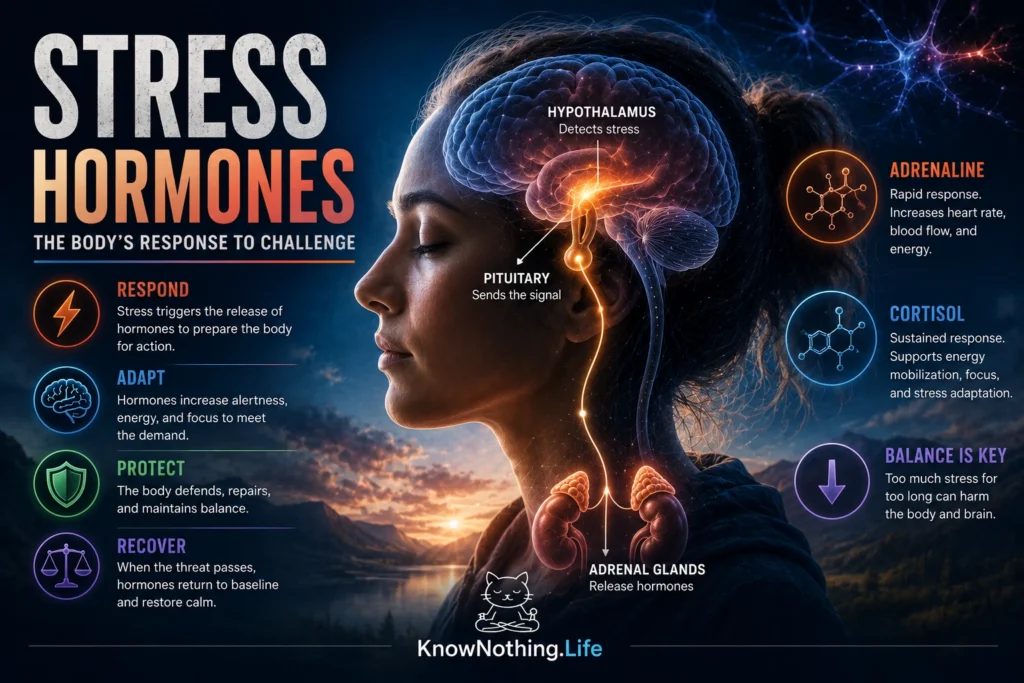
The fastest hormonal response to stress is associated with the sympathetic nervous system and adrenal medulla. When the brain detects a threat, sympathetic nerves increase activity throughout the body while the adrenal medulla releases adrenaline and noradrenaline into the bloodstream. These catecholamines increase heart rate, strengthen cardiac contraction, widen selected airways, redirect circulation toward active muscles, and make metabolic fuel more readily available. The resulting state is commonly described as the fight-or-flight response, although the same biology can support freezing, vigilance, rapid decision-making, and other defensive behaviors.
Adrenaline also promotes the release of glucose into the blood so that the brain and muscles have immediate access to energy. In a controlled human study, Robert Sherwin and colleagues found that epinephrine substantially increased glucose production and contributed to stress-related hyperglycemia. Noradrenaline has overlapping cardiovascular and metabolic effects, but it is especially important in sympathetic nerve signaling and the regulation of alertness. The catecholamine response begins within seconds, making it well suited to emergencies that demand action before the slower cortisol system has reached its full effect.
The HPA Axis and Cortisol
Cortisol is released through the hypothalamic-pituitary-adrenal axis, usually abbreviated HPA axis. Stress-related signals activate neurons in the hypothalamus, which release corticotropin-releasing hormone. CRH travels through specialized blood vessels to the anterior pituitary gland, where it stimulates the release of adrenocorticotropic hormone. ACTH then circulates to the adrenal cortex and promotes the production of cortisol. This multistage arrangement allows neural activity to produce a widespread hormonal response affecting the brain, cardiovascular system, immune system, liver, muscle, and adipose tissue.
A landmark advance came in 1981, when Wylie Vale, Joachim Spiess, Catherine Rivier, and Jean Rivier characterized the 41-amino-acid hypothalamic peptide that stimulates ACTH and beta-endorphin secretion. Their study, Characterization of a 41-Residue Ovine Hypothalamic Peptide That Stimulates Secretion of Corticotropin and β-Endorphin, identified the central releasing hormone of the HPA axis. Cortisol subsequently feeds back to the pituitary, hypothalamus, and other brain regions, reducing additional activation and helping the system return toward its baseline state.
Cortisol Is More Than a Stress Signal
Cortisol is often called the stress hormone, but it is present even when a person is not consciously distressed. It follows a strong daily rhythm, generally rising toward the beginning of the active period and declining toward night in people with conventional sleep schedules. Stress responses are therefore superimposed on an existing pattern rather than released into a hormone-free system. Cortisol also participates in normal blood-pressure regulation, energy metabolism, immune control, sleep-wake timing, and the maintenance of cardiovascular function.
During acute stress, cortisol helps preserve glucose for tissues with immediate demands, supports the actions of catecholamines, and limits inflammatory processes that could become excessive. These effects can be adaptive during injury, infection, or temporary danger. Cortisol should therefore not be treated as a toxin that must always be lowered. Both excessive and insufficient cortisol can be medically serious, as demonstrated by disorders such as Cushing syndrome and adrenal insufficiency. The biological goal is not the elimination of cortisol but an appropriately timed response followed by effective recovery.
Stress Hormones and the Brain
The brain contains receptors that allow cortisol to alter neural activity and gene expression. In 1968, Bruce McEwen, Joseph Weiss, and Lloyd Schwartz reported in Selective Retention of Corticosterone by Limbic Structures in Rat Brain that the rodent glucocorticoid corticosterone was selectively retained in the hippocampus. The discovery showed that adrenal hormones could act directly on a brain region involved in memory and emotional regulation, challenging the idea that stress hormones affected only peripheral organs.
Catecholamines and glucocorticoids can improve or impair cognition depending on timing, concentration, and context. A manageable acute response may strengthen attention toward important events and support memory consolidation. Excessive stress, however, can disrupt the prefrontal systems needed for working memory, flexible reasoning, and self-control. S Qin and colleagues found that experimentally induced psychological stress reduced working-memory-related activity in the dorsolateral prefrontal cortex of healthy participants. Stress can therefore shift brain function away from reflective control and toward faster, emotionally and habitually guided responses.
Emotional Memory and Noradrenaline
Stressful and emotionally arousing events are often remembered more strongly than ordinary experiences. Adrenaline released into the bloodstream does not freely enter every brain region, but bodily arousal activates neural pathways that influence noradrenergic signaling in the brain. Noradrenaline interacts with the amygdala and other memory systems, helping prioritize information associated with danger, reward, or emotional importance.
Larry Cahill and colleagues demonstrated this relationship in their 1994 study Beta-Adrenergic Activation and Memory for Emotional Events. Participants who received the beta-adrenergic blocker propranolol showed impaired delayed memory for an emotionally arousing story, while memory for a neutral story was not significantly affected in the same way. The finding supported the view that adrenergic activation contributes specifically to the enhanced retention of emotional experiences. Strong emotional memory can be adaptive when it helps a person avoid danger, but similar mechanisms may also contribute to intrusive or unusually persistent memories after traumatic events.
Acute Stress Versus Repeated Stress
An acute stress response is usually brief and directed toward a specific demand. Heart rate rises, fuel is mobilized, attention narrows, and hormonal activity then declines when the situation ends. Christopher Kirschbaum, Karl-Martin Pirke, and Dirk Hellhammer developed the Trier Social Stress Test in 1993 to study this response under standardized laboratory conditions. The procedure combines public speaking, social evaluation, and mental arithmetic, reliably producing measurable changes in cortisol and other stress indicators in many participants.
Repeated or prolonged stress is different because the systems designed for temporary use remain active or are repeatedly reactivated. The body may adapt by changing receptor sensitivity, daily hormone rhythms, autonomic activity, immune signaling, and behavior. Chronic stress does not always produce continuously high cortisol; some people develop flattened rhythms or reduced responses after repeated exposure. The problem is therefore broader than one elevated measurement. It involves dysregulation—the loss of an appropriately timed rise and recovery—rather than simply the presence of a hormone associated with stress.
Long-Term Effects on Memory and Brain Structure
Long-term exposure to elevated glucocorticoids has received particular attention because the hippocampus helps regulate memory and participates in feedback control of the HPA axis. In 1998, Sonia Lupien and colleagues followed older adults whose cortisol levels had been measured over several years. Participants with prolonged cortisol elevations showed smaller hippocampal volumes and poorer performance on hippocampus-dependent memory tasks than participants with more moderate cortisol patterns. The observational design could not prove that cortisol alone caused the structural differences, but it demonstrated a significant relationship between long-term hormonal exposure, brain anatomy, and memory.
The effects of stress hormones are not uniform across the brain. The hippocampus and prefrontal cortex may become less effective under persistent stress, while circuits involved in threat detection can become increasingly responsive. Individual outcomes depend on genetics, age, sleep, early experience, social support, health, and the degree of control a person has over the stressor. The same external event can therefore produce very different endocrine and cognitive responses in different people.
Metabolism, Immunity, and the Costs of Repetition
Stress hormones coordinate energy use by increasing glucose availability and modifying the handling of fats and proteins. In a short emergency, this redistribution is useful because it provides fuel for immediate action. When the pattern becomes chronic, repeated glucose mobilization and altered insulin signaling may contribute to metabolic strain, particularly when combined with inactivity, poor sleep, or an energy-dense diet. The effect is not produced by cortisol in isolation but by the interaction of hormonal activity with behavior and existing health conditions.
The immune effects are similarly complex. Acute stress can temporarily redistribute immune cells toward tissues where injury is more likely, while glucocorticoids prevent inflammatory activity from becoming uncontrolled. A study by Firdaus Dhabhar and colleagues found that endogenous stress hormones could enhance aspects of skin immunity by altering leukocyte trafficking and cytokine activity during short-term stress. Prolonged dysregulation, however, can weaken some protective responses while allowing other forms of inflammation to persist. Stress hormones do not simply switch immunity off; they reorganize it according to the body’s perceived priorities.
Why Stress Hormones Matter
Stress hormones demonstrate that psychological experience is inseparable from bodily regulation. A threatening thought can activate neural circuits that influence the heart, liver, immune system, and adrenal glands. Hormonal signals then return to the brain and modify attention, memory, motivation, and future threat perception. The stress response is therefore a feedback system connecting interpretation, physiology, and behavior.
The central lesson is not that stress hormones are enemies. Adrenaline, noradrenaline, CRH, ACTH, and cortisol make rapid adaptation possible. They become costly when temporary emergency responses are repeatedly recruited for problems that do not resolve, or when recovery systems cannot restore balance. Healthy regulation requires both activation and termination: the ability to respond strongly when necessary and to return toward ordinary functioning when the challenge has passed.