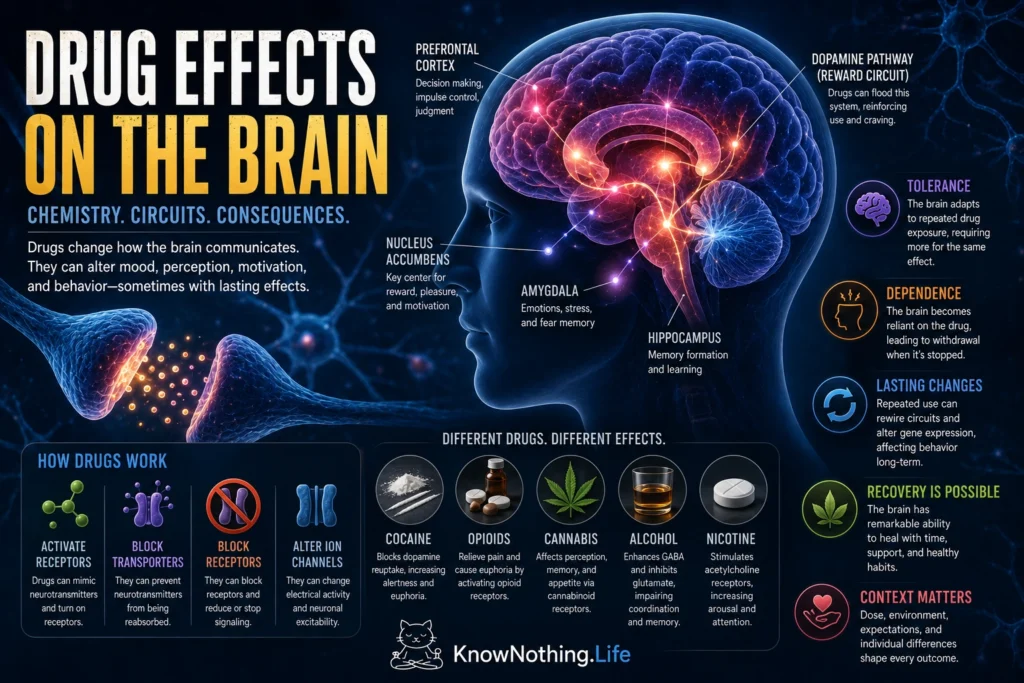
Psychoactive drugs change experience and behavior by altering communication within the nervous system. Some drugs imitate neurotransmitters and activate their receptors, while others block receptors, prevent neurotransmitter removal, change ion-channel activity, or alter the release of chemical signals. The resulting effects depend on which brain regions contain the targeted receptors. A drug acting on dopamine signaling may influence movement, motivation, and reinforcement, while one affecting GABA or glutamate may alter anxiety, memory, coordination, or consciousness. The same molecular action can therefore produce several psychological and physical effects.
Drug effects are also determined by dose, route of administration, speed of entry into the brain, metabolism, and previous exposure. A rapidly delivered drug can produce a more intense subjective effect than the same compound entering the brain gradually, even when overall receptor occupancy is similar. Nora Volkow and colleagues found that smoked cocaine produced stronger reports of a “high” than intranasal cocaine at comparable plasma concentrations and dopamine-transporter blockade. This finding illustrates why speed of delivery contributes to a drug’s reinforcing potential.
Receptors, Transporters, and Neurotransmitters
The modern understanding of drug action developed from the discovery that drugs bind to specific molecular targets. In 1973, Candace Pert and Solomon Snyder demonstrated selective opiate-receptor binding in nervous tissue. The finding showed that opioid effects were mediated through identifiable receptors rather than through a nonspecific chemical disturbance of the brain. Similar binding methods later identified targets for benzodiazepines, antipsychotics, stimulants, and other drug classes, allowing researchers to connect molecular affinity with behavioral and therapeutic effects.
Stimulants provide a clear example of transporter-based action. Cocaine binds to monoamine transporters and prevents the normal removal of neurotransmitters from synapses. Mark Ritz and colleagues reported in 1987 that the ability of cocaine-like drugs to inhibit dopamine uptake was closely related to their reinforcing potency in animal experiments. By slowing dopamine clearance, cocaine prolongs signaling in circuits involved in motivation and learning. Amphetamine and methamphetamine also affect monoamine systems, but they can additionally promote transmitter release and reverse the ordinary direction of transporter activity.
Reward, Reinforcement, and Motivation
Many drugs with high misuse potential influence dopamine signaling within pathways connecting the midbrain, nucleus accumbens, and related regions. In their 1988 study Drugs Abused by Humans Preferentially Increase Synaptic Dopamine Concentrations in the Mesolimbic System of Freely Moving Rats, Gaetano Di Chiara and Assunta Imperato found that several commonly misused drugs increased extracellular dopamine in the nucleus accumbens. Drugs without comparable misuse potential did not produce the same pattern in their experiment.
Dopamine should not be understood simply as a pleasure chemical. It helps reinforce actions, assign motivational importance to cues, and influence whether an organism repeats a behavior. With repeated drug use, environmental signals associated with taking the drug may acquire the ability to trigger craving. Volkow and colleagues found that cocaine-related cues increased dopamine in the dorsal striatum of people with cocaine dependence, and the size of the dopamine change was associated with reported craving. The learned context surrounding drug use can therefore become part of the brain’s response.
Different Drugs Produce Different Neural Effects
Nicotine activates nicotinic acetylcholine receptors located throughout the brain and peripheral nervous system. These receptors influence attention, arousal, autonomic function, and neurotransmitter release. Marina Picciotto and colleagues studied mice lacking the beta-2 receptor subunit and found that these animals did not show ordinary nicotine reinforcement or nicotine-related activation of the mesolimbic dopamine system. The experiment provided strong evidence that beta-2-containing nicotinic receptors are important for nicotine’s reinforcing effects.
Alcohol has broad actions rather than one exclusive receptor target. It influences inhibitory signaling, membrane proteins, ion channels, and excitatory glutamate transmission. David Lovinger, George White, and Forrest Weight found that ethanol inhibited NMDA-receptor-activated currents in hippocampal neurons, with the strength of inhibition related to the intoxicating potency of different alcohols. Suppression of NMDA signaling can contribute to impaired learning, slowed information processing, and memory disruption during intoxication.
Cannabis, Perception, and Memory
The principal intoxicating component of cannabis, delta-9-tetrahydrocannabinol, activates cannabinoid CB1 receptors that normally respond to endocannabinoid signals produced within the body. These receptors are widely distributed in regions involved in memory, reward, movement, sensory processing, and appetite. Because endocannabinoids help regulate neurotransmitter release, THC can change the balance of communication across several neural systems rather than affecting only one pathway.
Deepak D’Souza and colleagues examined intravenous THC in a randomized, double-blind experiment involving healthy adults. THC altered perception, increased anxiety and euphoria, and disrupted working memory, verbal fluency, distractibility, and immediate and delayed recall. The effects were temporary under the study conditions, but they demonstrated that a single active cannabis compound can influence several cognitive and emotional processes at once. Responses vary with dose, previous exposure, cannabinoid composition, individual vulnerability, and the setting in which the drug is used.
Opioids, Pain, and Respiratory Control
Opioid drugs activate receptors that normally respond to endogenous peptides involved in pain regulation, stress, reward, and bodily control. Mu-opioid receptor activation can greatly reduce pain, which makes opioid medications valuable in medical care. The same receptors also influence brainstem networks controlling breathing, however, so excessive activation can slow respiration. Opioids may additionally produce sedation, nausea, constipation, euphoria, and reinforcement because opioid receptors are distributed across several functionally different systems.
Repeated opioid exposure can reduce responsiveness to some drug effects. Laura Bohn and colleagues studied mice lacking beta-arrestin-2, a protein involved in receptor regulation. These mice did not develop ordinary antinociceptive tolerance to repeated morphine, even though signs of physical dependence were not eliminated. The results demonstrated that tolerance and dependence can involve partly distinct biological mechanisms. A person may consequently become tolerant to one effect of a drug more quickly than another, creating dangerous mismatches between the desired and harmful effects.
Tolerance, Dependence, and Withdrawal
Tolerance develops when repeated exposure produces adaptations that reduce a drug’s effect at the same dose. Receptors may become less responsive, intracellular signaling may change, or neural networks may compensate for the drug’s repeated presence. Tolerance does not necessarily develop equally across all effects. Increasing a dose to recover euphoria, sedation, or pain relief may therefore expose a person to serious effects for which tolerance is weaker. The specific process depends on the drug, receptor, dose, exposure pattern, and individual biology.
Physical dependence means that the nervous system has adapted to functioning in the presence of a substance. Abrupt removal can reveal the compensatory changes, producing withdrawal symptoms that often oppose the drug’s acute effects. Dependence is not identical to addiction. A person taking a medication as prescribed can become physically dependent without developing compulsive drug-seeking behavior, while addiction involves impaired control, persistent use despite harm, and powerful learned motivation. Tolerance, withdrawal, reinforcement, and social context can interact, but they represent different parts of the process.
Lasting Adaptation and Recovery
Repeated exposure can reshape neural systems involved in reward, habits, stress, attention, and self-control. These changes do not mean that the brain is permanently destroyed or that recovery is impossible. They indicate that drug use is a learned biological process: repeated actions strengthen particular associations, and environmental cues gain influence over motivation. Recovery similarly requires new learning, reduced exposure, changes in routine, and the gradual weakening or management of established cue-response patterns.
Some measurable brain changes improve during abstinence. Volkow and colleagues found reduced dopamine-transporter availability in people who had used methamphetamine, with lower transporter levels associated with motor and cognitive impairment. A later study found that transporter availability increased after prolonged abstinence, although improvement in the measured transporter signal did not necessarily mean that every aspect of dopamine function had fully recovered. Brain recovery can occur unevenly across molecules, circuits, cognition, and behavior.
Therapeutic Effects and the Importance of Context
The ability of drugs to alter the brain is not inherently harmful. Medications use the same pharmacological principles to restore function, reduce symptoms, or change abnormal signaling. George Cotzias and colleagues showed that levodopa could substantially improve Parkinsonian symptoms by supplying a precursor used to produce dopamine. Antipsychotic PET studies later connected clinical drug doses with dopamine D2-receptor occupancy, while Robert Berman and colleagues demonstrated that the NMDA-receptor antagonist ketamine could produce rapid antidepressant effects under controlled conditions.
The distinction between a medicine and a harmful drug effect cannot be reduced to whether a substance changes brain chemistry, because every effective neuroactive medication does so. What matters includes the target, dose, formulation, purpose, supervision, frequency, individual vulnerability, and balance between benefit and risk. Drugs can relieve pain, restore movement, suppress seizures, reduce psychosis, or improve mood, yet the same or related mechanisms may produce impairment, dependence, or toxicity when exposure is poorly controlled.
Why Drug Effects on the Brain Matter
Drug effects reveal both the power and adaptability of the nervous system. A small molecule can change receptor activity within seconds, alter perception and behavior within minutes, and produce compensatory adaptations after repeated exposure. These changes occur within systems already shaped by genes, development, stress, learning, health, and social experience. No drug acts on an empty brain, and no two people necessarily experience the same substance in exactly the same way.
Understanding drug action therefore requires more than labeling substances as stimulating, sedating, therapeutic, or addictive. Drugs interact with specific receptors and transporters, but their consequences emerge across complete neural networks and real environments. They can temporarily alter consciousness, reinforce repeated behavior, produce tolerance and dependence, or support meaningful medical recovery. The brain’s response reflects both pharmacology and plasticity: chemical exposure changes neural function, and the nervous system adapts to what repeatedly occurs.