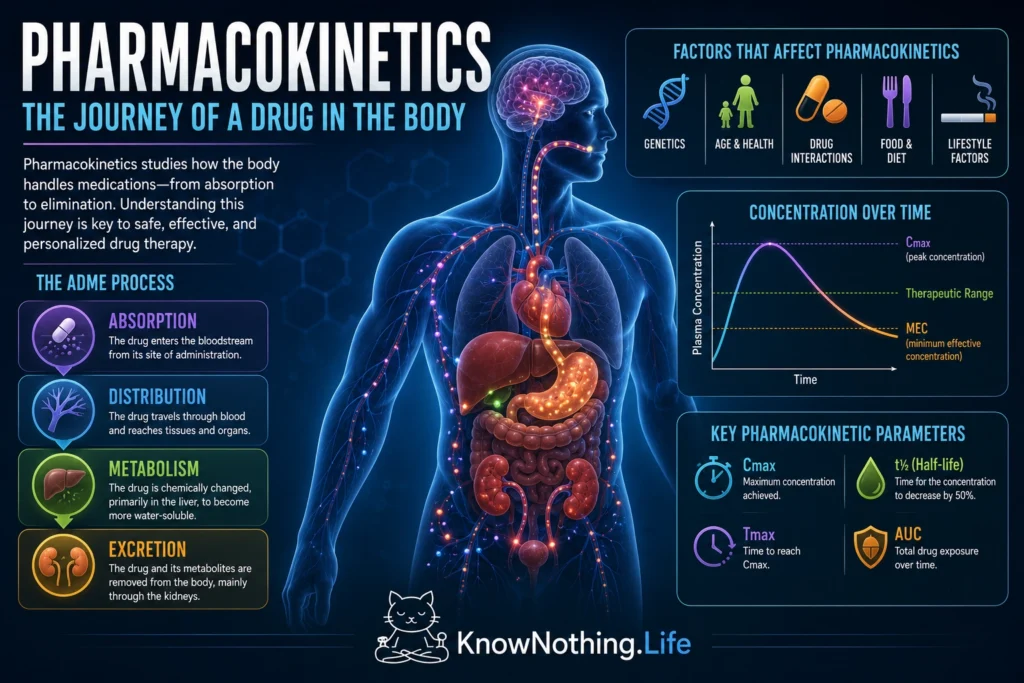
Pharmacokinetics is the study of how the body handles a drug after it has been administered. It follows the movement of a substance through absorption, distribution, metabolism, and excretion, often summarized as ADME. Pharmacokinetic research measures how quickly drug concentrations rise, how widely a compound spreads through tissues, how long it remains active in the body, and how efficiently it is removed. These processes help determine the dose, dosing interval, route of administration, and time required for a medication to reach a useful concentration.
The mathematical foundations of the field were established by Swedish physiologist Torsten Teorell. In his 1937 papers Kinetics of Distribution of Substances Administered to the Body, Teorell described drug movement using compartments, physiological volumes, transport rates, and differential equations. His models treated the body as an interconnected system in which drugs move between blood, tissues, sites of absorption, and routes of elimination. Modern pharmacokinetic models are far more detailed, but they retain this central idea: changes in drug concentration over time can be described and predicted mathematically.
Absorption and Bioavailability
Absorption is the process by which a drug moves from its site of administration into the bloodstream. The rate and completeness of absorption depend on the drug’s chemical properties, formulation, route, gastrointestinal conditions, blood flow, and interactions with food or other substances. Intravenous administration places the full dose directly into systemic circulation, while oral drugs must dissolve, cross the intestinal wall, and survive metabolism before reaching the rest of the body. The fraction of an administered dose reaching systemic circulation unchanged is called bioavailability.
Oral bioavailability can be reduced by first-pass elimination, in which a drug is metabolized in the intestinal wall or liver before entering systemic circulation. Propranolol is extensively absorbed from the digestive tract but has limited and variable oral bioavailability because much of the absorbed drug is removed during its first passage through the liver. Sumatriptan provides another clear example: its reported bioavailability is far higher after subcutaneous injection than after oral administration because the injected dose avoids much of the first-pass process.
Distribution Through the Body
Once a drug enters the bloodstream, it begins distributing into organs and tissues. Distribution depends on blood flow, membrane permeability, molecular size, lipid solubility, tissue binding, and the ability to cross specialized barriers. Highly perfused organs such as the brain, liver, kidneys, and heart may initially receive a drug more quickly than skin, fat, or resting muscle. Compounds that readily dissolve in lipids may enter fatty tissues or cross the blood-brain barrier more easily than strongly water-soluble substances.
Pharmacologists describe distribution using the apparent volume of distribution, which relates the amount of drug in the body to its measured concentration in plasma. This value is not necessarily a real anatomical volume; it indicates how strongly the drug remains in blood or moves into tissues. Plasma protein binding also matters because only the unbound fraction is immediately available to cross membranes, undergo filtration, or bind many pharmacological targets. Research on phenytoin has shown that its protein binding can change with concentration, complicating attempts to estimate the active free-drug level from the total plasma concentration.
Metabolism and Hepatic Clearance
Drug metabolism converts compounds into forms that are usually easier to eliminate. The liver is the principal site of metabolism for many medications, although enzymes in the intestine, kidneys, lungs, blood, and other tissues can also contribute. Metabolism may deactivate a drug, produce an active metabolite, transform an inactive prodrug into an active compound, or create a substance with different effects. Cytochrome P450 enzymes are especially important because they metabolize many structurally unrelated medications and are vulnerable to genetic differences, inhibition, and induction.
Gerhard Wilkinson and David Shand presented an influential physiological model of hepatic drug clearance in 1975. Their work emphasized that liver clearance depends on hepatic blood flow, the drug’s unbound fraction in blood, and the liver’s intrinsic metabolic capacity. A high-extraction drug may be removed so efficiently that its clearance is strongly influenced by blood flow to the liver, while the clearance of a low-extraction drug may depend more heavily on enzyme activity and protein binding. This framework helped explain why liver disease, reduced circulation, or interacting drugs can affect different medications in different ways.
Excretion and Renal Function
Excretion permanently removes drugs and metabolites from the body. The kidneys are the most important excretory organs for many medications, using glomerular filtration, active tubular secretion, and tubular reabsorption. Unbound drug molecules may be filtered from the blood, while transporter proteins can move selected compounds into or out of the forming urine. Urine flow and acidity can further influence the reabsorption of certain substances. Other routes of elimination include bile, feces, breath, sweat, saliva, and breast milk.
Kidney function is therefore a major consideration when selecting doses. In 1976, Donald Cockcroft and Matthew Gault published Prediction of Creatinine Clearance from Serum Creatinine, introducing an equation that estimated creatinine clearance using age, weight, sex, and serum creatinine. Although newer approaches are also used to evaluate kidney function, the Cockcroft–Gault estimate remains historically and clinically important because many drug-dosing recommendations were developed around estimated creatinine clearance. Reduced renal clearance can cause repeated doses to accumulate, increasing the risk of concentration-related toxicity.
Clearance, Half-Life, and Steady State
Clearance describes the body’s overall efficiency in removing a drug from plasma. It combines elimination by the liver, kidneys, and other routes into a single pharmacokinetic concept. Half-life describes how long it takes for the measured drug concentration to decrease by half during a defined elimination phase. Half-life depends on both clearance and distribution: a widely distributed drug may remain in the body for a long time even when elimination organs are functioning normally, while a drug restricted mainly to plasma may decline more quickly.
With repeated dosing, drug concentrations generally accumulate until the amount entering the body during each interval is balanced by the amount eliminated. This condition is called steady state. The time course can be studied by comparing single-dose and repeated-dose concentration profiles. In a study of a sustained-release theophylline formulation, Josep Torrent and colleagues found that steady-state levels could be predicted from single-dose kinetic data and were reached between the fourth and sixth administered doses under the study schedule. The formulation also reduced concentration fluctuations across the dosing interval.
Linear and Nonlinear Pharmacokinetics
Many drugs display approximately linear pharmacokinetics across their ordinary dosing range. Under linear conditions, increasing the dose by a certain proportion produces a similar proportional increase in exposure, commonly measured by the area under the concentration-time curve. Clearance and half-life remain reasonably stable, making future concentrations easier to predict. Linear behavior is not guaranteed, however. Absorption pathways, protein-binding sites, transporters, enzymes, and excretory processes all have finite capacities.
Phenytoin is a classic example of clinically important nonlinear pharmacokinetics. Its metabolism can approach saturation within the therapeutic range, meaning that a relatively small dose increase may produce a disproportionately large rise in serum concentration. Studies in adults and children have shown that nonlinear models describe the relationship between phenytoin dose and concentration more accurately than simple proportional assumptions. Because excessive concentrations can cause neurological toxicity, phenytoin dosing may require gradual adjustment and measurement of serum levels rather than large dose changes based solely on body weight.
Food, Drug Interactions, and Enzyme Activity
Pharmacokinetic interactions occur when one substance changes the absorption, metabolism, transport, protein binding, or elimination of another. An enzyme inhibitor may reduce drug metabolism and raise circulating concentrations, while an enzyme inducer may increase metabolic capacity and lower exposure. Drugs may also compete for transporters or protein-binding sites. The clinical importance of an interaction depends on the affected medication’s therapeutic range, the strength and duration of the interaction, and the patient’s existing ability to eliminate the drug.
The grapefruit juice interaction became one of the best-known examples of altered presystemic metabolism. David Bailey and colleagues found that grapefruit juice increased exposure to the calcium-channel blocker felodipine by reducing intestinal metabolism. Later work showed that an ordinary dietary quantity could produce a pronounced and variable interaction in older adults. The discovery demonstrated that food can change pharmacokinetics without changing the prescribed dose, and that interactions occurring before a drug reaches systemic circulation can significantly alter bioavailability.
Why Pharmacokinetics Varies Between People
Two people receiving the same dose may experience different concentrations because pharmacokinetics varies with age, body composition, pregnancy, genetics, organ function, disease, diet, smoking, and other medications. Infants may lack fully developed metabolic and renal pathways, while older adults may have reduced clearance or altered distribution. Changes in fat, muscle, plasma proteins, liver blood flow, or kidney function can modify how a drug moves through the body even when the dose remains unchanged.
Genetic variation can also influence metabolism and dose requirements. The International Warfarin Pharmacogenetics Consortium examined clinical and genetic data from a large, diverse population and developed a dosing algorithm incorporating variants in CYP2C9 and VKORC1 along with clinical characteristics. The pharmacogenetic model was particularly helpful for identifying patients requiring unusually low or high warfarin doses. This work demonstrated how pharmacokinetics and pharmacodynamics can be combined with genetic information to move treatment away from an assumed average patient and toward more individualized dosing.
Why Pharmacokinetics Matters
Pharmacokinetics transforms drug dosing from guesswork into a measurable science. Concentration-time data can reveal whether a drug is absorbed, whether it reaches the intended tissues, how long it remains in the body, and which organs control its elimination. These measurements guide formulation design, dosing intervals, therapeutic drug monitoring, interaction studies, and dose adjustments for patients with impaired liver or kidney function.
The field also shows why the administered dose is only the beginning of a medication’s biological story. A swallowed tablet may be incompletely absorbed, extensively metabolized, tightly bound to proteins, widely distributed, or slowly excreted. Enzyme saturation or an interaction may cause exposure to rise unexpectedly, while genetic or physiological differences can make a standard dose unsuitable. Pharmacokinetics provides the framework for anticipating these changes and designing treatment around the concentrations the body actually experiences rather than the amount printed on the prescription label.