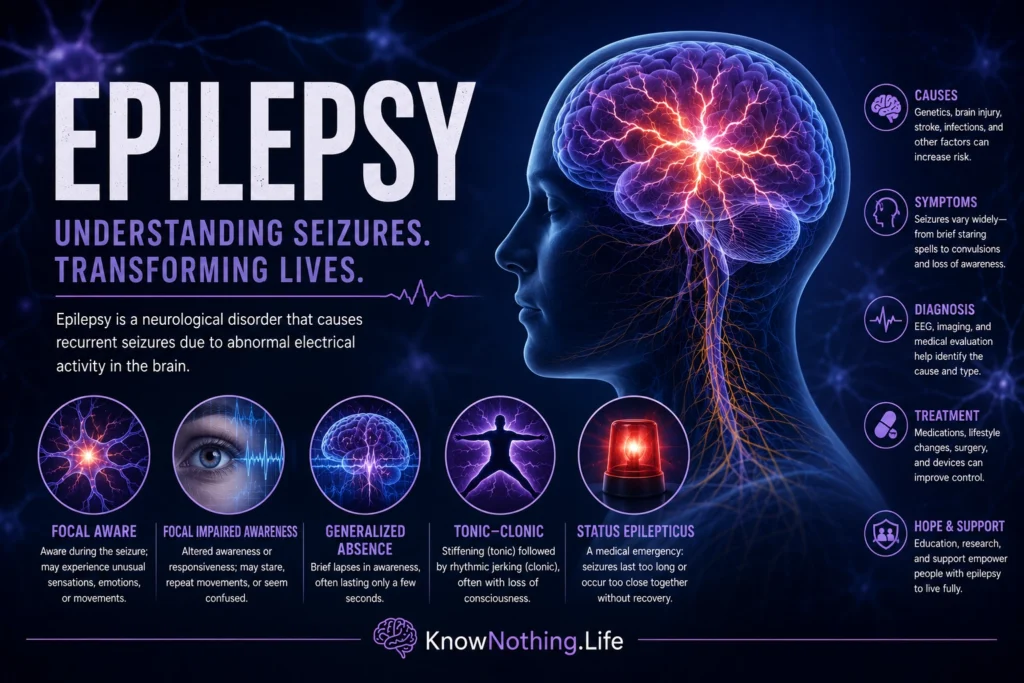
Epilepsy is a neurological disease characterized by an enduring tendency to experience epileptic seizures. A seizure is a temporary episode caused by abnormal, excessive, or unusually synchronized activity within networks of brain cells. Depending on the network involved, a seizure may produce convulsions, staring, confusion, unusual sensations, emotional changes, repetitive movements, muscle stiffening, or a brief interruption of awareness. Epilepsy is not a single disorder and should not be equated with every seizure. Fever, severe metabolic disturbances, alcohol withdrawal, infection, and acute brain injury can provoke seizures without necessarily producing a continuing predisposition to future episodes.
The International League Against Epilepsy’s 2014 practical definition allows epilepsy to be diagnosed after two unprovoked seizures occurring more than 24 hours apart, after one unprovoked seizure when the predicted recurrence risk is sufficiently high, or when a recognized epilepsy syndrome is present. This definition reflects an important distinction between a seizure as an event and epilepsy as an ongoing brain condition. Around 50 million people worldwide live with epilepsy, and nearly four-fifths of them reside in low- and middle-income countries, where access to diagnosis, medication, and specialist care may remain limited.
How Epileptic Seizures Develop
Neurons normally communicate through carefully regulated electrical and chemical signals. Epileptic seizures occur when the balance between excitation and inhibition is disrupted within a susceptible network. Abnormal activity may remain limited to a particular region or spread through connected pathways into both sides of the brain. Changes in ion channels, neurotransmitter receptors, synaptic organization, inflammation, scar tissue, and network development can all increase the likelihood that groups of neurons will begin firing abnormally. The process through which a previously normal brain develops a continuing tendency toward seizures is often called epileptogenesis.
The 2025 seizure classification from the International League Against Epilepsy organizes seizures into four principal classes: focal, generalized, unknown as to whether focal or generalized, and unclassified. Focal seizures arise within networks limited to one cerebral hemisphere, while generalized seizures rapidly engage networks distributed across both hemispheres. The classification also considers whether consciousness is preserved or impaired and describes observable manifestations in their chronological order. These distinctions are clinically important because seizure type influences the investigation, selection of medication, identification of an epilepsy syndrome, and consideration of surgery.
Causes, Genetics, and Epilepsy Syndromes
Epilepsy can arise from structural, genetic, infectious, metabolic, immune, or currently unknown causes. Structural causes include stroke, traumatic brain injury, tumors, developmental abnormalities, hippocampal sclerosis, and damage associated with complications around birth. Infections such as neurocysticercosis, meningitis, and encephalitis are significant causes in some regions. Immune-mediated epilepsy may develop when antibodies or inflammatory processes interfere with neuronal signaling. More than one mechanism can be present in the same patient, and identifying a probable cause may change treatment, prognosis, and counseling.
Genetics has transformed the understanding of epilepsy, particularly severe conditions beginning during infancy or childhood. The Epi4K Consortium’s 2013 study “De Novo Mutations in Epileptic Encephalopathies” identified an excess of newly arising mutations in genes involved in synaptic signaling and neuronal function. Such discoveries showed that epilepsy may result from disruption across many biological pathways rather than from a single “seizure gene.” Genetic findings now help define syndromes involving genes such as SCN1A, KCNQ2, STXBP1, and CDKL5. A genetic diagnosis may clarify recurrence risks, reduce unnecessary testing, identify associated developmental or medical concerns, and sometimes influence the choice of therapy.
Symptoms and Clinical Diagnosis
Seizures do not always resemble dramatic convulsions. A focal seizure may begin with an unusual smell, a rising abdominal sensation, fear, visual distortion, numbness, or involuntary movement of one limb. Impaired consciousness may lead to staring, reduced responsiveness, lip smacking, picking movements, or confused wandering. Generalized absence seizures can cause brief interruptions of awareness, while myoclonic seizures produce sudden shock-like jerks. Tonic seizures cause stiffening, atonic seizures involve sudden loss of muscle tone, and tonic-clonic seizures combine stiffening with rhythmic jerking followed by a period of fatigue, headache, confusion, or sleep.
Diagnosis begins with a detailed description of what occurred before, during, and after the suspected seizure. Witness accounts and smartphone recordings can be valuable because patients may not remember the event. Electroencephalography records electrical activity and may reveal epileptiform patterns, although a normal routine EEG does not exclude epilepsy. Magnetic resonance imaging can identify tumors, scars, vascular abnormalities, cortical malformations, and other structural causes. Blood tests, genetic analysis, prolonged video-EEG monitoring, functional imaging, and neuropsychological assessment may be required in complex cases. Conditions including fainting, migraine, sleep disorders, panic attacks, movement disorders, and functional nonepileptic seizures can resemble epilepsy, making accurate diagnosis essential.
Antiseizure Medication and Drug Resistance
Antiseizure medicines reduce the likelihood that seizures will begin or spread, but they do not necessarily eliminate the underlying cause. Medication selection depends on seizure type, epilepsy syndrome, age, reproductive considerations, other medical conditions, possible interactions, and the treatment’s cognitive or behavioral effects. Some medicines are effective against several seizure types, whereas others may worsen particular generalized epilepsies. The World Health Organization estimates that up to 70 percent of people with epilepsy could become seizure-free when appropriately diagnosed and treated, yet major treatment gaps remain in regions where medications and trained clinicians are difficult to access.
Patrick Kwan and Martin Brodie’s influential 2000 study, “Early Identification of Refractory Epilepsy,” showed that response to early medication trials provides important information about long-term seizure control. The International League Against Epilepsy subsequently defined drug-resistant epilepsy as the failure of adequate trials of two appropriately chosen, tolerated, and correctly used medication schedules to achieve sustained seizure freedom. This definition is clinically significant because repeatedly trying similar medications may postpone evaluation for more effective options. Patients meeting the criteria should generally be considered for referral to a comprehensive epilepsy center, where specialists can confirm the diagnosis and evaluate surgery, dietary therapy, neurostimulation, and other approaches.
Surgery, Neurostimulation, and Emergency Treatment
Epilepsy surgery may provide the best opportunity for seizure freedom when seizures consistently arise from a brain region that can be removed without causing unacceptable neurological impairment. In the landmark 2001 randomized trial led by Samuel Wiebe, surgery was substantially more effective than continued medical treatment for appropriately selected patients with temporal-lobe epilepsy. Surgical evaluation may involve high-resolution imaging, prolonged video-EEG monitoring, neuropsychological testing, language and memory assessment, and sometimes electrodes placed inside or on the surface of the brain. Available procedures include removing or disconnecting seizure-generating tissue, laser ablation, and operations intended to prevent seizures from spreading.
When removal is not possible, vagus nerve stimulation, responsive neurostimulation, or deep-brain stimulation may reduce seizure frequency. Dietary treatments, particularly the ketogenic diet and related approaches, are also valuable for certain drug-resistant epilepsies. Prolonged seizures and repeated seizures without adequate recovery can become status epilepticus, a neurological emergency requiring rapid treatment. The Veterans Affairs Status Epilepticus Cooperative Study led by David Treiman compared several therapies and helped establish benzodiazepines as central early treatments for generalized convulsive status epilepticus. Emergency care must then address persistent seizure activity and its underlying cause.
Safety, Quality of Life, and SUDEP
The effects of epilepsy extend well beyond the seizures themselves. Unpredictable episodes can affect driving, education, employment, relationships, pregnancy planning, independence, and emotional health. Injuries may occur through falls, burns, drowning, or accidents during impaired consciousness. Treatment plans therefore include practical safety measures, medication adherence, regular sleep, management of individual triggers, and seizure first-aid education for relatives or coworkers. Anxiety and depression are also common and should be recognized as treatable parts of neurological care rather than dismissed as inevitable reactions to illness.
Sudden unexpected death in epilepsy, known as SUDEP, is an uncommon but serious risk in which a person with epilepsy dies unexpectedly without another clear cause. Research consistently identifies frequent generalized tonic-clonic seizures as the most important modifiable clinical risk factor. The exact mechanism may involve interacting changes in breathing, heart rhythm, arousal, and autonomic control after a seizure. Discussing SUDEP should support prevention rather than fear: improving control of tonic-clonic seizures, taking medication consistently, reporting nocturnal events, and reviewing persistent seizures with an epilepsy specialist are central risk-reduction strategies.
The Future of Epilepsy Research
Epilepsy research is moving from broad symptom control toward treatments matched to biological mechanisms. Genetic testing, advanced imaging, computational EEG analysis, wearable seizure-detection systems, and biomarkers may improve diagnosis and reveal why seemingly similar patients respond differently to treatment. Precision therapies under investigation include gene replacement, gene silencing, targeted modification of ion channels, immune treatments, and interventions designed to prevent epileptogenesis after brain injury. Closed-loop devices already demonstrate the principle of detecting abnormal activity and responding with electrical stimulation before a clinical seizure fully develops.
The central challenge is to combine these advances with accessible everyday care. Many preventable seizures and deaths occur not because effective treatments do not exist, but because diagnosis is delayed, medication is unavailable, stigma discourages treatment, or specialist services cannot be reached. Epilepsy is highly diverse, ranging from self-limited childhood syndromes to severe developmental disorders and adult-onset structural disease. Understanding that diversity allows treatment to move beyond suppressing seizures toward protecting cognition, development, independence, mental health, and the individual’s ability to participate fully in life.