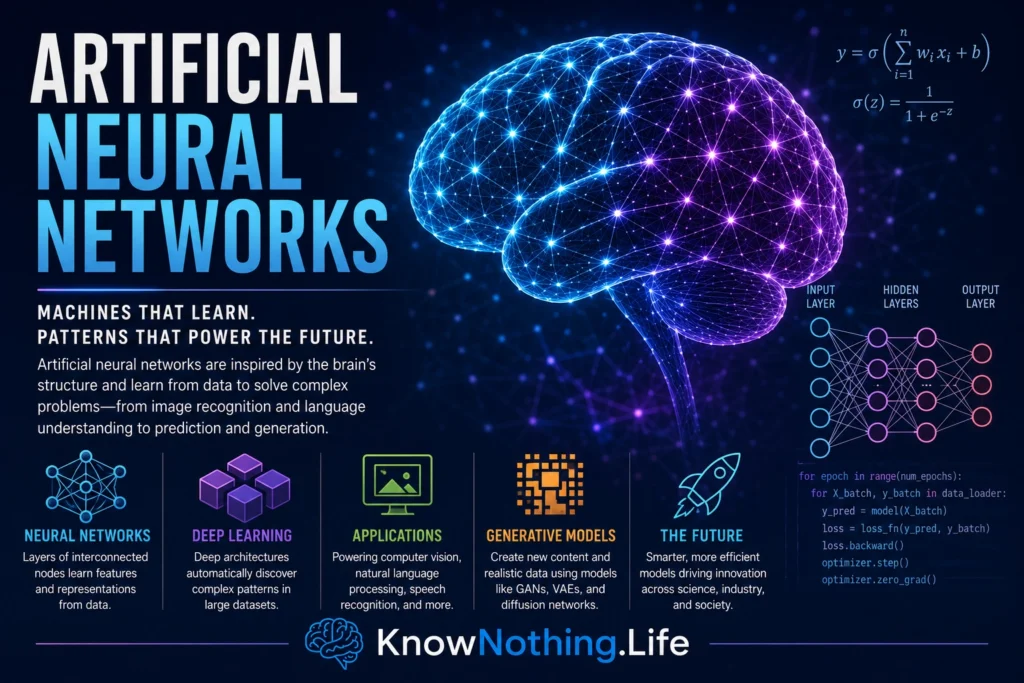
Artificial neural networks are computational systems designed to learn relationships from examples rather than depend entirely on rules written in advance. They consist of connected processing units arranged into layers. Each connection carries a numerical weight, while each unit combines incoming values, applies a mathematical transformation, and passes the result onward. During training, the network repeatedly adjusts its weights so that its predictions more closely match the correct or desired outputs.
This process allows artificial neural networks to identify objects in images, recognize speech, translate languages, analyze medical scans, forecast sequences, and generate text, audio, or visual media. The word “neural” reflects their historical inspiration from the nervous system, but artificial networks are not realistic digital replicas of biological brains. A software neuron usually performs a relatively simple calculation, whereas a biological neuron integrates electrical, chemical, structural, and metabolic processes across time.
From Mathematical Neurons to the Perceptron
An early foundation appeared in Warren McCulloch and Walter Pitts’s 1943 paper “A Logical Calculus of the Ideas Immanent in Nervous Activity.” They described simplified neuron-like units that received binary inputs and generated an output when a threshold was crossed. Networks of these units could implement logical operations, demonstrating that complex computation might emerge from many simple connected elements. The model omitted most biological detail, but it established a mathematical language for thinking about neural networks.
Frank Rosenblatt expanded this direction with the perceptron, presented in his 1958 paper “The Perceptron: A Probabilistic Model for Information Storage and Organization in the Brain.” A perceptron could adjust its connection weights from examples and learn to separate certain categories. It was an important demonstration that a machine could improve through experience, although a single-layer perceptron could only solve problems whose categories were linearly separable. More difficult problems required multiple processing layers and nonlinear transformations.
Layers, Representations, and Backpropagation
A feedforward neural network usually contains an input layer, one or more hidden layers, and an output layer. Information moves forward through the system as each layer transforms the representation produced by the layer before it. In image recognition, early layers may respond to edges or textures, while deeper layers combine those features into shapes, objects, and categories. Nonlinear activation functions are essential because stacking purely linear operations would still produce only a linear transformation, regardless of the number of layers.
Training commonly depends on backpropagation. In their influential 1986 paper “Learning Representations by Back-Propagating Errors,” David Rumelhart, Geoffrey Hinton, and Ronald Williams described a procedure for calculating how changes in each weight would affect a network’s total error. An optimization algorithm then adjusts the weights in the direction expected to reduce that error. Backpropagation provides a general system for assigning responsibility through many connected layers, making it possible for hidden units to develop useful internal representations.
Convolutional Networks and Visual Recognition
Convolutional neural networks, or CNNs, are designed to process information with spatial structure. Instead of connecting every unit to every image pixel, convolutional layers apply small filters across local regions. The same filter is reused in different locations, reducing the number of trainable parameters and allowing a feature to be detected wherever it appears. Deeper layers combine simple local patterns into progressively more complex representations.
Yann LeCun, Léon Bottou, Yoshua Bengio, and Patrick Haffner demonstrated the effectiveness of gradient-trained convolutional networks for handwritten document recognition in their 1998 paper “Gradient-Based Learning Applied to Document Recognition.” CNNs gained much wider influence after Alex Krizhevsky, Ilya Sutskever, and Geoffrey Hinton introduced AlexNet in 2012. Using deep convolutional layers, graphics processors, rectified activation functions, and regularization, AlexNet achieved a major improvement in large-scale ImageNet classification.
As researchers constructed deeper networks, optimization became increasingly difficult. Kaiming He and colleagues addressed this problem with residual networks, or ResNets, which use shortcut connections that allow information to bypass certain layers. Their 2015 work showed that residual learning made networks containing more than one hundred layers easier to train and produced major gains in image recognition. The architecture demonstrated that greater depth could be useful when information and gradients were given more direct paths through the network.
Recurrent Networks, Memory, and Attention
Feedforward networks process an input without necessarily maintaining an internal history of previous inputs. Recurrent neural networks introduce feedback connections so that information from earlier steps influences later calculations. This makes them suitable for speech, language, music, and time-series data. Standard recurrent networks can be difficult to train across long sequences because gradients may shrink or expand as they pass through many repeated operations.
Sepp Hochreiter and Jürgen Schmidhuber introduced long short-term memory, or LSTM, in 1997 to address this difficulty. LSTM networks contain gates that regulate which information is stored, changed, or released, allowing relationships to be preserved across longer intervals. LSTMs became widely used in speech recognition, translation, handwriting analysis, and sequence prediction.
In 2017, Ashish Vaswani and colleagues proposed the transformer architecture in “Attention Is All You Need.” Rather than relying primarily on recurrence, transformers use self-attention to calculate relationships among different parts of an input sequence directly. This structure allows many calculations to occur in parallel and makes it easier to model long-range dependencies. Transformers subsequently became central to large language models and were adapted for vision, audio, biology, and multimodal systems.
Generative Networks and Learned Distributions
Some neural networks are designed primarily to classify or predict, while generative networks learn patterns that allow them to create new examples. Autoencoders compress information into an internal representation and then attempt to reconstruct the original input. Other systems learn probability distributions or transformations that produce images, speech, text, molecular structures, and other complex outputs. These models can discover useful representations even when detailed human labels are unavailable.
Ian Goodfellow and colleagues introduced generative adversarial networks in 2014. A GAN trains two networks together: a generator creates artificial samples, while a discriminator tries to distinguish generated samples from real examples. The generator improves by learning to fool the discriminator, creating a competitive optimization process. GANs produced major advances in synthetic-image generation, although training can be unstable and may fail to represent the full diversity of the original data.
Generalization, Overfitting, and Reliability
A network may perform extremely well on its training examples while failing on unfamiliar data. This problem, known as overfitting, occurs when a model memorizes accidental details instead of learning relationships that generalize. Researchers address it through representative datasets, data augmentation, weight penalties, early stopping, architectural constraints, and validation on examples that were not used during training.
Nitish Srivastava and colleagues introduced dropout as a method for reducing overfitting. During training, randomly selected units and connections are temporarily removed, preventing the network from depending too heavily on particular combinations of features. At prediction time, the full network is used. Dropout can be interpreted as training many partially different networks that share parameters, encouraging more robust representations.
Strong benchmark performance does not guarantee dependable reasoning. Neural networks can exploit shortcuts in datasets, inherit historical biases, produce confident errors, or change their predictions after small alterations to an input. Their knowledge is distributed across many weights, making complete explanations difficult. Responsible evaluation must therefore consider robustness, uncertainty, subgroup performance, data quality, privacy, and behavior under conditions that differ from the training environment.
Artificial Networks and Biological Brains
Artificial neural networks can also serve as scientific models. Neuroscientists compare their internal representations with brain activity, use them to predict responses to natural images or sounds, and test theories about learning and sensory organization. Successful task performance does not prove that the artificial network uses the same mechanisms as the brain, but comparison can reveal which computational principles may be shared.
Important differences remain. Biological brains learn continually from relatively limited experience, integrate perception with action and bodily regulation, and operate with extraordinary energy efficiency. Standard artificial networks are usually trained on fixed datasets using backpropagation, which has no confirmed direct equivalent as a complete learning system in the brain. The relationship between biological and artificial intelligence is therefore one of selective inspiration rather than exact imitation.
The Future of Artificial Neural Networks
Future neural networks are likely to become more efficient, multimodal, adaptive, and specialized. Progress may involve models that require less data and energy, systems with stronger external memory, and architectures that combine learned pattern recognition with symbolic operations or structured reasoning. Researchers are also developing methods that make networks easier to inspect, update, verify, and align with human objectives.
The central challenge is not merely to create larger systems. It is to understand the conditions under which a network succeeds, the circumstances in which it fails, and the consequences of deploying it in medicine, education, science, government, and everyday life. Artificial neural networks are powerful because they can learn complex structure from data, but their outputs remain shaped by human choices about objectives, architecture, training information, evaluation, and use.