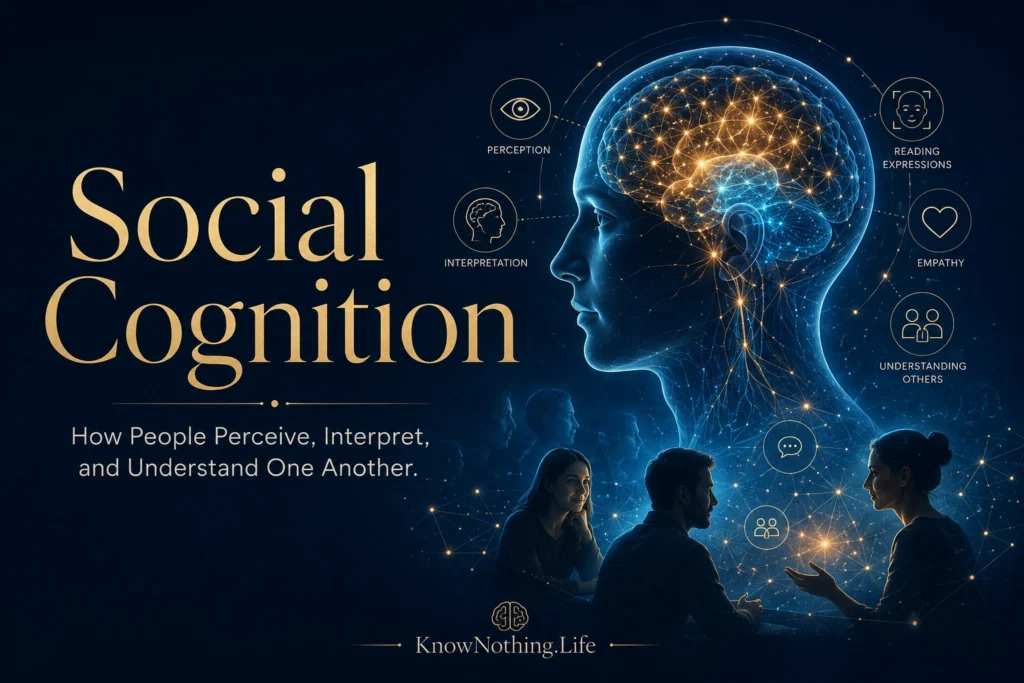
Social cognition refers to the mental processes people use to perceive, interpret, remember, and respond to information about themselves and others. It includes recognizing faces and emotions, forming impressions, explaining behavior, inferring intentions, evaluating trust, understanding social roles, and predicting how other people are likely to act. These abilities allow humans to navigate relationships and communities without analyzing every interaction from the beginning. Previous experiences, cultural knowledge, expectations, and emotional states provide frameworks that make the social world more understandable, although those same frameworks can also create errors and biases.
The field developed at the intersection of cognitive psychology and social psychology. Researchers began applying concepts such as attention, memory, categorization, schemas, and information processing to social behavior. Social cognitive neuroscience later connected these psychological processes to interacting brain systems. Kevin Ochsner and Matthew Lieberman described the emerging field as an effort to understand how people perceive themselves, understand others, regulate social responses, and interact within groups. Their work emphasized that social cognition does not depend on one specialized “social center,” but on coordinated neural systems that also support memory, emotion, perception, decision-making, and behavioral control.
Social Perception and the Search for Meaning
Human beings automatically search for social meaning, even when very little information is available. Fritz Heider and Marianne Simmel demonstrated this tendency in their influential 1944 study, An Experimental Study of Apparent Behavior. Participants watched simple geometric shapes move around a screen. Although the shapes had no faces, voices, or biological features, observers commonly described them as characters with emotions and intentions. A large triangle might be seen as aggressive, while smaller shapes appeared frightened, playful, or cooperative. Later research using similar animations has confirmed that people readily attribute motives and personalities to abstract movement when it resembles pursuit, conflict, protection, or coordinated action.
Social perception also operates rapidly when people encounter real faces and bodies. Alexander Todorov and colleagues found that observers form immediate judgments about traits such as trustworthiness, dominance, and competence from facial appearance. Brain-imaging studies showed that amygdala activity varied with perceived facial trustworthiness even when participants were not explicitly asked to evaluate the faces. These impressions can feel convincing, but they are not necessarily accurate indicators of character. Todorov and Nikolaas Oosterhof proposed that rapid face evaluation may overgeneralize features associated with emotional expressions, harmful intentions, or physical power. A face may therefore appear trustworthy or threatening because of its structure rather than because the observer has learned anything reliable about the person.
First Impressions and Thin Slices of Behavior
People can sometimes extract meaningful information from extremely brief observations. Nalini Ambady and Robert Rosenthal called these limited samples “thin slices” of expressive behavior. Their influential meta-analysis found that short exposures to nonverbal behavior could predict some interpersonal outcomes at levels better than chance. Later studies showed that observers may detect relationship familiarity, engagement, or aspects of professional effectiveness from short clips. Vocal tone, posture, facial movement, timing, and interpersonal coordination can provide information before the content of a conversation is fully understood.
However, rapid impressions should not be confused with complete social understanding. Accuracy varies substantially across observers, targets, traits, and situations. Studies by Daniel Ames and colleagues found that people had only a limited ability to determine which of their own first impressions were accurate. Confidence often reflected how clear or familiar an impression felt rather than how well it matched reality. Mood can also alter performance. Ambady and Heather Gray found that sadness reduced accuracy on several thin-slice judgment tasks, possibly because it interfered with the efficient integration of subtle nonverbal information. First impressions can contain useful signals, but their speed and confidence do not guarantee truth.
Attribution and Explaining Behavior
Social cognition involves more than observing what someone does. People also attempt to explain why the behavior occurred. Attribution theory examines how observers assign behavior to internal causes, such as personality, ability, or intention, and external causes, such as social pressure, opportunity, rules, or chance. When someone arrives late, an observer might decide that the person is irresponsible or consider that transportation problems caused the delay. These explanations affect emotion and behavior: an internal attribution may produce anger or distrust, while a situational explanation may produce patience.
Observers often place too much weight on personality and too little weight on circumstances, a pattern commonly called the fundamental attribution error or correspondence bias. Someone who acts nervously during a presentation may be judged insecure, even though public speaking would make many people anxious. Attribution research shows that mental states cannot be observed directly; they must be inferred from behavior and context. Because the actor is visually and psychologically prominent, personal explanations often come to mind before situational constraints are carefully considered. Yet attribution patterns also vary with goals, relationships, culture, and available information, making the so-called error a tendency rather than an unavoidable rule.
Schemas, Categories, and Stereotypes
The social world contains more information than the mind can process individually. People therefore use schemas—organized structures of knowledge that guide attention, interpretation, and memory. Schemas help an individual understand what usually happens in a classroom, workplace, friendship, or medical appointment. Person schemas contain beliefs about particular individuals, while group schemas organize expectations around social categories. These mental structures make social judgment faster, but they can also cause people to notice information that confirms expectations and overlook information that contradicts them.
Stereotypes are socially learned associations concerning members of a group. Patricia Devine’s landmark 1989 paper, Stereotypes and Prejudice: Their Automatic and Controlled Components, proposed that knowledge of cultural stereotypes can be distinguished from personal endorsement of those stereotypes. Her experiments suggested that culturally familiar associations may be activated automatically, particularly when attention and conscious monitoring are limited, while nonprejudiced responses can require controlled inhibition and the deliberate use of egalitarian beliefs. The work helped shift research away from treating prejudice solely as a consciously chosen attitude and toward examining how automatic knowledge and deliberate values can conflict.
Memory processes can also create stereotypes where no real relationship exists. Research on illusory correlation shows that distinctive events are especially memorable, causing observers to overestimate associations between minority groups and unusual negative behavior. McConnell, Sherman, and Hamilton found that distinctive group-and-behavior combinations could become highly accessible during judgment, encouraging perceived correlations unsupported by the actual evidence. Once formed, these impressions can influence what people remember, expect, and notice in later encounters. Social categories are therefore not merely neutral labels; they can reorganize memory and produce self-reinforcing interpretations.
Mentalizing and Understanding Other Minds
An essential part of social cognition is mentalizing, or inferring another person’s beliefs, intentions, desires, and knowledge. Mentalizing allows someone to understand that another individual can hold an incorrect belief, conceal an intention, misunderstand a statement, or interpret the same event differently. Chris and Uta Frith described this capacity as a collection of processes that includes interpreting actions, sharing emotional states, taking perspectives, and representing relationships between one’s own mind and the minds of others. Explicit mentalizing also allows people to reflect on their assumptions and revise an interpretation when new information becomes available.
Mentalizing overlaps with empathy but is not identical to it. A person may correctly understand another individual’s goals without sharing that person’s emotions, while emotional resonance can occur without an accurate understanding of the situation. Jean Decety and Philip Jackson proposed that empathy depends on interacting systems for shared emotional representation, self-awareness, perspective shifting, and emotion regulation. Successful social understanding requires people to respond to another person’s experience while preserving a distinction between the other person’s state and their own. Without this distinction, emotional resonance may become personal distress rather than useful understanding.
The Brain Networks of Social Cognition
Social cognition recruits a distributed collection of cortical and subcortical regions. The medial prefrontal cortex contributes to thinking about people, evaluating traits, reflecting on the self, and interpreting social meaning. The temporoparietal junction and posterior temporal regions participate in perspective taking, belief reasoning, gaze processing, and the interpretation of biological motion. The amygdala helps evaluate socially significant or uncertain information, while the anterior insula and anterior cingulate cortex contribute to emotional awareness, salience, conflict, and responses to other people’s distress.
These regions are not exclusively social. The medial prefrontal cortex also contributes to valuation and memory, the temporoparietal junction supports attention, and the amygdala responds to novelty and biological significance beyond social situations. David Amodio and Chris Frith proposed that the medial frontal cortex helps coordinate different forms of social information according to the demands of the situation. Lieberman similarly distinguished relatively automatic social processes from more deliberate forms of reflection and control. Social cognition emerges when general cognitive and emotional systems cooperate to solve problems involving people, relationships, and social meaning.
Social Cognition as a Flexible Human Capacity
Social cognition is shaped by development, language, relationships, culture, and experience. Children learn not only to recognize emotions and intentions but also to judge who is knowledgeable and trustworthy. Research on learning from testimony shows that children gradually become more sensitive to an informant’s accuracy, access to knowledge, group membership, and agreement with other people. Social understanding is therefore not simply an instinctive reading of behavior. It develops through repeated opportunities to compare claims, observe consequences, participate in conversation, and revise mistaken expectations.
Social cognition can be remarkably efficient, but it is never perfectly objective. People infer intentions from movement, personalities from brief behavior, and group characteristics from incomplete memories. These abilities make relationships and cooperation possible, yet they also create opportunities for misunderstanding, stereotyping, and misplaced confidence. More accurate social judgment requires curiosity about context, awareness of cognitive bias, and a willingness to revise first impressions. Social cognition is not the ability to read minds with certainty. It is the brain’s continuing attempt to build useful models of other people from limited, changing, and sometimes ambiguous evidence.