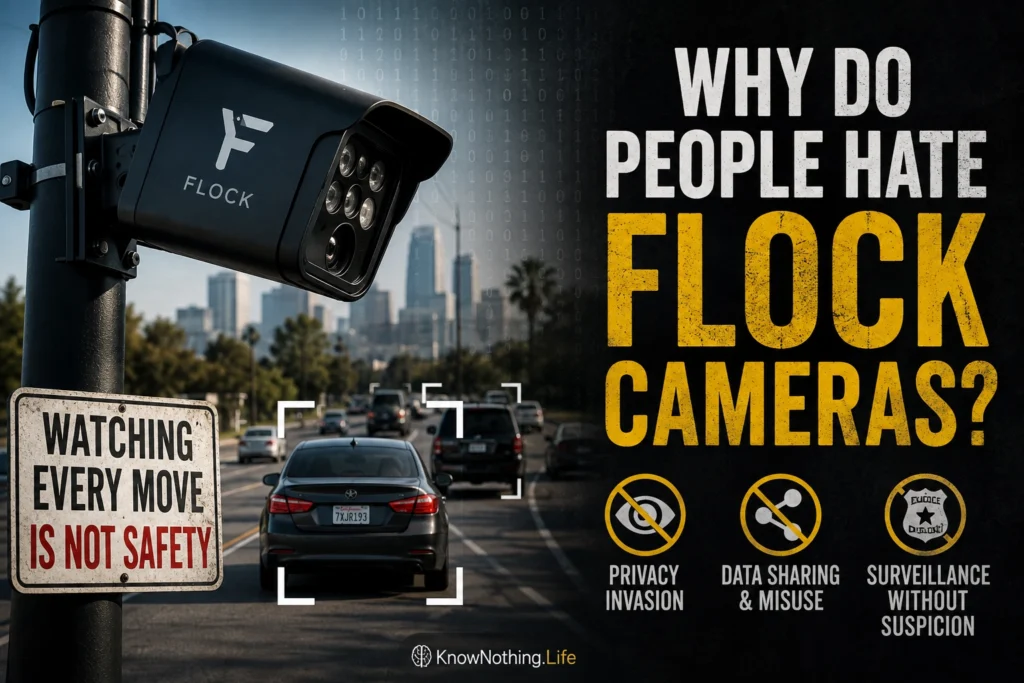
Flock cameras are automated license plate readers, commonly called ALPRs, that are installed beside roads, near intersections, at neighborhood entrances, and in commercial areas. As vehicles pass, the cameras photograph them and record information such as the license plate, time, location, make, model, color, and visible distinguishing features. Police can compare these observations with lists of stolen or wanted vehicles, receive automatic alerts, and search historical records during later investigations. Flock Safety states that its cameras do not use facial recognition and that license plate data is deleted after 30 days by default, although local laws and agency policies may require shorter or longer retention periods.
People who oppose Flock cameras rarely object only to the physical device. Their concern is the larger system behind it: searchable databases, interagency sharing, automated alerts, permanent audit records, and the ability to reconstruct someone’s travels without first suspecting that person of a crime. A single observation of a vehicle on a public street reveals little. Repeated observations across a connected camera network can suggest where someone lives, works, worships, receives medical treatment, attends meetings, visits friends, or spends the night. The controversy begins with the difference between briefly being visible in public and having those sightings collected, retained, connected, and searched by government agencies.
Surveillance Without Individual Suspicion
The most fundamental criticism is that Flock cameras record nearly every vehicle that passes, not merely those associated with a criminal investigation. Traditional surveillance is usually directed toward a suspect, location, organization, or offense. ALPR networks reverse that sequence: information is collected first, while a justification for searching it may arise days or weeks later. Civil-liberties organizations describe this as dragnet surveillance because the movements of innocent people must be placed in a database so the system can identify the much smaller number of vehicles connected to crimes. Critics believe this shifts policing away from investigating suspicious conduct and toward preserving ordinary activity as potential future evidence.
The psychological objection resembles the logic of Jeremy Bentham’s Panopticon and Michel Foucault’s analysis in Discipline and Punish. Surveillance can influence conduct even when nobody is actively examining a particular person because people know that their actions may be recorded and revisited. Research on monitored environments has found that perceived surveillance can encourage behavioral regulation and self-censorship, although the effect depends on the setting and the individual. Someone may hesitate to attend a political demonstration, addiction-recovery meeting, reproductive-health clinic, religious gathering, gun show, or other sensitive destination if the journey could later become part of a government search. Privacy, in this sense, protects association and autonomy rather than providing a place to conceal wrongdoing.
The Network Is More Powerful Than the Camera
A single roadside camera has limited reach, but connected cameras form a much more powerful surveillance architecture. The U.S. Government Accountability Office reported that selected Department of Homeland Security agencies had access to third-party ALPR sources providing a nationwide pool of license plate information. Flock maintains that local agencies control whether their data is shared, that users must provide an investigative purpose, and that searches are logged for review. Critics respond that residents may accept cameras for recovering stolen cars without realizing that locally gathered information could become accessible to agencies hundreds or thousands of miles away.
This network effect makes local assurances feel temporary. Administrators can expand access, elected officials can change, and cooperation between agencies can broaden beyond the purpose originally presented to the public. Researchers at the University of Washington found that at least eight Washington law-enforcement agencies enabled direct sharing with U.S. Border Patrol at some point during 2025. The Electronic Frontier Foundation also documented a Texas investigation in which Flock data was queried in connection with a woman who had obtained an abortion. Such incidents fuel fears that a system introduced for stolen vehicles and violent crime can migrate into immigration enforcement, healthcare investigations, political surveillance, and other contested areas.
Errors and Misuse Can Cause Real Harm
License plate recognition must operate through rain, darkness, glare, dirt, damaged plates, unusual fonts, oblique angles, and fast-moving traffic. Computer-vision researchers have found that license plate models performing well on familiar datasets may generalize poorly when exposed to different cameras, environments, or plate designs. Even a system with a high overall accuracy rate can produce a substantial number of false alerts when it scans millions of vehicles. Errors may also originate with people when officers enter the wrong plate, choose an incorrect state, rely on an outdated alert, or fail to confirm that the photographed vehicle actually matches the wanted one.
These are not merely technical inconveniences. CBS News verified more than a dozen wrongful police stops involving ALPR systems by July 2025, while the Electronic Frontier Foundation has documented innocent motorists and families being detained, handcuffed, or confronted by armed officers following plate-reading and data-entry mistakes. The technology can give uncertain information an appearance of mathematical objectivity, encouraging officers to treat an alert as proof rather than as an investigative lead. A single incorrect character can turn an ordinary drive into a high-risk traffic stop, which is why several states now require officers to independently verify ALPR alerts before taking enforcement action.
Insider misuse creates an additional source of anger. Investigations have alleged that officers used Flock databases to search for romantic partners, acquaintances, coworkers, or people involved in personal conflicts. Flock argues that every search is connected to a user and that permanent audit logs have helped agencies identify and discipline improper conduct. Those controls can make abuse easier to discover, but critics note that an audit generally reveals misuse only after someone’s location records have already been accessed. A database powerful enough to locate a criminal suspect may also be powerful enough to stalk an ex-partner, identify a journalist’s source, follow an activist, or intimidate someone seeking confidential services.
Mission Creep and Weak Public Consent
Flock cameras are usually promoted through emotionally compelling cases involving stolen vehicles, missing children, kidnappings, robberies, or violent offenders. Public resistance grows when the same infrastructure is used for increasingly minor purposes. An EFF analysis identified searches associated with school-residency verification, background checks, traffic matters, and noise complaints. These uses may involve legitimate local concerns, but they are far removed from the emergencies frequently emphasized when communities are asked to approve the cameras. This gradual expansion is known as mission creep: a technology adopted for a narrow purpose becomes normalized and then applied to a widening range of conduct.
Many residents also discover Flock cameras only after contracts have been approved or equipment has appeared beside local roads. Purchases may be treated as ordinary police expenditures rather than as major surveillance policies requiring extensive public debate. Residents may receive little information about camera locations, data-sharing partners, retention periods, error rates, acceptable search purposes, or disciplinary procedures. The involvement of a private company adds another layer of concern because the vendor designs the platform, hosts information, changes features, and influences how agencies understand the product. Opposition therefore reflects not only fear of police power but distrust of surveillance policy being shaped through private contracts with limited democratic scrutiny.
Are Flock Cameras Legal?
The constitutional status of large ALPR networks remains unsettled. Courts have often held that drivers have a reduced expectation of privacy in license plates exposed on public roads. Flock relies on this principle, arguing that its cameras create separate, point-in-time observations rather than continuous tracking. Privacy advocates counter that the Supreme Court has recognized constitutional concerns when government technologies aggregate large quantities of location information, even when individual observations might not be private in isolation. The dispute is therefore not simply whether a police officer may look at a plate, but whether thousands of automated observations can collectively become a search of someone’s movements.
A federal judge ruled in January 2026 that Norfolk, Virginia’s network of 176 Flock cameras did not violate the Fourth Amendment under its existing level of coverage. However, the ruling reportedly warned that a denser or more comprehensive network could eventually cross a constitutional boundary. Civil-liberties organizations appealed, arguing that widespread aggregation already permits the government to reconstruct revealing patterns of travel. The case illustrates why public opposition remains intense even where current deployments have survived legal challenges: a system may be lawful under existing precedent while still raising unresolved questions about how much automated monitoring society should accept.
Do Flock Cameras Reduce Crime?
Supporters have credible reasons for adopting the technology. ALPRs can identify stolen vehicles quickly, connect cars to crime scenes, generate investigative leads, and assist in locating missing or endangered people. Research reviewed by the National Policing Institute suggests that license plate readers can increase stolen-vehicle recoveries and auto-theft arrests and may improve clearance rates for some offenses. A 2025 evaluation of a major ALPR expansion found no overall decline in violent crime but reported associations with reductions in shootings, motor-vehicle theft, and property crime. The available evidence points toward usefulness for particular crimes rather than a universal crime-prevention effect.
That mixed record is central to the conflict. Communities are being asked to accept large-scale data collection in exchange for benefits that may be valuable but uneven. National Institute of Justice research found considerable public support for many police uses of license plate recognition, while also finding that the public often knows little about how the systems operate. Support depends heavily on the purpose of a search, confidence in law enforcement, transparency, and the presence of safeguards. Many opponents therefore advocate warrants, shorter retention periods, strict sharing limits, independent alert verification, public audits, and meaningful penalties rather than demanding that police abandon every form of license plate technology.
Why the Backlash Is So Intense
Flock cameras have become symbols of wider anxiety about artificial intelligence, privatized policing, and expanding government power. They are affordable enough to spread rapidly, discreet enough to escape public attention, and interconnected enough to turn isolated observations into revealing patterns. Opposition crosses traditional political divisions, attracting civil libertarians, immigration advocates, reproductive-rights supporters, gun-rights activists, small-government conservatives, police-accountability organizations, and residents who simply dislike being cataloged. Each group imagines a different future government or agency using the same infrastructure against people, activities, or rights it values.
The deepest objection is not that license plates are secret or that people have complete privacy while driving. It is that automation changes the scale of observation. Human officers cannot stand at every intersection, remember every vehicle, and search weeks of travel instantly. Networked cameras can approximate that power. People hate Flock cameras because they are being asked to trust not one police officer or one investigation, but an expanding information system whose future users and purposes cannot be predicted. The debate is ultimately about whether public safety should depend on recording everyone first and deciding later whose movements matter.