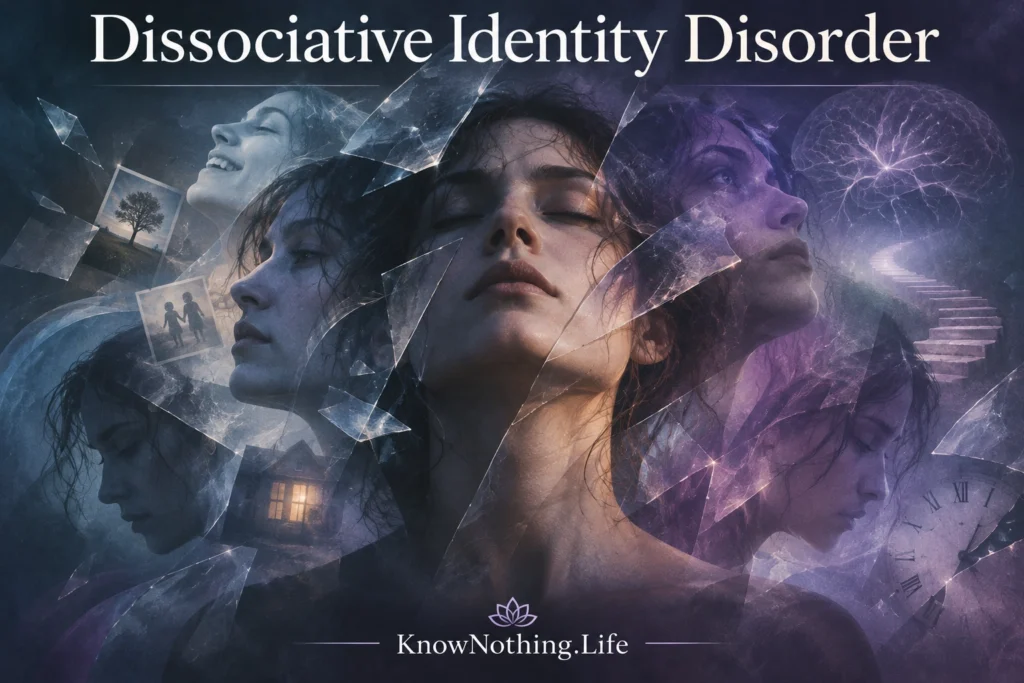
What happens when a person’s sense of identity no longer feels continuous? Most people experience themselves as relatively stable individuals, even though their emotions, behavior, and self-perception change across different situations. Someone may behave confidently at work, feel vulnerable in an intimate relationship, or respond defensively when threatened, yet still recognize these experiences as belonging to one continuous self. For individuals living with dissociative identity disorder, however, the relationship between identity, memory, emotional experience, and conscious awareness can become profoundly disrupted. Different states of self may emerge with distinctive patterns of thought and behavior, sometimes accompanied by substantial gaps in memory.
Dissociative identity disorder, commonly abbreviated DID, is among the most complex and debated conditions in clinical psychology. Formerly known as multiple personality disorder, it is characterized by disruptions in identity alongside difficulties integrating memory, awareness, and other psychological functions. Although frequently portrayed in films as the dramatic emergence of entirely separate personalities, clinical presentations are often subtler and considerably more distressing. Understanding DID requires examining the science of dissociation, its relationship with traumatic experiences, the limitations of memory research, and the competing theories that attempt to explain how disruptions in identity develop.
What Is Dissociative Identity Disorder?
Dissociative identity disorder is a recognized psychiatric diagnosis involving significant disruption in an individual’s sense of self and personal agency. The American Psychiatric Association‘s Diagnostic and Statistical Manual of Mental Disorders, Fifth Edition, Text Revision (DSM-5-TR, 2022) describes DID through the presence of two or more distinct personality states, together with recurring gaps in memory that exceed ordinary forgetfulness. These disturbances must cause clinically significant distress or impairment and must not be better explained by substances, medical conditions, or culturally accepted practices. Personality states may differ in emotional responses, perceptions, memories, or patterns of behavior, but they belong to one individual rather than representing literally separate human beings.
A related diagnosis appears in the World Health Organization‘s ICD-11, which also recognizes partial dissociative identity disorder. Its framework emphasizes discontinuities in identity and the extent to which different identity states influence or take control of behavior. Importantly, DID does not always involve clearly observable switching. Some individuals experience internal changes in perspective, emotional state, or agency that others rarely notice. The condition is therefore better understood as a disturbance involving the organization of psychological experience than as the existence of several independent personalities within one body.
The History of Dissociation and Multiple Personality
The psychological study of dissociation emerged during the nineteenth century through investigations of memory, hypnosis, consciousness, and unusual states of awareness. French psychologist Pierre Janet developed particularly influential ideas in L’Automatisme Psychologique (1889), proposing that psychological experiences could become insufficiently integrated into ordinary consciousness. Janet investigated how overwhelming experiences might contribute to disruptions in memory, behavior, and personal awareness. His work helped establish dissociation as a major concept in the emerging science of psychopathology, influencing later theories of trauma and identity.
William James also explored divided consciousness in The Principles of Psychology (1890), while physician Morton Prince documented complex identity disturbances in The Dissociation of a Personality (1905). The diagnosis entered the American psychiatric classification system as multiple personality disorder in DSM-III in 1980, before being renamed dissociative identity disorder in DSM-IV in 1994. The change in terminology reflected a shift in emphasis from supposedly possessing multiple complete personalities toward understanding failures in the integration of identity and memory. Nevertheless, the condition’s history also includes periods of sensationalized reporting, diagnostic disagreement, and concern about suggestive clinical practices.
Dissociation and the Experience of Fragmented Identity
Dissociation is a broad psychological phenomenon involving disruptions or discontinuities in normally integrated aspects of experience. Everyday examples include becoming deeply absorbed in an activity or momentarily arriving somewhere without clearly remembering parts of a familiar journey. Such experiences are not equivalent to DID. Clinical dissociation can involve much more substantial changes in self-awareness, memory, perception, emotional experience, or control over behavior. Depersonalization may produce a feeling of detachment from one’s body or thoughts, while derealization can make surroundings seem unreal or distant. These symptoms also occur in other mental health conditions.
In DID, individuals may experience different self-states that organize emotions, expectations, and behavior in distinct ways. A person might feel confident and capable during one period but later experience intense vulnerability or perceive familiar circumstances through a markedly different sense of self. Some report internal voices or experiences of observing their own behavior without feeling fully in control. These phenomena can be frightening and confusing, particularly when individuals struggle to understand the relationship between their different experiences. Researchers emphasize that the specific presentation varies considerably, and dramatic identity changes are not required for clinically significant dissociation.
Dissociative Amnesia and the Fragmentation of Memory
Memory disturbances are among the most important clinical features of DID. Individuals may report gaps involving ordinary daily activities, conversations, personal information, or emotionally significant experiences. Someone might discover evidence of an activity they cannot recall or struggle to reconstruct periods of their day. These episodes differ from ordinary absentmindedness because they may involve substantial disruptions in autobiographical continuity. However, memory difficulties can also arise from sleep disorders, neurological conditions, substance use, medications, and other psychiatric disorders, making careful assessment essential.
A controversial question concerns how independently different identity states store and retrieve information. Some clinical accounts describe substantial amnesia between states, yet experimental research has frequently identified information transfer even when participants report limited conscious access to memories. A recent review of DID and partial DID research emphasizes that evidence for complete barriers between identity states remains weak. This does not mean that reported memory difficulties are necessarily fabricated. Rather, subjective access to memory, confidence in recollection, and objective performance on memory tests are different phenomena. Research must distinguish between them rather than assuming that each identity state possesses a completely isolated memory system.
Childhood Trauma and the Development of DID
One influential explanation of DID is the trauma model, which proposes that severe or repeated early adversity can interfere with the development of an integrated sense of identity. Childhood is a period in which emotional regulation, autobiographical memory, attachment, and self-understanding are still developing. Under conditions of overwhelming stress, dissociative responses may provide temporary psychological distance from experiences that feel impossible to manage. Over time, some theorists propose, patterns of dissociation can become increasingly organized around different emotional states, memories, and ways of responding to perceived threats.
Psychiatrists Onno van der Hart, Ellert Nijenhuis, and Kathy Steele developed an influential theoretical account in The Haunted Self: Structural Dissociation and the Treatment of Chronic Traumatization (2006). Their framework proposes that traumatic experiences can contribute to divisions between psychological systems oriented toward ordinary functioning and those associated with defensive responses. However, this structural dissociation model remains a theoretical interpretation rather than a universally established account of DID. Research strongly associates trauma exposure with dissociative symptoms, but retrospective reports, overlapping psychiatric conditions, and methodological limitations complicate attempts to establish one definitive developmental pathway. Not everyone exposed to severe trauma develops DID, and trauma history alone cannot establish the diagnosis.
The Scientific Debate Over the Origins of DID
DID remains controversial partly because researchers disagree about the processes responsible for its symptoms. The trauma model emphasizes overwhelming experiences and disruptions in psychological integration. By contrast, sociocognitive explanations investigate how expectations, fantasy involvement, cultural narratives, therapist suggestion, and attention to identity-related experiences may influence the expression or interpretation of symptoms. These explanations do not require dismissing patients’ suffering. Instead, they raise questions about how genuine psychological experiences are shaped by individual cognition and social context.
In their 2022 review, Dissociation and Dissociative Disorders Reconsidered: Beyond Sociocognitive and Trauma Models Toward a Transtheoretical Framework, Steven Jay Lynn and colleagues argued that neither traditional model adequately explains the full range of dissociative phenomena. They proposed examining interacting influences including sleep disruption, emotional regulation, cognitive control, source monitoring, and metacognition. Guy Boysen’s 2024 review of research published between 2011 and 2021 similarly identified substantial methodological limitations, including small samples and repeated analyses of the same participants. The appropriate scientific position is therefore neither unquestioning acceptance of every theoretical claim nor dismissal of DID symptoms, but continued investigation through carefully designed research.
How Dissociative Identity Disorder Is Diagnosed
Diagnosing DID requires a comprehensive clinical assessment conducted by a qualified professional familiar with dissociative disorders. Clinicians investigate identity disruptions, memory disturbances, emotional symptoms, developmental history, daily functioning, and possible alternative explanations. Structured assessment instruments, including the Structured Clinical Interview for DSM Dissociative Disorders developed by Marlene Steinberg, can support systematic evaluation. Questionnaires such as the Dissociative Experiences Scale, developed by Eve Bernstein and Frank Putnam in 1986, can identify elevated dissociative experiences but cannot independently establish a diagnosis. Screening and diagnosis are different processes, particularly when symptoms overlap with several other conditions.
Differential diagnosis is essential because DID can resemble or coexist with post-traumatic stress disorder, borderline personality disorder, certain psychotic conditions, and neurological disorders. Hearing internal voices, for example, does not automatically indicate schizophrenia or DID. Similarly, changing emotional states are not sufficient evidence of distinct dissociative identities. The clinician must examine the overall pattern, including changes in agency, autobiographical memory, contextual factors, and impairment. The DSM-5-TR also requires excluding experiences that are accepted components of cultural or religious traditions. Diagnosis should emerge from careful assessment rather than dramatic behavior, online questionnaires, or expectations created by popular media.
Neuroscience and the Brain in Dissociative Identity Disorder
Neuroscience has attempted to identify whether dissociative identity states correspond to measurable differences in physiological and neurological functioning. In their 2012 study, Fact or Factitious? A Psychobiological Study of Authentic and Simulated Dissociative Identity States, Antje Reinders and colleagues compared individuals diagnosed with DID against participants instructed to simulate different identity states. The investigators reported differences in regional cerebral blood flow and physiological responses that could not be reproduced fully through instructed simulation under their experimental conditions. These findings contributed evidence that DID-related experiences may involve measurable psychobiological processes.
Nevertheless, neuroimaging studies require cautious interpretation. Small samples, medication effects, psychiatric comorbidity, differences in experimental tasks, and repeated examination of the same patients can limit the strength of conclusions. A 2025 critical review of functional neuroimaging research found that available findings were insufficient to establish firm claims about identity fragmentation or amnesia between states and could not settle the debate between trauma-based and sociocognitive explanations. Brain scans are not currently accepted as diagnostic tests for DID. The existing evidence supports continued investigation of altered self-processing, memory, and emotion regulation without demonstrating that each identity state possesses an independent brain or neurological identity.
Living With DID and Its Effects on Daily Life
The everyday consequences of DID can extend far beyond changes in identity. Memory gaps may complicate work, education, relationships, and ordinary responsibilities. Individuals may experience uncertainty about conversations, difficulty maintaining consistent routines, or anxiety about changes in their emotional state. Co-occurring depression, trauma-related symptoms, sleep disturbances, and feelings of disconnection can further increase distress. Some individuals attempt to conceal their experiences because they fear ridicule, disbelief, or discrimination, making social isolation an additional burden.
Popular representations frequently exaggerate danger, but DID does not make someone inherently violent or unpredictable toward others. The condition is associated more consistently with psychological distress, vulnerability, and difficulties maintaining a stable sense of self than with the sensational criminal behavior portrayed in entertainment. Clinical support is most constructive when it treats the individual as a whole person whose experiences deserve careful understanding. Respectful relationships, predictable environments, and appropriate professional care can support stability while avoiding the assumption that every difference in emotion or behavior represents the emergence of a separate identity.
Treatment and the Role of Psychotherapy
Psychotherapy is the principal treatment approach for DID, although rigorous evidence comparing specific treatments remains limited. The International Society for the Study of Trauma and Dissociation‘s 2011 Guidelines for Treating Dissociative Identity Disorder in Adults recommends a phased approach emphasizing safety and stabilization, carefully paced work with traumatic experiences when appropriate, and improved integration of psychological functioning. Early treatment may focus on managing distress, strengthening emotional regulation, improving awareness of dissociative episodes, and reducing harmful coping behaviors. More intensive trauma-focused work should take account of an individual’s stability, preferences, and ability to tolerate difficult experiences.
Treatment goals do not necessarily require eliminating every experience of distinct self-states. Some individuals seek greater integration into a continuous sense of identity, while others prioritize cooperation among self-states, reduced memory disruption, and improved functioning. Research is expanding beyond traditional psychodynamic approaches. A small 2026 case-series study of adapted schema therapy reported improvements in dissociative symptoms among ten participants, providing preliminary evidence that additional treatment models deserve investigation. Nevertheless, small case series cannot establish effectiveness as confidently as well-designed randomized controlled trials. No medication has been established to treat DID itself, although medication may be appropriate for co-occurring depression, anxiety, sleep difficulties, or other conditions.
The Importance of Safe, Evidence-Based Care
A central ethical challenge in treating DID concerns the handling of memory and suggestion. Human memory is reconstructive, meaning that recollections can be influenced by expectations, questioning, and subsequent information. Therapists should not assume that a symptom proves the existence of a forgotten traumatic event or encourage patients to reconstruct memories through leading questions. Similarly, hypnosis and other suggestive techniques require particular caution because increased confidence in a recollection does not guarantee its historical accuracy. Clinical progress should not depend on producing dramatic identity changes or adopting a predetermined explanation of a person’s past.
Effective care instead emphasizes safety, autonomy, collaborative assessment, and the reduction of distress and functional impairment. Individuals experiencing severe dissociation may benefit from practical strategies for managing disorientation, identifying triggers, maintaining continuity in everyday activities, and accessing supportive relationships. Treatment may also involve addressing co-occurring psychiatric conditions and evaluating neurological or medical symptoms when indicated. The broader goal is not to transform complex experiences into a compelling narrative, but to help individuals develop greater stability, psychological flexibility, and control over their lives.
Final Thoughts on Dissociative Identity Disorder
Dissociative identity disorder challenges familiar assumptions about identity, memory, and the unity of conscious experience. While most people experience themselves as relatively continuous individuals, DID involves disruptions that can make personal awareness, emotional experience, and autobiographical memory feel fragmented. Research associates dissociative symptoms with traumatic experiences and has identified possible neurological correlates, but important questions remain about the origins, mechanisms, and boundaries of the disorder. Historical theories provide valuable perspectives without resolving every scientific controversy.
Perhaps the most important lesson is that DID should be approached through neither sensationalism nor dismissal. The condition is recognized within contemporary psychiatric classification, yet its scientific literature remains limited in ways that require careful interpretation. Understanding dissociation demands attention to subjective experience alongside objective evidence, recognition of trauma without assuming one universal cause, and a commitment to treatment that prioritizes safety and functioning. Ultimately, the study of DID contributes to a broader psychological question: how does the human mind create a continuous sense of self, and what happens when the processes supporting that continuity become disrupted?