Hermann Ebbinghaus is one of the foundational figures in the scientific study of memory, a pioneer who transformed how psychologists understand learning, retention, and forgetting. At a time when psychology was still emerging as a discipline, Ebbinghaus introduced rigorous experimental methods to investigate mental processes that had long been considered too subjective to measure. His work marked a decisive shift toward quantifying the inner workings of the mind.
What makes Ebbinghaus particularly remarkable is that he conducted many of his most important experiments on himself, developing innovative techniques to isolate and measure memory. Through careful observation and repetition, he uncovered patterns that continue to influence modern psychology, education, and cognitive science. His discoveries—especially the forgetting curve and the spacing effect—remain central to how we understand how information is learned and lost.
Early Life and Intellectual Context
Hermann Ebbinghaus was born on January 24, 1850, in Barmen, Germany. He studied philosophy at the University of Bonn, where he was introduced to the intellectual traditions that would shape his approach to psychology. Like many thinkers of his time, Ebbinghaus was influenced by the growing emphasis on scientific methodology, particularly the work of Wilhelm Wundt, who was establishing psychology as an experimental science.
However, Ebbinghaus chose a different path from many of his contemporaries. While Wundt focused on perception and consciousness, Ebbinghaus turned his attention to memory—a domain that had received relatively little systematic study. He believed that memory, despite its complexity, could be investigated using precise and controlled methods, provided that researchers developed the right tools.
His intellectual environment was one of transition, as psychology began to separate from philosophy and establish itself as an independent field. Ebbinghaus’s work reflects this shift, combining philosophical curiosity with experimental rigor. He sought not only to understand memory but to measure it, bringing a new level of precision to the study of the mind.
The Study of Memory and Nonsense Syllables
Ebbinghaus’s most famous innovation was the use of “nonsense syllables” as a tool for studying memory. These syllables—such as “BOK” or “ZAT”—were deliberately constructed to be meaningless, allowing him to eliminate the influence of prior knowledge and associations. By using neutral material, Ebbinghaus could focus on the pure mechanics of memory.
He conducted extensive experiments in which he memorized lists of these syllables and then tested his ability to recall them over time. This method allowed him to quantify memory performance with unprecedented accuracy. He measured how long it took to learn a list, how much was retained after various intervals, and how quickly forgotten material could be relearned.
Through these experiments, Ebbinghaus demonstrated that memory is not a static capacity but a dynamic process influenced by time, repetition, and practice. His approach was groundbreaking because it introduced a level of control and precision that had previously been absent from psychological research. By treating memory as something that could be measured and analyzed, he helped establish the scientific credibility of psychology.
The Forgetting Curve and the Spacing Effect
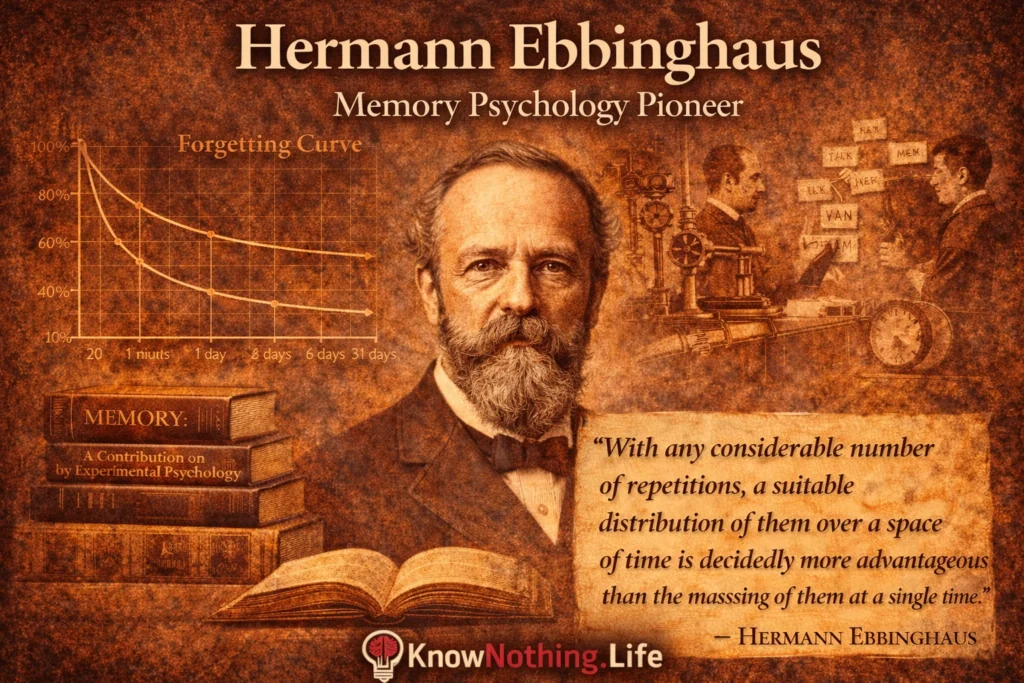
One of Ebbinghaus’s most enduring contributions is the discovery of the forgetting curve, which illustrates how information is lost over time when there is no attempt to retain it. His findings showed that forgetting occurs rapidly at first, with a steep decline in retention shortly after learning, followed by a slower rate of loss over time.
He observed that “with any considerable number of repetitions, a suitable distribution of them over a space of time is decidedly more advantageous than the massing of them at a single time.” This insight led to the identification of the spacing effect, the principle that information is better retained when study sessions are spaced out rather than concentrated in a single period.
These discoveries have had profound implications for education and learning. The forgetting curve highlights the importance of review and reinforcement, while the spacing effect provides a practical strategy for improving memory. Together, they form the basis of many modern learning techniques, from spaced repetition systems to educational curricula designed to optimize retention.
Major Work and Scientific Contributions
Ebbinghaus’s findings are most fully presented in Memory: A Contribution to Experimental Psychology, a landmark publication that remains one of the most influential texts in the history of psychology. In this work, he details his experimental methods, results, and theoretical insights, offering a comprehensive account of how memory operates.
The book is notable not only for its content but for its methodological rigor. Ebbinghaus carefully documented his procedures, ensuring that his experiments could be replicated and verified. This commitment to scientific standards helped establish psychology as a discipline grounded in empirical evidence.
Beyond memory, Ebbinghaus also contributed to the study of perception and intelligence. He developed the Ebbinghaus illusion, a visual phenomenon that demonstrates how context influences perception. This work further illustrates his broader interest in understanding how the mind processes information, reinforcing his role as a pioneer in multiple areas of psychology.
Influence and Legacy
Hermann Ebbinghaus’s influence extends across psychology, education, and cognitive science. His work laid the foundation for the scientific study of memory, inspiring generations of researchers to explore how information is encoded, stored, and retrieved. Concepts such as the forgetting curve and spacing effect continue to inform both academic research and practical applications.
In education, Ebbinghaus’s insights have transformed teaching methods, emphasizing the importance of repetition, review, and distributed practice. Modern learning technologies, including digital flashcard systems and adaptive learning platforms, are built on principles he first identified over a century ago.
Ebbinghaus also played a role in shaping the broader direction of psychology as a discipline. By demonstrating that complex mental processes could be studied experimentally, he helped legitimize psychology as a science. His work stands alongside that of pioneers like Wilhelm Wundt and William James, contributing to the establishment of psychology as a field grounded in empirical investigation.
Conclusion
Hermann Ebbinghaus’s legacy lies in his ability to bring clarity and precision to one of the most fundamental aspects of human experience: memory. Through his innovative methods and meticulous experiments, he revealed patterns that continue to shape our understanding of learning and forgetting.
His work serves as a reminder that even the most complex mental processes can be studied systematically, provided that researchers are willing to develop new tools and approaches. By transforming memory into a subject of scientific inquiry, Ebbinghaus opened the door to a deeper understanding of the mind.
As modern research continues to build on his discoveries, his influence remains as strong as ever. The principles he uncovered not only explain how we remember but also guide how we learn, making his contributions both timeless and profoundly practical.