John B. Watson is one of the most influential and controversial figures in the history of psychology, known for radically redefining what psychology should study and how it should be conducted. Rejecting introspection and the study of consciousness, Watson argued that psychology must become a purely objective science focused on observable behavior. His ideas gave rise to behaviorism, a movement that would dominate American psychology for decades.
Watson’s work represented a decisive break from earlier traditions, shifting attention away from internal mental states toward measurable actions and environmental influences. By emphasizing conditioning and learning, he introduced a framework that sought to explain behavior through scientific principles, laying the groundwork for later developments in psychology, education, and even marketing. His bold claims and experimental approach reshaped the field, challenging long-standing assumptions about the nature of the mind.
Early Life and Intellectual Formation
John Broadus Watson was born on January 9, 1878, in Greenville, South Carolina, into a rural and economically modest environment. His early life was marked by instability and hardship, including a troubled family dynamic that would later influence his views on behavior and development. Despite these challenges, Watson demonstrated academic potential and eventually enrolled at Furman University, where he began his higher education.
Watson later attended the University of Chicago, where he studied psychology under the influence of scholars such as James Rowland Angell and John Dewey. During this period, he became increasingly interested in animal behavior, conducting research on rats and exploring how environmental factors shape learning. This work laid the foundation for his later emphasis on observable behavior as the primary subject of psychology.
His early research reflected a growing dissatisfaction with introspective methods, which he viewed as subjective and unreliable. Watson sought a more scientific approach, one that would align psychology with disciplines like biology and physics. This ambition would culminate in his development of behaviorism, a theory that redefined the scope and methods of psychological inquiry.
The Birth of Behaviorism
Watson formally introduced behaviorism in his landmark 1913 paper, Psychology as the Behaviorist Views It, often referred to as the behaviorist manifesto. In this work, he argued that psychology should abandon the study of consciousness and focus exclusively on observable behavior. He believed that mental states were not suitable subjects for scientific investigation because they could not be directly measured.
According to Watson, behavior is the result of environmental stimuli and learned responses. He proposed that all behavior could be explained through conditioning, a process by which associations are formed between stimuli and responses. This perspective shifted the focus of psychology from internal processes to external influences, emphasizing the role of the environment in shaping behavior.
Watson’s approach was both radical and influential. By redefining psychology as a science of behavior, he opened the door to new methods and applications. His ideas challenged existing paradigms and set the stage for a new era in psychological research, one that prioritized objectivity and empirical evidence.
The Little Albert Experiment and Emotional Conditioning
One of Watson’s most famous and controversial studies is the Little Albert experiment, conducted with his graduate student Rosalie Rayner. In this experiment, Watson sought to demonstrate that emotional responses could be conditioned in the same way as other behaviors. By pairing a loud, frightening noise with the presentation of a white rat, he conditioned a young child—known as Albert—to develop a fear of the animal.
The results of the experiment suggested that fear could be learned through association, rather than being purely innate. Albert’s fear generalized to other objects, such as rabbits and fur coats, indicating that conditioned responses could extend beyond the original stimulus. This finding supported Watson’s broader claim that behavior is shaped by environmental experiences.
While the experiment had a significant impact on psychology, it has also been widely criticized for its ethical implications. The study lacked safeguards for the child’s well-being, raising questions about the responsibilities of researchers. Despite these concerns, the experiment remains a landmark in the study of conditioning and emotional learning.
Major Works and Theoretical Contributions
Watson’s ideas are further developed in works such as Behaviorism, where he elaborates on his vision of psychology as a science of behavior. In this text, he presents a comprehensive account of behaviorist principles, emphasizing the role of conditioning, habit formation, and environmental control.
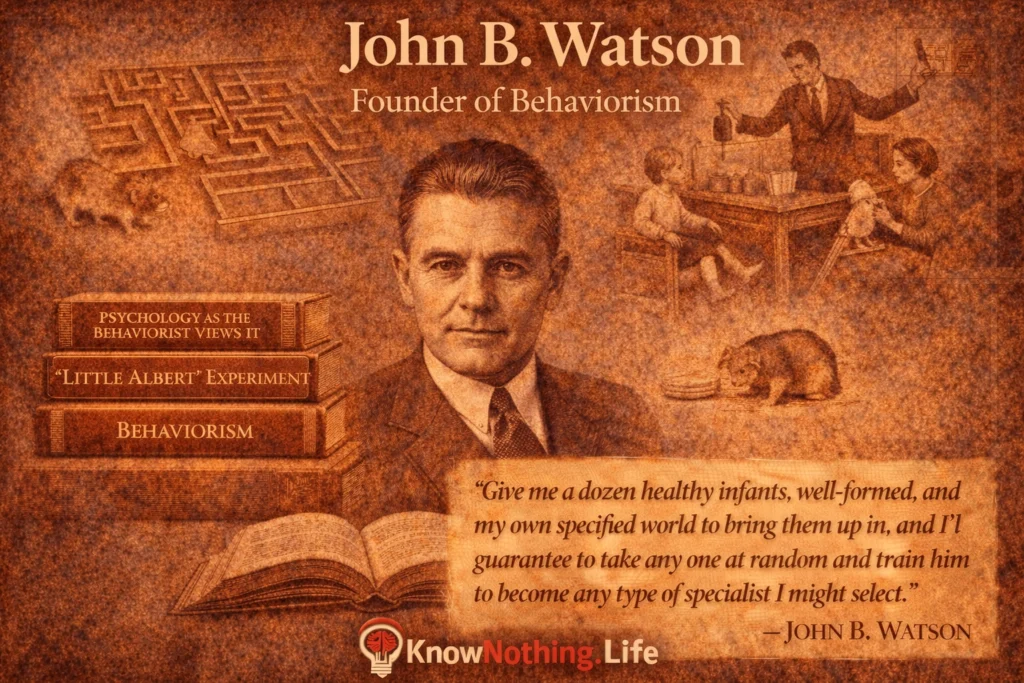
He famously declared, “Give me a dozen healthy infants, well-formed, and my own specified world to bring them up in, and I’ll guarantee to take any one at random and train him to become any type of specialist I might select.” This statement encapsulates his belief in the power of environmental influence, suggesting that behavior and personality are largely shaped by experience rather than innate factors.
Watson’s work also contributed to the development of applied psychology, particularly in areas such as advertising and education. After leaving academia, he worked in the advertising industry, applying behaviorist principles to influence consumer behavior. His insights into conditioning and habit formation proved valuable in shaping marketing strategies, demonstrating the practical implications of his theories.
Influence, Criticism, and Legacy
John B. Watson’s influence on psychology is both profound and enduring. Behaviorism dominated American psychology for much of the 20th century, shaping research methods and theoretical approaches. His emphasis on objectivity and empirical evidence helped establish psychology as a scientific discipline, aligning it with the natural sciences.
However, Watson’s work has also been subject to significant criticism. Critics argue that behaviorism oversimplifies human behavior by ignoring internal mental processes such as thoughts, emotions, and motivations. The rise of cognitive psychology in the mid-20th century challenged behaviorist assumptions, reintroducing the study of the mind as a central concern.
Despite these critiques, Watson’s contributions remain foundational. His insistence on scientific rigor and his focus on learning and environment continue to influence contemporary psychology. Concepts such as conditioning and behavior modification are widely used in fields ranging from education to therapy, reflecting the lasting impact of his work.
Conclusion
John B. Watson’s legacy lies in his bold redefinition of psychology as a science of behavior. By rejecting introspection and emphasizing observable phenomena, he transformed the field, setting new standards for research and inquiry. His development of behaviorism provided a framework for understanding how behavior is shaped by environmental factors, offering insights that continue to inform modern psychology.
While his theories have been refined and challenged, their influence remains undeniable. Watson’s work paved the way for future developments, including the study of learning, conditioning, and behavior modification. His contributions serve as a reminder of the importance of questioning assumptions and seeking new approaches to understanding the human condition.
In the end, Watson’s impact extends beyond psychology, influencing how we think about learning, development, and the power of environment. His vision of a scientific psychology continues to shape the field, ensuring his place as one of its most significant pioneers.