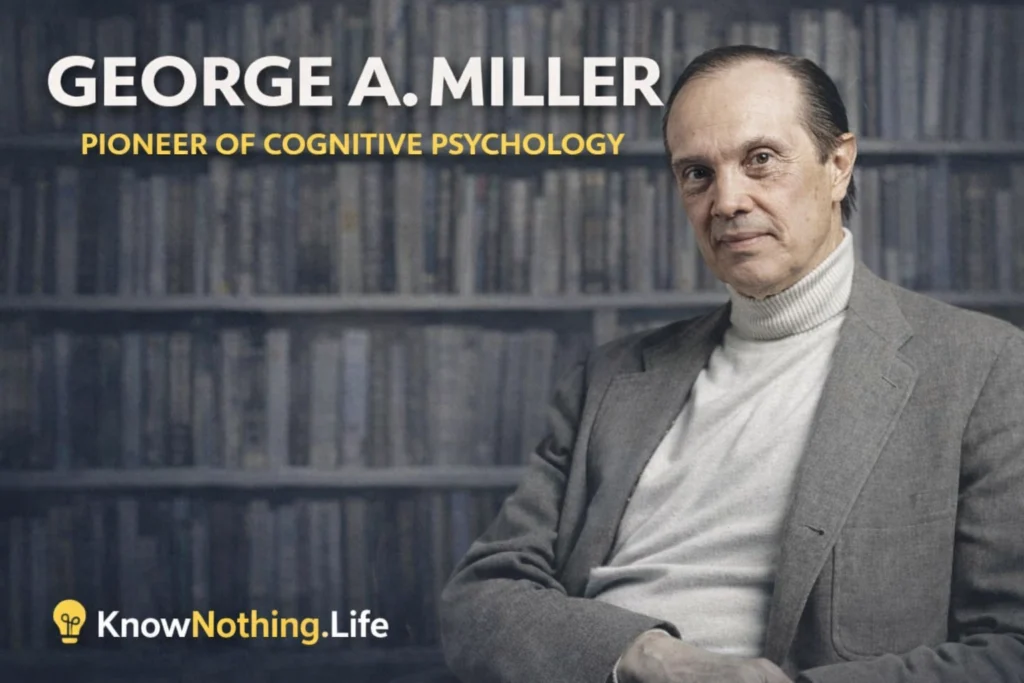
Among the foundational figures of the cognitive revolution, George A. Miller stands as one of the most influential architects of modern psychology. His work reshaped how scientists understand human thought, particularly in the domains of memory, language, and information processing. At a time when behaviorism dominated psychological theory, Miller helped redirect attention toward the internal workings of the mind, demonstrating that cognition could be studied with the same rigor as observable behavior.
Miller’s contributions are perhaps best known through his seminal paper, “The Magical Number Seven, Plus or Minus Two,” which revealed fundamental limits on human information processing. Yet his influence extends far beyond a single idea. Through his research, writing, and collaboration with other pioneers such as Ulric Neisser, Miller played a central role in establishing cognitive psychology as a dominant paradigm. His work bridged psychology, linguistics, and computer science, laying the groundwork for interdisciplinary approaches that continue to define the field today.
Early Life and Academic Formation
George Armitage Miller was born on February 3, 1920, in Charleston, West Virginia. Raised during the Great Depression, Miller developed an early interest in communication and human understanding, influenced in part by his father’s work in education. He pursued his undergraduate studies at the University of Alabama, where he initially focused on speech and language, areas that would later intersect with his psychological research.
Miller went on to earn his Ph.D. in psychology from Harvard University, where he studied under prominent figures in experimental psychology. During World War II, he contributed to research on communication and human factors, examining how people process information under conditions of stress and complexity. These experiences deepened his interest in the mechanisms of perception and memory, particularly in real-world contexts.
After the war, Miller joined the faculty at Harvard, where he became part of a growing movement that challenged the limitations of behaviorism. Influenced by developments in information theory and early computing, he began to conceptualize the mind as an information-processing system. This perspective would become central to his later work and to the broader cognitive revolution.
The Magical Number Seven and Memory Limits
Miller’s most famous contribution came in 1956 with the publication of “The Magical Number Seven, Plus or Minus Two.” In this groundbreaking paper, he demonstrated that the average person can hold approximately seven items—give or take two—in short-term memory. This finding provided one of the first quantitative insights into the limits of human cognition, revealing that mental capacity is constrained in systematic ways.
Miller’s analysis extended beyond simple memory tasks to include perception and judgment. He showed that people use strategies such as “chunking” to organize information into meaningful units, thereby expanding their effective memory capacity. For example, a sequence of numbers can be remembered more easily when grouped into familiar patterns. This insight highlighted the active role of the mind in structuring information, rather than passively storing it.
Reflecting on his findings, Miller wrote, “My problem is that I have been persecuted by an integer.” This famously humorous remark underscores the profound impact of his discovery. The concept of limited capacity has influenced fields ranging from psychology and education to design and human-computer interaction, shaping how information is presented and processed.
Language, Communication, and Psycholinguistics
In addition to his work on memory, Miller made significant contributions to the study of language and communication. He was deeply interested in how people understand and produce language, viewing it as a central aspect of human cognition. His research helped establish psycholinguistics as a distinct field, bridging the gap between psychology and linguistics.
Miller collaborated with linguist Noam Chomsky, whose theories of generative grammar emphasized the innate structures underlying language. Together, they explored how linguistic knowledge is represented in the mind and how it interacts with cognitive processes. This collaboration played a crucial role in challenging behaviorist accounts of language, which had attempted to explain speech as a series of conditioned responses.
Miller’s work on language also had practical implications. He studied how people comprehend sentences, resolve ambiguity, and interpret meaning in context. His research demonstrated that language processing involves complex mental operations, including memory, attention, and inference. These insights contributed to a broader understanding of cognition as an integrated system.
Major Works and Intellectual Contributions
Beyond his famous paper, Miller authored and co-authored numerous influential works that shaped the development of cognitive science. His book Language and Communication (1951) explored the relationship between linguistic structure and human cognition, providing a foundation for later research in psycholinguistics.
Another major contribution was his involvement in the development of the TOTE model (Test-Operate-Test-Exit), proposed with colleagues as an alternative to simple stimulus-response models. This framework described behavior as a goal-directed process involving feedback and adjustment, anticipating later theories of cognitive control and decision-making.
Miller also played a key institutional role in the cognitive revolution. He co-founded the Center for Cognitive Studies at Harvard, creating a hub for interdisciplinary research that brought together psychologists, linguists, and computer scientists. Through his leadership, he helped establish cognitive science as a unified field, characterized by collaboration and theoretical innovation.
Criticism and Evolving Perspectives
While Miller’s work has been widely celebrated, it has also been subject to reinterpretation and critique. Subsequent research has shown that the capacity of short-term memory may be more limited than Miller initially suggested, with some studies proposing a capacity closer to four chunks rather than seven. These findings have refined our understanding of memory without undermining the importance of Miller’s original insight.
Critics have also noted that the concept of chunking depends heavily on prior knowledge and context, making it difficult to define memory capacity in purely numerical terms. Nevertheless, Miller’s work remains foundational, as it introduced the idea that cognitive processes have measurable limits.
Importantly, Miller himself was open to revising his ideas in light of new evidence. His willingness to engage with evolving research reflects the scientific mindset that defined his career. Rather than clinging to fixed conclusions, he contributed to an ongoing dialogue about the nature of cognition.
Legacy and Lasting Influence
George A. Miller’s legacy is deeply embedded in the foundations of cognitive psychology and cognitive science. His work on memory, language, and information processing helped transform psychology into a discipline focused on the mind’s internal operations. By demonstrating that cognitive processes could be studied scientifically, he paved the way for decades of research and innovation.
His influence extends beyond academia into practical domains such as education, technology, and design. The principles he identified—such as limited capacity and chunking—are applied in everything from user interface design to instructional methods. His work continues to inform how information is structured and communicated in a world increasingly shaped by digital technology.
Miller once observed, “What we have learned from experience depends on how we organize and interpret it.” This statement captures the essence of his contribution: a recognition that the mind actively shapes its own understanding. His insights continue to guide researchers and practitioners in their efforts to understand and enhance human cognition.
Final Thoughts
To study George A. Miller is to encounter one of the central figures in the transformation of psychology into a science of the mind. His work revealed the limits and possibilities of human cognition, providing tools for understanding how we perceive, remember, and communicate. By bridging disciplines and challenging established paradigms, he helped create a new vision of psychological science.
Miller’s legacy endures not only in the theories he developed but in the questions he inspired. His work invites us to explore the boundaries of human understanding and to consider how the mind organizes the world. In doing so, he left an enduring mark on psychology and on the broader quest to understand human thought.