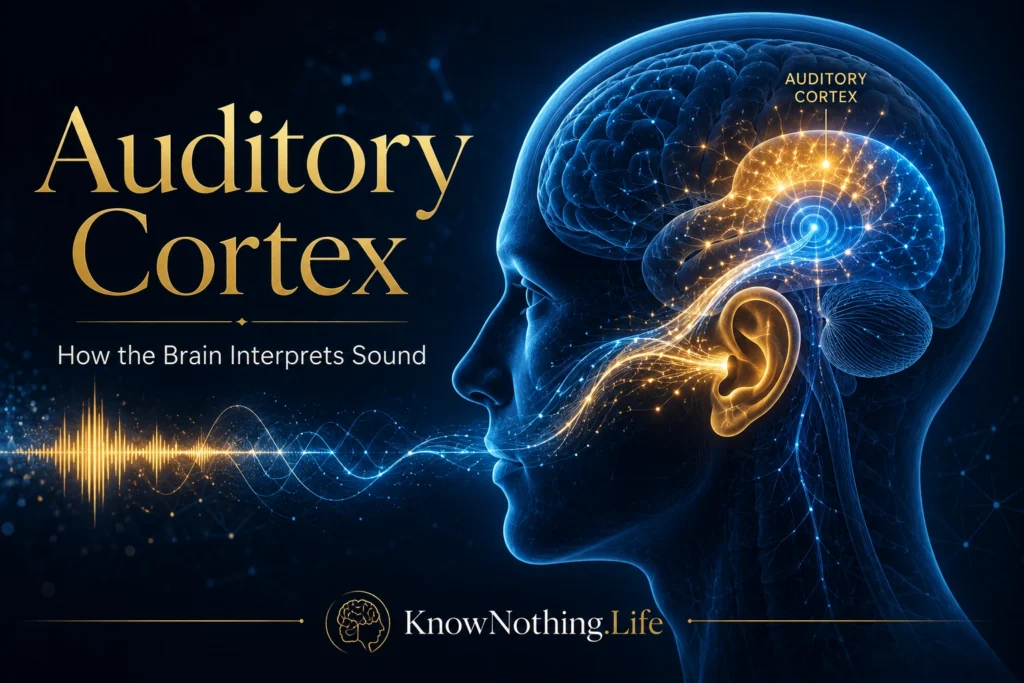
The auditory cortex is the collection of cerebral regions that transforms neural signals from the ears into meaningful perceptions of voices, language, music, movement, and environmental sound. It lies primarily within the temporal lobes, with core auditory areas positioned on the superior temporal plane near Heschl’s gyrus. By the time information reaches these regions, the cochlea has already separated sound into frequency components, auditory nerve fibers have encoded intensity and timing, and brainstem circuits have compared signals arriving at the two ears. The cortex builds upon this earlier processing by analyzing complex patterns, identifying sound sources, and linking what is heard with memory, attention, emotion, and action.
The auditory cortex is not one uniform sound center. It contains several fields with different connections, response properties, and levels of complexity. Primary regions respond strongly to basic acoustic features such as frequency and intensity, while surrounding areas are increasingly sensitive to combinations of frequencies, temporal patterns, vocalizations, speech sounds, and auditory objects. Studies of primate anatomy and physiology describe a core region surrounded by belt and parabelt areas, with information moving through both serial and parallel pathways. This organization allows detailed acoustic analysis to occur alongside rapid communication with language, motor, spatial, and memory systems.
The Pathway from the Cochlea to the Cortex
Sound processing begins when inner-ear hair cells convert cochlear vibration into electrical activity. Auditory nerve fibers carry these signals to the cochlear nuclei in the brainstem. Information then travels through structures including the superior olivary complex, lateral lemniscus, inferior colliculus, and medial geniculate nucleus of the thalamus before reaching the cortex. These intermediate stations do not merely pass signals forward. They analyze timing, intensity, spectral structure, and differences between the ears, producing increasingly organized representations of pitch, location, and sound identity.
The medial geniculate nucleus provides the principal thalamic input to the auditory cortex, but the relationship between the thalamus and cortex is reciprocal. Cortical feedback can influence thalamic responsiveness according to attention, behavioral goals, and acoustic context. Auditory cortex also communicates with the inferior colliculus and other lower auditory centers, allowing higher-level expectations to modify earlier stages of sound processing. Hearing therefore involves recurrent loops rather than a one-way chain in which information simply travels from the ear to a final cortical destination.
Primary Auditory Cortex and Tonotopy
Primary auditory cortex, often called A1, is one of the first cortical regions to receive detailed auditory information from the thalamus. Many of its neurons respond most strongly to particular sound frequencies, although their responses are also influenced by intensity, timing, modulation, and surrounding frequencies. The orderly spatial arrangement of frequency preferences is called tonotopy. Regions responding more strongly to low frequencies are located next to regions preferring progressively higher frequencies, creating a cortical continuation of the frequency map that begins along the basilar membrane of the cochlea.
Gian Luca Romani, Samuel Williamson, and Lloyd Kaufman provided early evidence for human cortical tonotopy in 1982. Using neuromagnetic measurements, they found that the estimated location of auditory cortical activity changed systematically with sound frequency. Modern imaging has revealed multiple frequency gradients extending across Heschl’s gyrus and neighboring auditory fields rather than one perfectly linear map. Research by Michelle Moerel and colleagues showed that human auditory cortex contains intersecting tonotopic patterns organized along more than one anatomical axis, helping reconcile previously conflicting descriptions of its functional layout.
Processing Complex and Changing Sounds
Natural sounds are more complicated than isolated pure tones. A human voice contains a fundamental frequency, harmonics, rapid transitions, amplitude fluctuations, and resonances produced by the vocal tract. Music contains overlapping notes, rhythms, timbres, and melodic relationships, while environmental scenes frequently contain many simultaneous sources. Auditory cortical neurons must therefore respond to combinations of spectral and temporal features. Some neurons prefer particular frequency sweeps, modulation rates, sound durations, or patterns that unfold over time.
Processing becomes increasingly complex outside primary auditory cortex. Neurons in belt and parabelt regions often respond more strongly to structured sounds than to simple tones, and their receptive fields can combine information across wider frequency ranges and longer periods. Experiments in awake primates have shown that cortical firing patterns can carry substantial information about time-varying acoustic stimuli. The cortex does not encode every moment independently; it integrates sound across time, allowing changing vibrations to be perceived as coherent words, melodies, calls, and identifiable events.
Auditory Objects and Perceptual Streams
An auditory object is a sound or sound sequence perceived as coming from one meaningful source, such as a barking dog, ringing telephone, or speaking person. Constructing these objects is difficult because the ears receive mixtures rather than neatly separated sources. The cortex must decide which frequencies and temporal changes belong together. Similarity in pitch, timing, location, and timbre can cause sounds to be grouped into one stream, while large differences encourage perceptual separation.
This process becomes especially important in noisy environments. At a crowded gathering, several voices may reach the ears simultaneously, yet attention can help a listener follow one conversation. Research on auditory streaming indicates that the auditory cortex participates in grouping repeating sounds and separating competing sequences. Neural responses can gradually change as one mixed pattern becomes perceived as two independent streams, suggesting that cortical activity reflects not only the acoustic stimulus but also the listener’s changing organization of it.
Ventral and Dorsal Auditory Pathways
Auditory cortical processing is often described through two broad, interacting pathways. The ventral pathway extends from anterior auditory regions toward temporal and inferior frontal areas. It contributes strongly to identifying sounds and answering the question of what produced them. The dorsal pathway projects from posterior auditory areas toward parietal, premotor, and frontal regions. It contributes to spatial processing, sensorimotor coordination, and determining where a sound originated or how the body should respond to it.
Josef Rauschecker and Biao Tian developed an influential account of these “what” and “where” streams based on primate anatomy and physiology. Human imaging studies later found greater anterior activity during sound-identification tasks and greater posterior activity during sound-location judgments. The distinction is useful but not absolute. Posterior pathways also connect heard sounds with movements, including the articulatory actions used in speech, while anterior pathways interact with memory and conceptual knowledge. Auditory perception depends on cooperation between streams rather than a complete separation of identity and location.
Speech Processing in the Auditory Cortex
Speech places exceptional demands on the auditory system because small acoustic differences can alter meaning. Consonants and vowels are distinguished through combinations of frequency structure, timing, voicing, and rapidly changing resonances. The superior temporal gyrus plays a major role in transforming these patterns into phonetic representations. Its neural populations respond to acoustic-phonetic features shared across groups of speech sounds rather than functioning as a simple collection of neurons assigned to individual letters or words.
Nima Mesgarani and colleagues recorded directly from the human superior temporal gyrus and found distributed patterns encoding features such as manner and place of articulation. Related research has shown that auditory cortical representations become increasingly abstract along a hierarchy while retaining information about lower-level acoustics. Regions near primary cortex respond strongly to spectrotemporal details, whereas more distant sites increasingly represent phonetic, lexical, or linguistic structure. Speech comprehension therefore emerges through successive and overlapping transformations rather than through one isolated language center.
Attention and the Selection of Sound
Attention changes how sounds are represented in the auditory cortex. When listeners focus on a particular frequency, location, voice, or rhythm, cortical responses associated with the selected information can become stronger or more distinct. Attention also suppresses interference from competing sources, although this filtering is rarely complete. The influence of attention begins early enough to affect sensory representations rather than operating only after a sound has been fully identified.
In a study involving two simultaneous speakers, Mesgarani and Edward Chang recorded from nonprimary auditory cortex while participants attended to one voice. Reconstructions based on cortical activity more closely resembled the attended speaker than the ignored one, as though the cortex had enhanced the selected voice within the mixture. This finding helped explain the neural basis of the so-called cocktail-party effect. The ears receive overlapping sound waves, but attention changes which features dominate the cortical representation and enter conscious awareness.
Plasticity, Learning, and Hearing Loss
The auditory cortex remains capable of change throughout life. Developmental exposure helps shape sensitivity to language sounds, voices, music, and environmental patterns. In adulthood, perceptual learning can modify cortical timing, tuning, and responsiveness when particular acoustic features become behaviorally important. Shaowen Bao and colleagues trained animals to distinguish temporal patterns and found that successful learning altered response timing within primary auditory cortex. These results showed that cortical organization is not fixed after development but continues to reflect experience and behavioral relevance.
Plasticity can also follow hearing loss, injury, or artificial stimulation. Reduced cochlear input may change cortical inhibition and frequency organization, while hearing aids and cochlear implants provide altered signals that the brain must learn to interpret. Some reorganization may support recovery, but other changes may contribute to tinnitus or difficulty understanding speech in noise. The auditory cortex is therefore both a source of adaptability and a potential site of maladaptive change.
How the Auditory Cortex Creates Meaning
The auditory cortex transforms organized neural activity into recognizable voices, words, melodies, locations, and events. Primary fields preserve detailed information about frequency and timing, surrounding areas combine features across broader spectral and temporal ranges, and distributed pathways connect sound with language, movement, emotion, and memory. Attention selects among competing signals, while learning changes which acoustic distinctions receive the strongest representation.
Hearing feels immediate because these operations normally occur rapidly and without conscious effort. Yet the cortex must continually infer which sounds belong together, what produced them, where they originated, and whether they require action. It does not reproduce the acoustic world as a perfect internal recording. It constructs useful interpretations from changing patterns of neural evidence, turning vibrations arriving at the ears into the meaningful experience of listening.