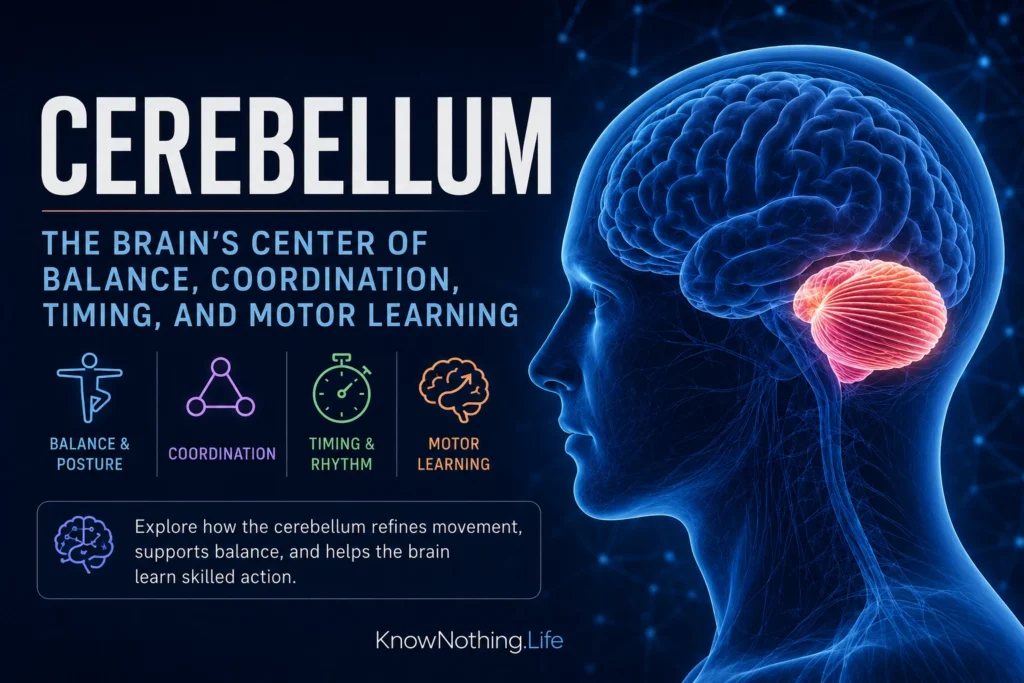
The cerebellum is a major structure of the hindbrain located at the back of the skull, beneath the cerebrum and behind the brainstem. Its name comes from the Latin word for “little brain,” which is fitting because it has its own two hemispheres, folded surface, and highly organized internal circuitry. Although it is much smaller than the cerebrum, the cerebellum is not a minor structure. It is essential for balance, posture, coordination, movement accuracy, motor learning, speech timing, eye movement control, and increasingly recognized cognitive and emotional functions. Anatomically, the cerebellum sits in the posterior cranial fossa behind the fourth ventricle, pons, and medulla, and it is separated from the cerebrum by the tentorium cerebelli.
The simplest description of the cerebellum is that it helps the nervous system make movement smooth, accurate, and well timed. It does not usually initiate movement by itself; rather, it adjusts movement once a goal has been set. When someone reaches for a glass, walks across uneven ground, plays piano, speaks clearly, or catches a ball, the cerebellum helps compare intended action with actual performance. It makes tiny corrections so quickly that the person usually does not notice them. This is why cerebellar damage often does not cause paralysis, but instead produces clumsy, poorly coordinated movement, tremor, balance problems, abnormal eye movements, and difficulty with precise timing.
Structure and Organization
The cerebellum has two lateral hemispheres joined in the middle by the vermis. It is commonly divided into three anatomical lobes: the anterior lobe, posterior lobe, and flocculonodular lobe. These lobes are separated by deep fissures, and each contributes to different aspects of movement and regulation. Another useful way to describe the cerebellum is by functional zones: the vestibulocerebellum, spinocerebellum, and cerebrocerebellum. The vestibulocerebellum is strongly involved in balance and eye movements; the spinocerebellum helps regulate posture, gait, and ongoing body movement; and the cerebrocerebellum connects heavily with the cerebral cortex and contributes to planning, skilled movement, timing, and higher-level functions.
One of the remarkable facts about the cerebellum is how densely packed it is. It represents only a small portion of total brain volume, yet it contains a huge proportion of the brain’s neurons, largely because of its enormous number of tiny granule cells. Comparative neuroscience research connected with Suzana Herculano-Houzel’s work on brain cell counts has emphasized that cerebellar and cerebral cortical neuron numbers scale together in primates, suggesting that the cerebellum expanded alongside the cortex rather than merely serving as an accessory motor structure. This dense architecture helps explain why the cerebellum can perform rapid, fine-grained computations across many domains of movement and behavior.
The Cerebellum and Movement
The cerebellum’s classic role is motor coordination. It receives information from the spinal cord, vestibular system, brainstem, and cerebral cortex, then uses that information to refine bodily action. If the motor cortex sends a command to move the arm, the cerebellum helps predict how that movement should unfold and compares the prediction with sensory feedback from muscles, joints, skin, and vision. When there is a mismatch between intention and outcome, cerebellar circuits help update future movement. This process is essential for learning physical skills, from riding a bicycle to typing, dancing, throwing, or speaking with precise articulation.
Cerebellar movement problems are often described through the term ataxia, meaning lack of order or coordination. A person with cerebellar ataxia may walk with a wide-based gait, overshoot a target when reaching, have slurred speech, or experience intention tremor that worsens as the hand approaches an object. These symptoms show what the cerebellum normally does in the background: it stabilizes, calibrates, times, and corrects movement. The cerebellum does not simply make muscles stronger or weaker. It helps make action accurate. Without healthy cerebellar function, the body may still be capable of movement, but movement loses its smoothness and precision.
Motor Learning and Predictive Control
The idea that the cerebellum is a learning machine became especially influential in twentieth-century neuroscience. In 1969, David Marr proposed a detailed theory of the cerebellar cortex in which the cerebellum learns motor skills through its distinctive circuitry. Marr’s theory helped frame the cerebellum as a system that transforms repeated experience into improved performance. Later models by James Albus and Masao Ito expanded the idea that the cerebellum uses error signals to adjust behavior. These theories became central to computational neuroscience because they suggested that the cerebellum may operate partly through prediction, correction, and supervised learning.
Modern reviews still treat Marr, Albus, and Ito as foundational figures in cerebellar theory, even though their models differ in important ways. A 2021 review by Mitsuo Kawato notes that these theories vary in how they explain pattern recognition, control, plasticity, climbing-fiber signals, and internal models. Ito’s work was especially influential in linking cerebellar learning to synaptic plasticity, particularly long-term depression at parallel fiber–Purkinje cell synapses. More recent work has updated this view, suggesting that cerebellar learning involves several mechanisms rather than a single rule, but the basic insight remains powerful: the cerebellum helps the nervous system learn from error and improve future performance.
Balance, Timing, and Coordination
Balance depends heavily on the cerebellum because standing and walking require constant adjustment. The body is never perfectly still. Even when a person stands quietly, muscles make subtle corrections to prevent falling. The cerebellum helps integrate vestibular information from the inner ear, visual information from the eyes, and proprioceptive information from muscles and joints. This is especially important when the environment changes, such as walking on ice, climbing stairs, stepping onto a moving escalator, or turning the head while running. The cerebellum allows posture and movement to remain adaptable rather than rigid.
Timing may be one of the cerebellum’s deepest functions. Movement is not only a matter of which muscles activate, but also when they activate and in what sequence. Speech requires precise timing of the tongue, lips, jaw, vocal folds, and breathing. Playing music requires accurate prediction of rhythm and force. Eye movements require rapid correction so the visual world remains stable. This has led many researchers to see the cerebellum as a biological timing and prediction system. It helps the body anticipate what should happen next and adjust before errors become large. In this sense, coordination is not merely mechanical. It is predictive intelligence applied to action.
The Cerebellum, Cognition, and Emotion
For much of medical history, the cerebellum was treated almost entirely as a motor structure. That view has changed. Research in the late twentieth and early twenty-first centuries showed that cerebellar injury can affect not only movement, but also executive function, language, spatial reasoning, emotional regulation, and personality. The most influential clinical framework is cerebellar cognitive affective syndrome, also known as Schmahmann syndrome, first described by Jeremy Schmahmann and Janet Sherman in 1998. Their work identified impairments in planning, set-shifting, verbal fluency, abstract reasoning, working memory, spatial cognition, affect, and language following cerebellar damage.
This does not mean the cerebellum “thinks” in the same way the cerebral cortex thinks. A better interpretation is that the cerebellum helps regulate the precision, timing, and modulation of both motor and nonmotor processes. Schmahmann later developed the “dysmetria of thought” hypothesis, suggesting that just as cerebellar damage can produce poorly measured movement, it can also produce poorly regulated thought and emotion. Later reviews describe cerebellar cognitive affective syndrome as involving executive, visuospatial, linguistic, and emotional changes, strengthening the modern view that the cerebellum participates in broad cerebrocerebellar networks.
Why the Cerebellum Matters
The cerebellum matters because it shows that intelligence is not limited to conscious reasoning. Much of human skill depends on silent correction, prediction, balance, sequencing, and adaptation. A person does not consciously calculate every muscle contraction needed to walk, speak, write, or gesture. The cerebellum helps automate and refine these patterns through practice. It is one of the reasons repetition can turn awkward effort into graceful skill. The beginner thinks through every step; the expert moves with timing and economy. Behind that transformation is a nervous system that learns from error, and the cerebellum is central to that process.
The cerebellum also matters because it complicates the old division between “movement” and “mind.” Human life is embodied. Thought, speech, emotion, posture, gesture, and action are deeply connected. The cerebellum helps make this connection visible. It is not merely a balance organ, nor simply a coordinator of muscles. It is a densely organized, evolutionarily conserved, highly connected structure that helps the brain regulate performance across multiple domains. To understand the cerebellum is to understand that the nervous system is not just built to think, but to act, adapt, predict, and learn from the world.