Dreaming is a form of conscious experience generated while a person is disconnected, partially or completely, from the external environment. Dreams may contain visual scenes, voices, movement, bodily sensations, emotions, memories, and an experienced sense of self. Their narratives can feel coherent while they unfold, even when they combine impossible locations, altered identities, abrupt transitions, and violations of ordinary physical rules. The dreaming brain does not merely replay a recording of waking life. It constructs an internally generated world from fragments of memory, emotion, imagination, and ongoing neural activity.
Scientific theories of dreaming have changed considerably since Sigmund Freud published The Interpretation of Dreams in 1900. Freud treated dreams as disguised expressions of wishes and psychological conflict, whereas later researchers sought explanations grounded in measurable brain activity. In their influential 1977 paper, “The Brain as a Dream State Generator,” J. Allan Hobson and Robert McCarley proposed the activation-synthesis model, arguing that the forebrain attempts to organize internally generated activation during sleep into a meaningful experience. Modern evidence suggests that dream formation involves both spontaneous neural activity and structured cognitive processes, making dreams neither coded messages with universal meanings nor completely random neurological noise.
REM Sleep and the Discovery of the Active Sleeping Brain
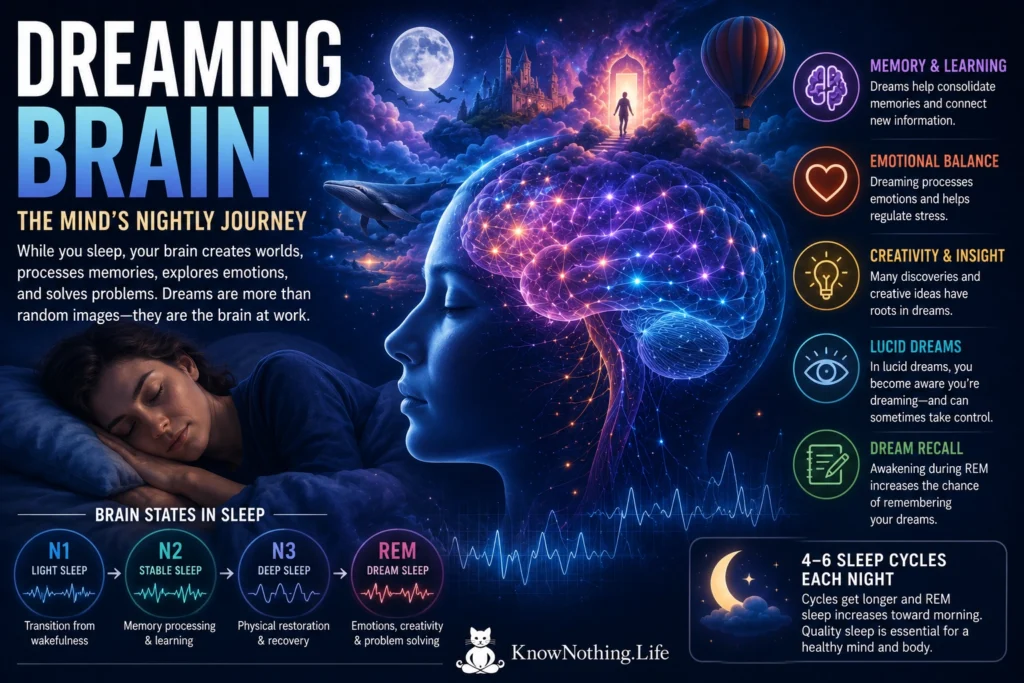
The modern science of dreaming began with Eugene Aserinsky and Nathaniel Kleitman’s 1953 study, “Regularly Occurring Periods of Eye Motility, and Concomitant Phenomena, During Sleep.” They identified recurring periods of rapid eye movements accompanied by distinctive physiological activity and frequent reports of vivid dreams. Rapid eye movement sleep, or REM sleep, became known as paradoxical sleep because the brain displays activated, wake-like electrical activity while the body remains largely immobile. During REM, skeletal muscles are strongly inhibited, breathing and heart rate become less regular, and internally generated sensory experiences can become exceptionally vivid.
Dreaming is strongly associated with REM sleep, but the two are not identical. People also report dreams after awakenings from NREM sleep, including deep sleep. NREM dreams are often shorter, more thought-like, and less visually elaborate, although vivid experiences can occur in any stage. Neurologist Mark Solms emphasized this distinction in “Dreaming and REM Sleep Are Controlled by Different Brain Mechanisms,” drawing on neurological cases in which REM physiology survived despite a loss of dreaming, or dreaming persisted despite disrupted REM mechanisms. These observations indicate that REM provides favorable conditions for vivid dreams but is not the sole generator of dream consciousness.
Neural Activity Behind Dream Experience
Dreaming appears to depend on a distributed network rather than one “dream center.” Brain-imaging research commonly finds activity in visual-association areas, limbic regions, the medial prefrontal cortex, and structures involved in memory and self-generated thought. Activity in some executive regions of the frontal cortex is reduced during ordinary dreams, potentially helping explain poor critical reasoning, unstable narratives, and the tendency to accept impossible events without question. Emotional systems can remain highly responsive: direct recordings reported by Corsi-Cabrera and colleagues showed increased human amygdala activation associated with rapid eye movements during REM sleep.
Francesca Siclari and colleagues used high-density electroencephalography to compare awakenings followed by reports of dreaming with awakenings followed by reports of no experience. In both REM and NREM sleep, dreaming was associated with reduced low-frequency activity in a posterior cortical region sometimes called the posterior hot zone. Higher-frequency activity within parts of this region was related to specific contents, including faces, movement, spatial settings, and speech. These results suggest that the presence and character of a dream depend partly on localized cortical activation rather than on sleep stage alone, although researchers continue to debate whether one posterior region can fully explain dream consciousness.
How Memories Become Dream Worlds
Dreams commonly draw from waking experience, but they rarely reproduce complete events accurately. People, places, concerns, and emotions are separated from their original contexts and recombined into new scenes. Tore Nielsen and Philippe Stenstrom described dream formation as a process involving fragments from recent events, remote memories, semantic knowledge, and personal concerns. Diary research by Josie Malinowski and Caroline Horton similarly found that most dreams contained features related to autobiographical experience, while intact replay of a specific episodic memory was extremely rare. The sleeping brain appears to extract elements from experience rather than presenting the past as a faithful recording.
Dream content also changes across the night. A serial-awakening study found that recent events were more frequently incorporated into dreams from N1 and REM sleep, while later-night dreams contained proportionally more distant memories. Similar themes could recur in different stages without producing identical narratives. In another experiment, Erin Wamsley and Robert Stickgold found that participants who dreamed about a recently practiced navigation task later showed greater improvement than participants who slept without reporting task-related dreams. This association supports the idea that some dreams reflect memory-processing activity, although dreaming about a task may indicate effective consolidation rather than directly causing it.
Emotion, Fear, and Social Experience
Dreams are frequently emotional because brain systems involved in motivation, threat detection, social relationships, and memory remain active during sleep. Anxiety, confusion, fear, curiosity, and frustration are common, but dreams can also contain affection, excitement, humor, wonder, and relief. Emotional concerns from waking life may be incorporated indirectly through similar situations rather than literal repetition. A disagreement at work might become a dream about being excluded from a group, while uncertainty about a decision might appear as being lost in an unfamiliar building.
Some theories propose that dreams help regulate emotion by reactivating difficult material in a different neurochemical environment. Rosalind Cartwright and colleagues examined dream affect across successive REM periods and found that participants with moderate presleep depressed mood showed a progression toward less negative dream emotion across the night. Other findings are mixed, and dream emotion cannot yet be considered a proven therapeutic mechanism. Dreams may reflect emotional processing, contribute to it, or emerge as a conscious side effect of the same underlying neural activity.
Nightmares illustrate what happens when threatening dream content becomes intense and repetitive. They may occur during ordinary stress but are especially common in post-traumatic stress disorder, anxiety, and disrupted sleep. Antti Revonsuo’s threat-simulation theory proposes that dreams evolved partly as virtual rehearsals for recognizing and escaping danger. The theory helps explain the frequency of pursuit, conflict, and survival themes, but many dreams contain mundane, social, creative, or nonthreatening experiences. No single evolutionary function has been shown to account for the full diversity of dreaming.
Lucid Dreams and Awareness Within Sleep
A lucid dream occurs when the dreamer recognizes that the current experience is a dream. Some lucid dreamers can intentionally change their behavior, examine the dream environment, or carry out previously planned actions. Martin Dresler and colleagues combined electroencephalography and functional brain imaging to study experienced lucid dreamers. Compared with ordinary REM dreaming, lucid dreams showed increased activity in regions associated with self-reflection, attention, and voluntary control, suggesting that lucidity partially restores cognitive abilities that are normally reduced during dreaming.
Lucid dreams have also allowed researchers to connect reported actions with measurable brain responses. In one study, participants signaled that they had become lucid using a predetermined eye-movement pattern and then repeatedly clenched a dreamed hand. The imagined movement activated corresponding regions of the sensorimotor cortex. Karen Konkoly and colleagues later demonstrated limited real-time communication with lucid dreamers in several laboratories. Sleeping participants correctly answered some spoken questions using eye movements or facial-muscle signals while remaining in verified REM sleep. These experiments show that the dreaming brain can sometimes perceive external information, perform simple calculations, and intentionally communicate without fully awakening.
Why Dreams Are So Difficult to Remember
Dream production and dream recall are not the same process. A person may experience several dreams but remember only the final one because memories formed during sleep are fragile and easily disrupted. The neurochemical environment of REM sleep differs from waking, and the brain systems needed to encode experiences into stable autobiographical memory may not operate normally. Awakening during or shortly after a dream increases the chance of recall, while returning to sleep can erase the experience within minutes.
Individual differences in dream recall are associated with brain activity as well as waking habits. Jean-Baptiste Eichenlaub and colleagues found that frequent dream recallers showed greater activity in the temporoparietal junction during both sleep and wakefulness and in the medial prefrontal cortex during REM sleep and waking rest. People with posterior cortical lesions may lose the ability to report dreams, particularly when visuoperceptual functions are also impaired. These findings suggest that dream recall depends on networks involved in mental imagery, attention, awakening, and memory encoding—not merely on whether dreaming occurred.
Why the Brain Dreams
Scientists have proposed that dreaming supports memory consolidation, emotional adaptation, threat rehearsal, creativity, social simulation, and the maintenance of predictive brain models. Evidence supports connections between dream content and several of these processes, but it has not established that dreams exist for one essential purpose. The brain mechanisms that consolidate memories and regulate emotion during sleep may generate conscious experiences as they operate. Dreams could sometimes contribute to these functions while also being products of them.
The dreaming brain demonstrates that consciousness does not require continuous sensory input from the external world. During sleep, the brain can construct immersive environments, simulated bodies, social encounters, fear, pleasure, and a temporary sense of reality from its own activity. Neuroimaging can identify patterns related to dream content, and researchers have even decoded broad visual categories from sleeping-brain activity. Yet science cannot currently reconstruct an entire dream or assign universal meanings to its symbols. Dreams remain deeply personal experiences created by biological mechanisms that researchers are only beginning to understand.