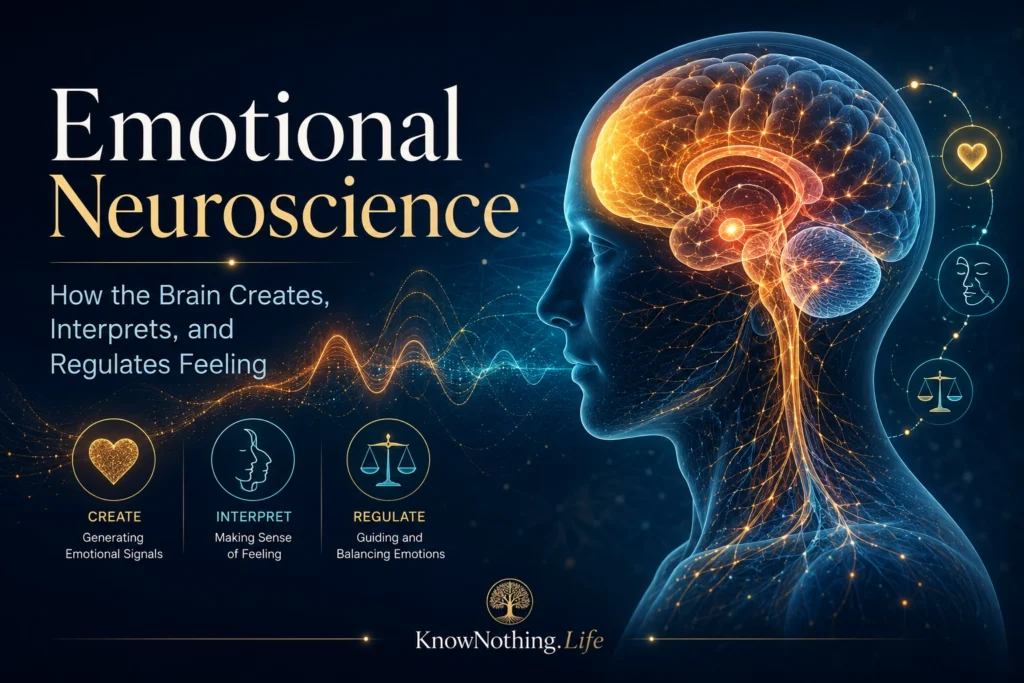
Emotional neuroscience examines how the brain and body generate emotional states, assign value to experience, and use feeling to guide attention, memory, learning, and behavior. The field overlaps with affective neuroscience, a term closely associated with Jaak Panksepp and his influential book Affective Neuroscience: The Foundations of Human and Animal Emotions. Panksepp argued that ancient subcortical systems produce primary affective states that help mammals seek resources, avoid danger, care for offspring, form attachments, play, defend themselves, and respond to separation. His framework described SEEKING, FEAR, RAGE, CARE, PLAY, LUST, and PANIC/GRIEF as evolutionarily conserved foundations of emotional life.
Modern emotional neuroscience combines brain imaging, lesion studies, electrophysiology, animal research, and clinical observation. Its central conclusion is that emotions are not produced by one “emotional center.” They emerge through interactions among systems that monitor the body, detect important events, retrieve memories, predict consequences, organize actions, and construct conscious meaning. Meta-analyses find emotion-related activity across the amygdala, insula, anterior cingulate cortex, prefrontal cortex, hypothalamus, ventral striatum, and brainstem.
Beyond the Limbic System
Older explanations often described emotion as the work of a “limbic system” opposed by the rational cortex. That model is now considered too simple. Emotional and cognitive processes are deeply integrated: attention changes emotional reactions, emotion changes perception, memories shape present feelings, and bodily arousal influences decisions. The same brain area can support emotional, cognitive, sensory, and social functions depending on the larger network in which it participates. Kristen Lindquist and Lisa Feldman Barrett support a network-based view in which broad psychological operations combine to produce states identified as fear, anger, sadness, disgust, or joy.
This does not mean that all emotions are neurologically identical. Different situations recruit partially different circuits, neurotransmitters, bodily responses, and learned concepts. However, evidence does not support a tidy map in which one region exclusively produces one emotion. Joseph LeDoux’s survival-circuit framework distinguishes neural systems that detect and respond to threats from the conscious experience of feeling afraid. Defensive reactions can begin rapidly and automatically, while conscious fear depends on additional systems that represent, interpret, and label what is happening.
The Amygdala and Emotional Significance
The amygdala is frequently described as the brain’s “fear center,” but it is better understood as a group of nuclei that helps detect biologically significant information, learn associations, and coordinate attention and adaptive responses. It participates in threat conditioning, yet it also responds to novelty, uncertainty, reward-related cues, and social signals. Its connections reach sensory areas, memory systems, the hypothalamus, brainstem, and prefrontal cortex. Elizabeth Phelps showed that the amygdala contributes to emotional learning through extensive interaction with cortical systems rather than acting alone.
When a neutral cue repeatedly predicts danger, amygdala-centered circuits help the nervous system learn the association. Later, the cue may accelerate heart rate, increase vigilance, and prepare defensive action before the person has fully interpreted the situation. Context remains crucial. The hippocampus contributes memory for places and circumstances, while prefrontal areas help determine whether a formerly threatening cue is still dangerous. Reviews of prefrontal-amygdala function show that fear acquisition, expression, extinction, and regulation depend on interconnected systems, explaining why emotional learning can be powerful without being permanently fixed.
The Body, Insula, and Interoception
Emotions are experienced through the body as well as the brain. Heartbeat, breathing, muscle tension, temperature, pain, hunger, and hormonal activity provide information about the organism’s internal condition. The nervous system’s sensing, interpretation, and integration of these signals is called interoception. The insular cortex is a major part of this process, helping represent bodily states and connect them with attention, prediction, motivation, and conscious feeling. Contemporary frameworks describe interoception as a multilevel system operating both within and outside awareness.
Bodily feedback does not simply decorate an emotion after the brain creates it. It can shape emotional intensity and meaning. A pounding heart may be experienced as fear during a threat, excitement before a performance, or exertion during exercise because the brain interprets bodily signals in relation to context, memory, and expectation. Experimental work indicates that the insular cortex integrates sensory and interoceptive information to calibrate defensive behavior. Blood-pressure pulses can also rapidly modulate neuronal activity, illustrating how tightly emotion is coupled to physiology.
Reward, Motivation, and Social Emotion
Emotional neuroscience is not limited to fear and stress. Positive emotion and motivation depend on reward circuits linking the ventral tegmental area, nucleus accumbens, ventral striatum, orbitofrontal cortex, amygdala, hippocampus, and prefrontal regions. Dopamine is often called a pleasure chemical, but its role is broader: it helps organisms learn which cues predict valuable outcomes, energizes approach, and supports goal pursuit. Panksepp’s SEEKING system anticipated this emphasis by describing an exploratory motivational network that drives engagement with the environment rather than passive pleasure alone.
Pleasure, wanting, learning, and satisfaction are related but separable. A person can strongly want an outcome without enjoying it proportionally, as addiction research demonstrates. Social rewards also recruit motivational circuitry. Research on oxytocin shows that it can affect the detection and salience of social cues, bonding, approach behavior, and the rewarding properties of interaction, but its effects depend on context. Modern reviews therefore treat oxytocin as one component of broader social-emotional systems rather than a universal “love hormone.”
Emotion Regulation, Memory, and the Prefrontal Cortex
Emotion regulation includes processes that change which emotions arise, when they arise, and how they are experienced or expressed. The prefrontal cortex supports regulation by maintaining goals, shifting attention, inhibiting habitual reactions, changing interpretations, and evaluating consequences. Cognitive reappraisal—deliberately interpreting a situation differently—is one of the most studied strategies. A major meta-analysis by Jason Buhle and colleagues found that reappraisal recruits frontal and parietal control systems while altering responses in emotion-related regions, including the amygdala.
Regulation is not merely the rational brain suppressing an irrational emotional brain. Emotion can guide good decisions, while excessive control can become avoidance, detachment, or rumination. Effective regulation is flexible: sometimes a person benefits from calming a feeling, sometimes from sustaining it, and sometimes from acting on its information. Amygdala-prefrontal connectivity helps explain individual differences in regulatory success, while chronic stress can weaken prefrontal functions involved in working memory, self-control, and goal-directed behavior.
Emotion also influences what people remember. Arousing events receive priority when they signal danger, reward, loss, or social importance. The amygdala interacts with the hippocampus and cortical memory systems to strengthen selected aspects of experience, although emotional memory remains reconstructive rather than perfectly accurate. The medial prefrontal cortex helps connect memories, contexts, and adaptive responses, allowing previous experiences to shape present emotional expectations.
Emotional Neuroscience and Mental Health
Many psychiatric conditions involve disrupted emotional networks rather than damage to one structure. Anxiety disorders may include heightened threat prediction and difficulty updating safety learning. Depression can involve altered reward processing, negative expectations, stress physiology, and impaired regulation. Post-traumatic stress disorder often includes persistent defensive responses, intrusive memory, avoidance, and disrupted prefrontal control over threat processing. These conditions vary greatly, so researchers increasingly study circuits, connectivity, development, and symptom dimensions rather than searching for one marker for each diagnosis.
The field also demonstrates that emotional systems are plastic. Learning, psychotherapy, medication, social relationships, sleep, exercise, and repeated patterns of attention can change how emotional networks function, although change is rarely immediate or uniform. Emotional neuroscience therefore does not reduce love, grief, fear, or hope to chemicals and brain scans. Its deeper contribution is to show how evolution, physiology, memory, culture, and conscious interpretation converge in every emotional episode. Feelings are not separate from reason or mere noise in the nervous system. They are embodied signals that help the brain determine what matters and prepare the person to respond.