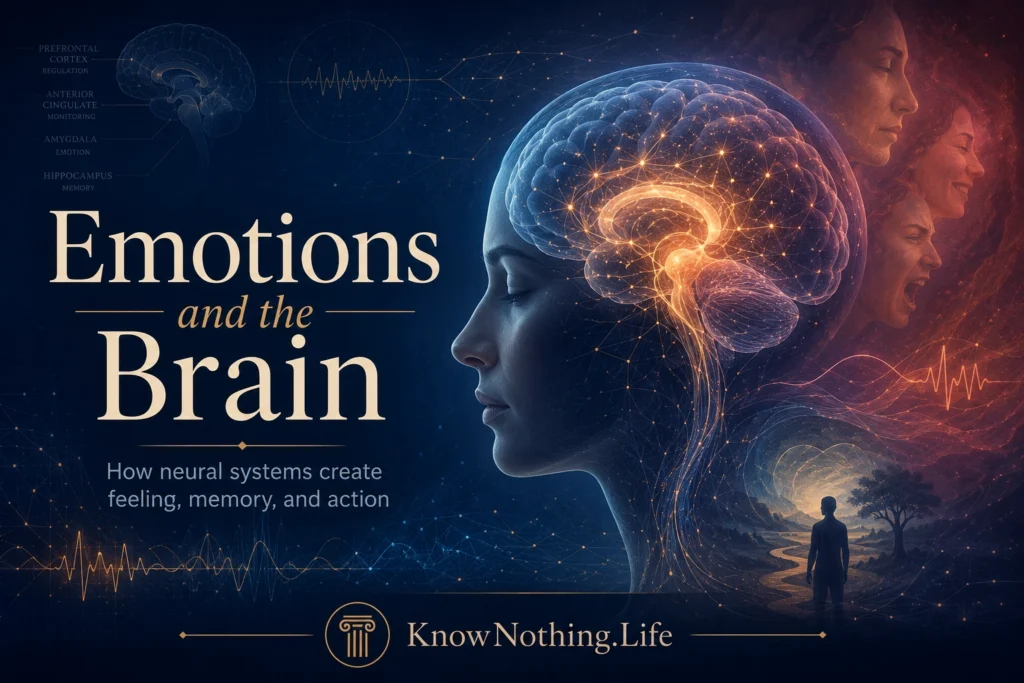
Emotions are coordinated states that help the brain and body respond to events that matter. Fear prepares an organism to detect and escape danger, anger can support confrontation, sadness may redirect attention toward loss, and joy can reinforce rewarding relationships or activities. An emotion is not only a private feeling. It can include changes in attention, memory, facial expression, posture, heart rate, hormone release, motivation, and decision-making. These components often occur together, but they can also become partly separated. A person may show bodily arousal without clearly identifying a feeling or experience an emotion without expressing it openly.
There is no single emotional center in the brain. Emotional episodes emerge from interactions among the amygdala, hypothalamus, brainstem, insula, striatum, hippocampus, cingulate cortex, and prefrontal regions, together with signals from the body and information about the surrounding situation. Different emotions recruit overlapping systems in different patterns. In a 2015 neuroimaging study, Philip Kragel and Kevin LaBar found that distributed patterns of brain activity could distinguish states such as fear, anger, sadness, amusement, surprise, and contentment better than chance, even though individual regions were not uniquely dedicated to one emotion.
Early Theories of Emotion
Modern debates about emotion were strongly shaped by William James. In The Principles of Psychology, published in 1890, James argued that people do not simply encounter an event, consciously feel an emotion, and then experience bodily changes. Instead, the perception of bodily responses is central to emotional experience. From this perspective, people feel afraid partly because they notice trembling, changes in breathing, muscular tension, and other physical reactions. The theory became associated with Danish physiologist Carl Lange and is now known as the James–Lange theory.
Walter Cannon challenged this account in Bodily Changes in Pain, Hunger, Fear and Rage. He argued that similar visceral reactions occur across different emotions and that bodily changes alone may be too slow or undifferentiated to explain the richness of emotional experience. Later, Stanley Schachter and Jerome Singer proposed that emotion depends on both physiological arousal and the interpretation of that arousal within a particular context. Their influential 1962 experiment suggested that social information could affect how participants labeled an aroused bodily state. These theories disagree about sequence and causation, but each identified an enduring part of the problem: emotions involve bodily activity, neural processing, interpretation, and the meaning assigned to physiological change.
The Amygdala and Fear Learning
The amygdala is often described as the brain’s fear center, but this label is too simple. It is a group of nuclei that helps detect biologically significant information and connect sensory events with defensive responses, attention, learning, and memory. In a landmark 1990 study, Joseph LeDoux and his colleagues found that the lateral amygdala receives auditory information needed for fear conditioning. When a neutral sound is repeatedly paired with an aversive event, amygdala circuits help the sound acquire the ability to trigger defensive reactions.
Research comparing amygdala and hippocampal lesions further clarified these functions. Ralph Phillips and LeDoux found that amygdala damage interfered with fear conditioning involving both a specific cue and the wider environment, whereas hippocampal damage more selectively impaired fear associated with the surrounding context. The amygdala therefore contributes to attaching defensive significance to stimuli, while the hippocampus helps represent where and under what circumstances a threatening event occurred.
Lesion research also demonstrates the limits of calling the amygdala a universal fear center. Justin Feinstein and colleagues studied a woman known as patient S.M., whose bilateral amygdala damage left her unusually unable to experience fear in response to many external threats used in laboratory and real-world tests. Yet a later experiment found that inhaling carbon dioxide produced intense fear and panic in S.M. and two other people with bilateral amygdala damage. The contrast suggests that the amygdala is especially important for organizing responses to many external dangers, while internal bodily threat signals can recruit additional pathways capable of generating panic without it.
The Body, the Insula, and Subjective Feeling
Emotions are experienced through a living body. The brain continually receives information about breathing, heartbeat, temperature, pain, digestion, muscle tension, and hormonal state. This process is called interoception. Bodily signals do not mechanically determine one specific emotion, but they provide information that the brain can combine with memories, expectations, goals, and context. A racing heart can contribute to fear during a threat, excitement before a performance, or attraction during a social encounter.
Hugo Critchley and his colleagues investigated interoceptive awareness by asking participants to judge their own heartbeats during brain imaging. Activity in the right anterior insula predicted how accurately people detected their heartbeats, and the same region was related to subjective awareness of bodily responses and negative emotional experience. The findings supported the idea that the insula helps create conscious feeling by representing the internal condition of the body. Emotions are therefore neither purely mental judgments nor automatic bodily reflexes. They emerge partly through the brain’s ongoing interpretation of physiological state.
The hypothalamus and brainstem also help translate emotional significance into bodily action. They influence heart rate, breathing, hormone release, defensive posture, appetite, and other responses necessary for adaptation. The prefrontal cortex and cingulate cortex can then modify these reactions according to goals and social circumstances. Someone may feel anger while choosing not to act aggressively, or experience fear while deciding that the apparent danger is manageable. Emotional experience reflects both automatic preparation and higher-level evaluation.
Emotion Changes What We Remember
Emotion gives some experiences lasting priority in memory. A frightening accident, humiliating mistake, joyful reunion, or major achievement may remain vivid long after routine events from the same period have disappeared. Emotional arousal directs attention toward significant details and activates hormonal and neural systems that influence memory consolidation. The amygdala interacts with the hippocampus and other memory systems rather than storing a complete emotional memory by itself.
Larry Cahill and his colleagues demonstrated this relationship in human research. In a 1995 case study, a patient with selective amygdala damage failed to show the usual memory advantage for the emotionally arousing portion of a story. In a subsequent positron emission tomography study, amygdala activity while participants viewed emotional material was correlated with how much of that material they freely recalled several weeks later. These findings helped establish that amygdala activity can modulate the storage of emotionally important experiences in other brain systems.
Emotional memory is adaptive because events involving danger, reward, attachment, or loss may contain information important for future behavior. However, emotional intensity does not guarantee a perfectly accurate record. Attention may become focused on central details while peripheral information receives less processing, and memories can change during later recall. Emotion can strengthen the persistence and confidence of memory without turning the brain into an objective recording device.
Emotion and Decision-Making
Reason and emotion are often treated as opponents, but effective decision-making depends on their interaction. Emotions assign value to possible outcomes, signal danger or opportunity, and help narrow the enormous number of choices a person could consider. Without emotional valuation, someone may understand facts and rules yet struggle to decide what deserves priority. The prefrontal cortex, amygdala, insula, and striatum work together to compare immediate rewards, future consequences, uncertainty, and bodily reactions.
In a 1997 study, Antoine Bechara, Hanna Damasio, Daniel Tranel, and Antonio Damasio used the Iowa Gambling Task to compare healthy participants with patients who had prefrontal damage and serious real-life decision-making problems. Healthy participants began producing anticipatory skin-conductance responses before choosing from disadvantageous card decks, whereas the patients failed to develop comparable warning signals and continued making costly selections. The work supported the somatic-marker hypothesis, which proposes that bodily and emotional signals can influence choices before people can fully explain the reasoning behind them.
Emotion can improve judgment when it carries relevant information, but it can impair judgment when it becomes disproportionate or attached to misleading cues. Anxiety may encourage appropriate caution or lead someone to overestimate danger. Anger may create determination while also increasing impulsivity. The effects depend on the emotion, its intensity, the situation, previous learning, and the individual’s capacity to regulate attention and behavior.
How the Brain Regulates Emotion
Emotion regulation does not mean eliminating feelings. It refers to processes that influence which emotions arise, how strongly they are experienced, how long they continue, and how they are expressed. People regulate emotion by changing situations, shifting attention, reconsidering meaning, suppressing behavior, seeking support, or acting on the feeling. These strategies have different effects because they intervene at different stages of an emotional episode.
Cognitive reappraisal involves changing the interpretation of a situation to alter its emotional impact. A person might reinterpret criticism as useful information, view a stressful performance as a challenge, or remind themselves that a frightening image is fictional. In a 2002 functional imaging study, Kevin Ochsner and colleagues found that reappraisal recruited prefrontal and cingulate regions associated with cognitive control while changing activity in systems involved in emotional processing.
Later research comparing reappraisal with expressive suppression found that the strategies differed in their effects on emotional experience, facial behavior, and neural activity. Reappraisal attempts to modify the meaning of an event, whereas suppression attempts to conceal an emotional response after it has already developed. These findings show that regulation is not a single control switch. It is a dynamic interaction in which systems involved in language, attention, memory, and self-control reshape the meaning and expression of emotional events.
Understanding the Emotional Brain
The science of emotion has moved away from searching for one structure that contains fear, anger, happiness, or sadness. Specific regions make important contributions, but emotions are assembled through networks that integrate sensory information, bodily condition, past experience, goals, social context, and predictions about what may happen next. The amygdala supports threat learning and relevance detection, the insula represents internal bodily state, the hippocampus supplies context and memory, the striatum contributes to reward and action, and prefrontal systems help interpret and regulate emotional responses.
Emotions are not irrational interruptions imposed on an otherwise logical brain. They organize attention, prepare action, strengthen learning, communicate social information, and assign value to choices. They can become excessive, inaccurate, or difficult to regulate, but they remain essential to adaptive behavior. Understanding emotions and the brain therefore requires more than mapping feelings onto anatomy. It requires explaining how neural activity, bodily responses, interpretation, memory, and social experience combine to create meaningful states that prepare people to act.