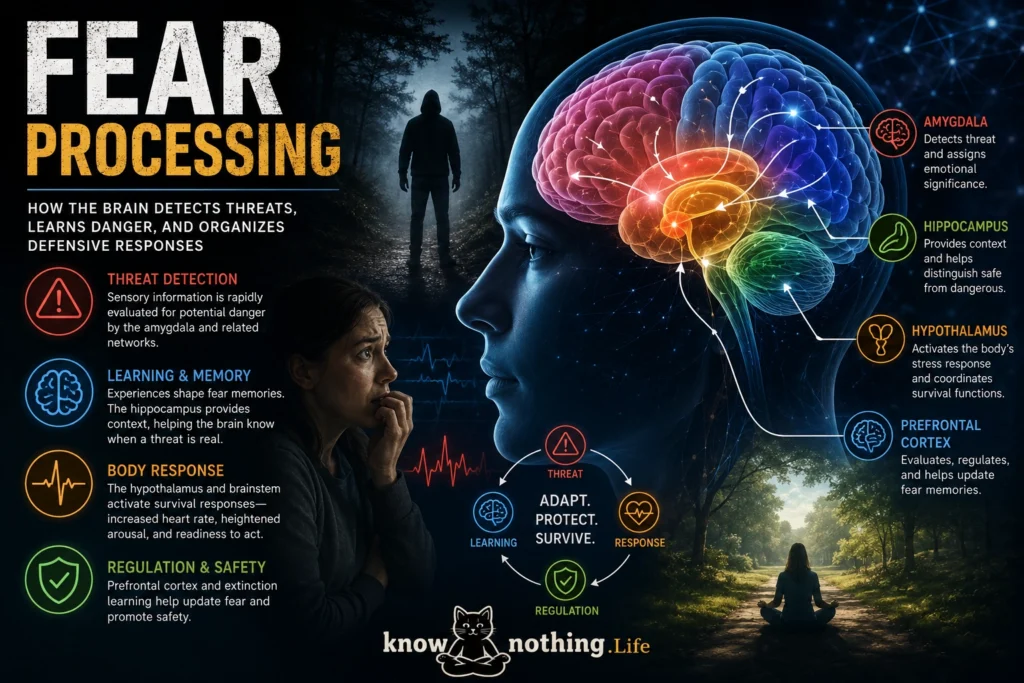
Fear processing refers to the coordinated neural and bodily operations through which an organism detects possible danger, evaluates its meaning, learns from threatening events, and selects a response. These operations can sharpen attention, change breathing and heart rate, strengthen memory, and prepare freezing, escape, avoidance, or defensive action. Fear is therefore part of a survival system linking perception, learning, physiology, memory, and behavior. Joseph LeDoux’s research on conditioned threat responses helped establish that the brain can learn relationships between neutral cues and aversive events, allowing defensive reactions to begin when those cues appear again.
Modern neuroscience distinguishes defensive responses from the conscious experience of being afraid. A person may startle or freeze before consciously identifying why, while conscious fear requires interpretation of bodily sensations, memories, expectations, and context. This distinction has weakened the popular idea of a single “fear center.” The amygdala is important for many forms of threat learning, but fear processing also depends on the hippocampus, prefrontal cortex, insula, hypothalamus, thalamus, brainstem, and periaqueductal gray. Their influence changes with the nature and immediacy of the threat.
The Amygdala and Learning What Predicts Danger
Much of what neuroscience knows about fear processing comes from Pavlovian fear conditioning. In this procedure, a neutral cue such as a tone is paired with an aversive event. After learning, the cue alone can trigger defensive responses. In a landmark 1990 experiment, LeDoux and colleagues found that lesions of the lateral amygdala disrupted auditory fear conditioning in rats, supporting the idea that this region connects sensory signals with threat value. Human imaging later extended this work: Kevin LaBar, Elizabeth Phelps, and colleagues observed amygdala activity during the acquisition and extinction of conditioned fear.
The amygdala is not one uniform structure. Its lateral and basolateral regions integrate sensory and contextual information, while central pathways influence systems that organize defensive output. Cell-specific studies have revealed finer divisions. Stéphane Ciocchi and colleagues showed that inhibitory microcircuits within the central amygdala contribute differently to acquiring and expressing conditioned fear. Jonathan Fadok and colleagues later identified competing central-amygdala cell populations involved in selecting active flight or passive freezing in mice. The amygdala is therefore a flexible learning and action-selection circuit, not a simple alarm button.
Context, Memory, and Fear Generalization
Threat cues do not have the same meaning in every environment. The hippocampus helps represent the context in which an event occurs. In a classic lesion study, Robert Phillips and LeDoux found that amygdala damage disrupted conditioned responses to both a simple cue and the surrounding context, whereas hippocampal damage selectively impaired contextual fear conditioning. The amygdala helps assign defensive significance, while the hippocampus identifies the situation in which it should apply.
Context also explains why a fear that appears to be gone can return. Extinction repeatedly presents a threat-predicting cue without the expected aversive outcome, creating new learning that the cue is currently safe. It does not necessarily erase the original association. Mohammed Milad and colleagues demonstrated that human extinction memory is context dependent: physiological fear responses remained low in the setting where extinction occurred but returned when the cue was presented in the earlier conditioning context. Excessive generalization, however, can cause harmless people, sensations, or environments to trigger responses after the original threat has ended.
The Body and the Immediacy of Threat
Fear processing changes as danger becomes more immediate. Michael Fanselow’s defensive-behavior model proposed that animals shift among pre-encounter vigilance, post-encounter freezing, and circa-strike escape or fighting depending on proximity to threat. Dean Mobbs and colleagues tested a related idea in humans using a virtual predator that could chase participants and deliver an unpleasant shock. Distant threat emphasized regions associated with evaluation and planning. As capture approached, activity shifted toward the periaqueductal gray, while dread increased and confidence in escape decreased.
The body is not simply carrying out commands issued by the brain. Internal signals can themselves become sources of danger information. Justin Feinstein and colleagues found that inhaling concentrated carbon dioxide produced fear and panic even in rare patients with bilateral amygdala damage. Animal work by John Wemmie and colleagues showed that carbon dioxide and resulting acidity can engage acid-sensing mechanisms relevant to defensive behavior. Externally perceived threats and internally generated alarms can therefore reach fear through partly different pathways.
Conscious Fear and Social Information
The amygdala contributes to recognizing signals of danger in other people. Ralph Adolphs and colleagues reported that bilateral amygdala damage could impair recognition of fear in facial expressions while leaving recognition of identity relatively intact. A later study involving nine individuals with bilateral amygdala damage found a group-level difficulty recognizing fearful expressions, although performance varied. The amygdala helps direct attention toward threat information, but conscious fear emerges from distributed systems integrating perception, bodily arousal, memory, language, and beliefs.
Humans also learn fear without direct injury. Phelps and colleagues showed that verbal instruction that a stimulus might predict shock was sufficient to recruit the amygdala and generate anticipatory responses. Andreas Olsson, Katherine Nearing, and Phelps later found that watching another person react to an aversive event could establish fear toward the observed cue, engaging amygdala mechanisms similar to direct conditioning. This allows people to learn about hazards without personally experiencing them, while also making fear sensitive to family behavior, cultural narratives, and repeated warnings.
Extinction, Regulation, and Maladaptive Fear
Fear memories remain open to modification. During extinction, the amygdala continues to represent learned significance while the ventromedial prefrontal cortex and hippocampus help retrieve information that a cue is safe in a particular context. Phelps and colleagues found that human extinction learning involved both the amygdala and ventromedial prefrontal cortex. Milad and colleagues later showed that successful recall of extinction recruited the ventromedial prefrontal cortex and hippocampus together, with greater activation related to stronger extinction memory. Regulation depends on coordinated retrieval of competing danger and safety memories.
Retrieved fear memories may also become temporarily unstable before being stored again, a process called reconsolidation. Daniela Schiller and colleagues reported that presenting extinction training during this reconsolidation window reduced the later return of conditioned fear in their human experiment. The study suggested that old threat memories might sometimes be updated rather than merely suppressed, although the limits of reconsolidation remain under investigation.
Maladaptive fear develops when defensive systems respond too strongly, generalize too broadly, persist after danger has passed, or fail to retrieve safety learning. In a twin study, Milad and colleagues found reduced recall of fear extinction in combat-exposed participants with post-traumatic stress disorder compared with their non-exposed identical twins and other groups, suggesting that the deficit was associated with acquired PTSD rather than simply a preexisting vulnerability. Fear-processing research therefore helps explain anxiety, panic, phobias, and traumatic stress without reducing them to one damaged region. Suffering arises when protective systems cannot accurately distinguish present danger from remembered, imagined, or uncertain threat.