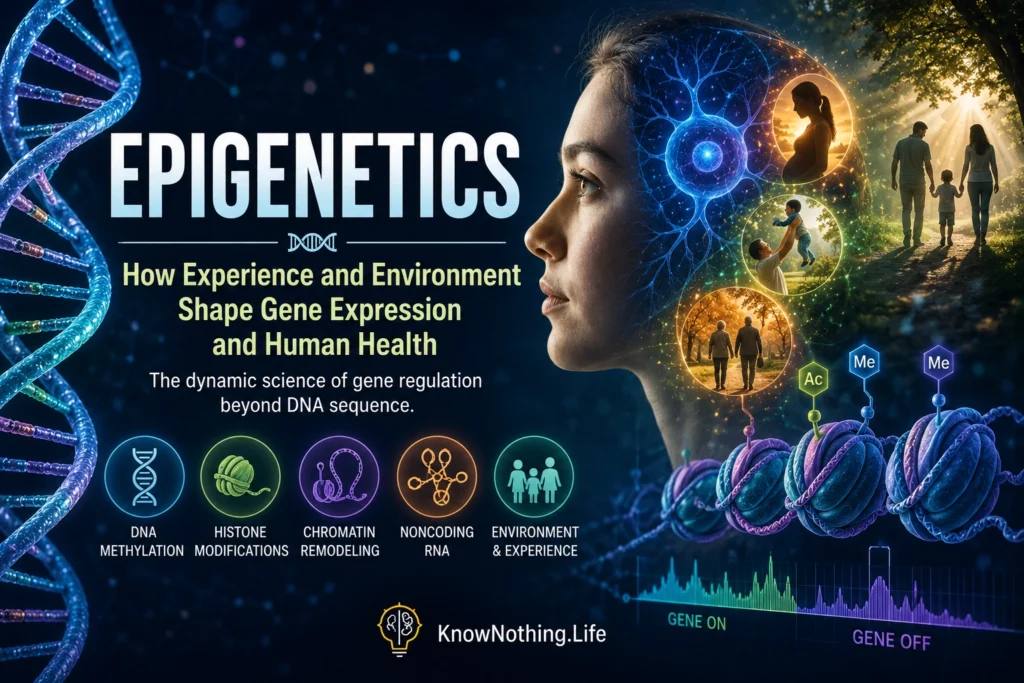
Epigenetics is the study of molecular processes that influence how genes are used without changing the underlying DNA sequence. Nearly every cell in the human body contains essentially the same genome, yet neurons, muscle cells, and immune cells differ dramatically in structure and function. These differences arise because each cell activates some genes, suppresses others, and organizes its chromosomes in a specialized way. Epigenetic regulation helps establish and maintain those patterns through DNA modification, chemical changes to histone proteins, chromatin remodeling, three-dimensional chromosome organization, and regulatory noncoding RNA.
The familiar idea that epigenetic marks are switches that turn genes on or off is useful but incomplete. Many marks fine-tune expression, and their effects depend on genomic location, cell type, developmental stage, and the proteins that interpret them. Some states persist through many rounds of cell division and provide a form of cellular memory; others change quickly in response to biological signals. Epigenetics therefore does not replace genetics. DNA sequence provides instructions and regulatory sites, while the epigenetic system helps determine when, where, and how strongly those instructions are read.
DNA Methylation and Histone Regulation
DNA methylation is one of the best-studied epigenetic mechanisms. In mammals, enzymes commonly attach a methyl group to cytosine bases, especially at cytosine–guanine sites called CpGs. Depending on its location, methylation can interfere with regulatory proteins or recruit proteins that support gene repression. Maintenance enzymes copy many patterns when cells divide, while DNMT3A and DNMT3B establish new methylation. In 1999, Masaki Okano and colleagues showed that eliminating Dnmt3a and Dnmt3b disrupted de novo methylation and normal mouse development, demonstrating that these enzymes are essential components of developmental regulation.
Methylation is not a universal “off” label. Ryan Lister and colleagues produced single-base maps of human embryonic stem cells and fetal fibroblasts in 2009, finding extensive differences between the cell types and unexpectedly widespread non-CpG methylation in embryonic stem cells. DNA is also wrapped around histone proteins to form chromatin. Chemical modifications to histones can alter DNA accessibility or create docking sites for other proteins. In 2001, Thomas Jenuwein’s group and others showed that methylation of histone H3 at lysine 9 creates a binding site for heterochromatin protein 1, linking a specific histone mark to compact, repressive chromatin.
Development and Cellular Identity
Epigenetic regulation is fundamental to development because an embryo must generate many specialized cell types from one fertilized cell. As cells divide and differentiate, transcription factors work with DNA methylation, histone modifications, chromatin-remodeling complexes, and chromosome architecture to stabilize new identities. Some regions become accessible to lineage-specific regulators, while other developmental programs are silenced. Genome-wide studies have shown that methylation patterns are extensively reorganized as stem cells differentiate, allowing cells with the same DNA sequence to adopt very different functions.
Cell identity is stable, but it is not completely irreversible. Experiments in cellular reprogramming show that mature cells can be pushed toward a pluripotent state by altering regulatory networks and rebuilding their epigenome. Studies of induced pluripotent stem cells have detected broad resetting of methylation and chromatin, but also incomplete reprogramming and residual memory of donor tissue. In 2011, Lister and colleagues identified recurrent regions of abnormal or incomplete methylation in human induced pluripotent stem cells. The results showed that epigenetic reprogramming is powerful but not automatically perfect, an important concern when reprogrammed cells are considered for disease modeling or regenerative medicine.
Experience, Environment, and the Brain
Environmental conditions can influence epigenetic regulation because cells respond to hormones, nutrients, toxins, inflammation, neuronal activity, and stress signals. This does not mean that every experience leaves a permanent molecular mark or that behavior can be explained by methylation at one gene. Researchers must distinguish correlation from causation, account for differences in the types of cells present in a sample, and determine whether a measured change is a cause, consequence, or by-product of a biological state. The strongest evidence comes from experiments that manipulate a mechanism and measure its functional effects.
A landmark animal study by Ian Weaver and colleagues examined maternal care and stress regulation in rats. Offspring receiving different patterns of maternal licking and grooming showed differences in methylation and chromatin near a glucocorticoid receptor gene in the hippocampus, along with differences in gene expression and stress responses. Cross-fostering and pharmacological experiments supported a causal relationship and showed that some effects could be reversed. In humans, Bastiaan Heijmans and colleagues found that people exposed around conception to the Dutch Hunger Winter showed lower methylation at a regulatory region of the imprinted IGF2 gene about six decades later than their unexposed siblings. The human study identified a persistent association, but it did not prove that methylation alone caused later health outcomes.
Epigenetics in Disease and Inheritance
Epigenetic disruption can contribute to disease when regulatory states develop in the wrong cells, at the wrong genes, or at the wrong stage. Cancer is a clear example. Tumor cells often show widespread loss of methylation in some genomic regions alongside abnormal gain of methylation at particular regulatory regions. These alterations may destabilize chromosomes, affect repetitive DNA, or silence genes that restrain cell growth. In 1983, Andrew Feinberg and Bert Vogelstein reported reduced methylation in DNA from several human tumors compared with normal tissue, helping establish cancer epigenetics as a major research field. In the nervous system, research by Junjie Guo and colleagues found abundant non-CpG methylation in mature neurons and showed that it is recognized by MeCP2, the protein disrupted in most cases of Rett syndrome.
Epigenetic information is routinely inherited when one body cell divides into two daughter cells, allowing liver cells and skin cells to preserve their identities. Inheritance between generations is more difficult. During the formation of eggs and sperm and after fertilization, mammals undergo extensive reprogramming that erases and rebuilds much of the methylation landscape. Zachary Smith and colleagues mapped this process in mouse embryos, showing why stable transmission of acquired epigenetic states faces a major biological barrier. Animal studies suggest that limited information can sometimes pass through germ cells through retained chromatin states or sperm RNA, but evidence for environmentally induced transgenerational inheritance in humans remains limited and difficult to separate from shared genes, culture, diet, and prenatal exposure.
Epigenetic Medicine and the Future
Because epigenetic states can sometimes be modified, they offer potential targets for treatment. Drugs that affect DNA methylation or histone-modifying enzymes have become important therapeutic and research tools, particularly in cancer. A newer approach is targeted epigenome editing, in which an inactive CRISPR-associated protein is guided to a selected DNA sequence while carrying an enzyme that adds or removes a regulatory mark. Unlike conventional gene editing, the aim is to change gene activity without cutting or rewriting the DNA sequence. In 2021, Muneaki Nakamura and colleagues created CRISPR-based combinations that produced durable gene silencing in cultured cells through coordinated DNA methylation and repressive chromatin.
The future of the field will depend on increasingly precise maps of particular cells, tissues, and stages of life. Single-cell methods are revealing regulatory differences that were hidden when millions of mixed cells were analyzed together, while longitudinal studies may clarify whether epigenetic changes precede disease or follow it. The central lesson is not that genes are unimportant or that experience can freely rewrite biology. It is that the genome operates within a dynamic regulatory system. Epigenetics helps explain how one DNA sequence supports many cell identities, how development stabilizes biological programs, and how regulation can remain durable while still retaining a capacity for change.