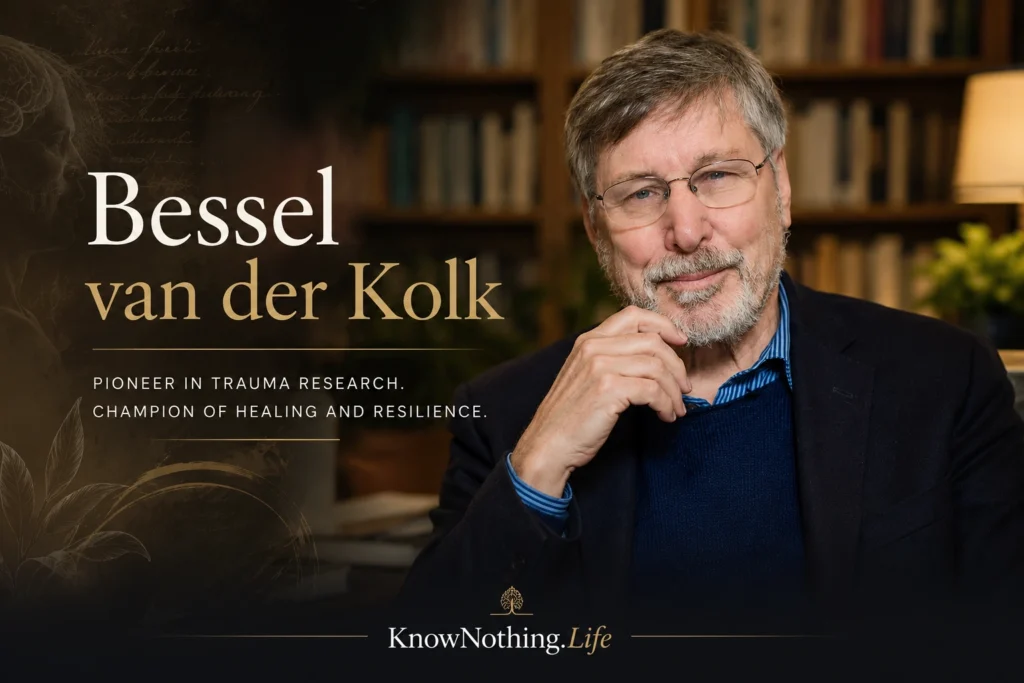
Bessel van der Kolk is a Dutch-born American psychiatrist, researcher, and author whose work helped transform the modern understanding of psychological trauma. Beginning with Vietnam veterans in the late 1970s, he studied why terrifying experiences may continue to shape emotion, memory, relationships, and physical states long after immediate danger has ended. His central argument is that trauma cannot be understood only as a disturbing story about the past. It can also persist as a present-tense pattern of alarm, numbness, bodily tension, dissociation, and difficulty feeling safe.
Van der Kolk became internationally known through The Body Keeps the Score: Brain, Mind, and Body in the Healing of Trauma, but his influence began decades earlier through clinical research, professional organizations, and books written for specialists. He helped direct attention from combat trauma toward childhood abuse, neglect, domestic violence, and disrupted attachment. He also encouraged researchers to examine treatments involving movement, bodily awareness, relationships, and creative expression alongside established psychotherapies and medication.
Early Life and Medical Education
Bessel A. van der Kolk was born in The Hague in 1943, during the Nazi occupation of the Netherlands. He has described growing up amid the consequences of war, including hunger, social devastation, and a family marked by his father’s wartime imprisonment. These experiences did not determine his career, but they later supplied a personal context for his interest in how people adapt to danger and how violence can affect families and communities across generations.
He studied at the University of Hawaii, completing a bachelor’s degree in 1965 with premedical preparation and political science. He earned his medical degree from the University of Chicago’s Pritzker School of Medicine in 1970, completed an internship at Queen’s Medical Center in Honolulu, and trained in psychiatry at the Massachusetts Mental Health Center from 1971 to 1974. His education exposed him to biological psychiatry, psychoanalysis, community mental health, and clinicians who treated symptoms as experiences carrying personal histories and meanings.
Vietnam Veterans and the Study of PTSD
Van der Kolk’s decisive encounter with traumatic stress came while working with Vietnam veterans at a Veterans Administration clinic in Boston. Many suffered nightmares, emotional withdrawal, explosive reactions, substance misuse, and an inability to settle into civilian life. Their responses challenged models that treated symptoms as isolated disorders or personal weakness. He became interested in how traumatic experience could reorganize a person’s sense of danger, intimacy, and time, leaving the nervous system prepared for threats that were no longer present.
Posttraumatic stress disorder entered the third edition of the Diagnostic and Statistical Manual of Mental Disorders in 1980, giving clinicians a shared language for patterns observed after war, assault, disaster, and other overwhelming experiences. Van der Kolk contributed to the developing field through research, teaching, and professional leadership, including service as president of the International Society for Traumatic Stress Studies. His work emphasized that traumatic reactions were not confined to soldiers and could arise within homes, schools, neighborhoods, and intimate relationships.
The Trauma Center and Psychobiological Research
In 1982, van der Kolk founded the Trauma Center in Massachusetts, one of the early American clinical and research programs devoted to traumatic stress in civilian populations. The center trained clinicians and investigated overwhelming experience across childhood and adulthood. His research included early studies of selective serotonin reuptake inhibitors for PTSD, participation in pioneering neuroimaging work, and investigations connecting childhood maltreatment with dissociation, self-injury, and severe difficulties in emotional regulation.
This work supported a psychobiological account of trauma. Instead of locating distress solely in beliefs or verbal memories, van der Kolk described trauma as affecting systems involved in threat detection, attention, arousal, bodily sensation, and social connection. A person may intellectually recognize that danger has passed while still reacting with panic, shutdown, or rage. His conclusion was not that reasoning is useless, but that insight alone may be insufficient when automatic survival responses continue to dominate everyday experience.
Childhood Trauma, Attachment, and Development
A major part of van der Kolk’s career has focused on children exposed to chronic abuse, neglect, instability, or violence by caregivers. These experiences occur while the brain, identity, emotional regulation, and expectations of relationships are still developing. Children may become highly alert to anger, struggle to calm themselves, disconnect from bodily feelings, or interpret ordinary frustration as an emergency. Their behavior can then attract several diagnoses that describe separate symptoms without capturing the developmental history beneath them.
Van der Kolk proposed developmental trauma disorder as a framework for these complex adaptations. The proposal was not adopted as a separate diagnosis in the DSM, but it stimulated research and debate about how chronic interpersonal trauma affects children beyond the conventional symptom pattern of PTSD. He also helped initiate the process that led to the National Child Traumatic Stress Network, created by Congress in 2000 to improve access to trauma-informed services and raise standards of care for affected children and families.
The Body Keeps the Score
Published in 2014, The Body Keeps the Score synthesized van der Kolk’s clinical experiences with research on attachment, memory, neuroscience, and treatment. Its title expresses the idea that traumatic experience can remain active through bodily states and automatic reactions even when a person cannot easily narrate what happened. The book describes survivors caught between intrusive reliving and emotional numbness, arguing that recovery involves restoring the ability to inhabit the present rather than living as though the original danger were continuing.
The book also places relationships at the center of mental health. Van der Kolk writes, “Being able to feel safe with other people is probably the single most important aspect of mental health.” Safety does not mean avoiding every difficult emotion; it means developing enough trust and internal stability to remain connected without becoming overwhelmed. In an interview, he similarly observed, “To feel and know your body safely is an essential ingredient of healing.” Together, these statements capture his belief that recovery requires both relational security and renewed ownership of bodily experience.
Treatment, Embodiment, and the Search for Safety
Van der Kolk has advocated a broad treatment repertoire rather than a single universal method. He has researched or promoted approaches including eye movement desensitization and reprocessing, yoga, neurofeedback, theater, rhythmic activity, meditation, and MDMA-assisted psychotherapy. His rationale is that traumatized people may need experiences of agency, coordinated movement, bodily control, and safe connection in addition to verbal understanding. Some of these methods have accumulated stronger evidence than others, and one approach will not work for every patient.
His research groups conducted randomized studies of EMDR and trauma-sensitive yoga, while later work examined neurofeedback and MDMA-assisted treatment. These efforts widened the questions asked by trauma researchers, but they also generated debate about how firmly particular brain-based explanations and body-oriented therapies are supported. Van der Kolk’s importance lies partly in making those questions unavoidable: effective care should address the whole person while remaining accountable to careful evidence, individual differences, and clinical safety.
Major Works and Lasting Influence
Before his popular bestseller, van der Kolk edited or coedited several important professional volumes. Post-Traumatic Stress Disorder: Psychological and Biological Sequelae appeared in 1984, followed by Psychological Trauma in 1987. With Alexander McFarlane and Lars Weisaeth, he edited Traumatic Stress: The Effects of Overwhelming Experience on Mind, Body, and Society in 1996. These works helped organize an emerging field around the biological, psychological, developmental, and social consequences of overwhelming events.
Van der Kolk’s career has also drawn controversy. In 2018, the organization overseeing the Trauma Center ended his role amid allegations that he had created a hostile workplace; he denied mistreating employees and disputed the reasons for his dismissal. He subsequently continued his work through the Trauma Research Foundation. His lasting influence nevertheless remains substantial: he helped move trauma from the margins of psychiatry into public discussion, expanded attention to childhood and relational injury, and argued that recovery involves restoring safety, agency, connection, imagination, and the capacity to participate fully in present life.
BESSEL VAN DER KOLK BOOKS
Psychological Trauma (1987)
Traumatic Stress: The Effects of Overwhelming Experience on Mind, Body and Society (1996)
The Body Keeps the Score: Brain, Mind, and Body in the Healing of Trauma (2014)