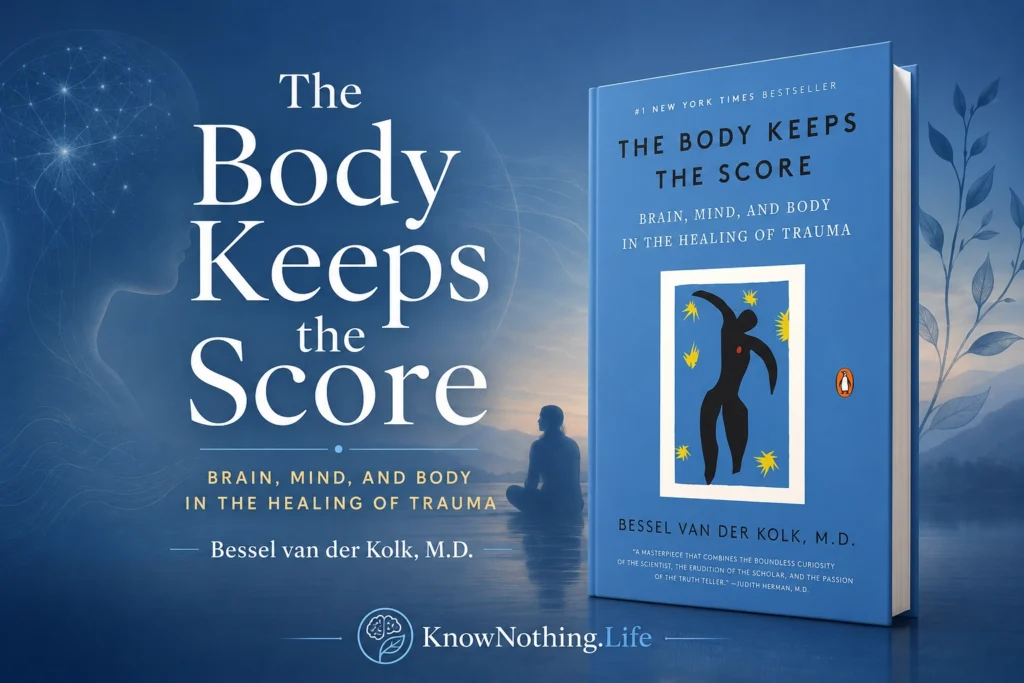
Bessel van der Kolk’s The Body Keeps the Score: Brain, Mind, and Body in the Healing of Trauma is one of the most influential popular books about psychological trauma. Published in 2014, it represents the culmination of decades of van der Kolk’s clinical work with combat veterans, survivors of childhood abuse, people experiencing chronic PTSD, and patients whose symptoms did not fit neatly within conventional psychiatric categories. The book’s central argument is that traumatic experience can affect far more than explicit memory. It may alter attention, emotional regulation, bodily awareness, relationships, perceptions of danger, and the ability to feel fully present. Van der Kolk therefore argues that trauma should be understood as a disturbance involving brain, mind, body, and relationships rather than simply as a distressing story about the past.
The title is deliberately provocative. Van der Kolk does not literally mean that muscles or organs maintain a photographic record of traumatic events. Rather, “the body keeps the score” describes the persistence of physiological and behavioral adaptations to danger. A person may consciously know that an emergency ended years ago while continuing to experience startling, panic, numbness, tension, dissociation, or overwhelming emotion when something resembles the original threat. This distinction is essential to understanding the book. Trauma is not merely remembering that something happened; it can involve responding as though some aspect of it is still happening. Van der Kolk’s earlier review of PTSD neurobiology similarly emphasized how extreme stress can leave people vulnerable to intense responses to sensory information that is no longer dangerous in the present.
The Brain Learns to Expect Danger
Van der Kolk uses neuroscience to explain why traumatic responses can seem irrational from the outside while making sense as adaptations to overwhelming circumstances. Systems involved in detecting threat, regulating arousal, contextualizing memory, and exerting executive control interact differently under extreme stress. The book frequently discusses structures such as the amygdala, hippocampus, and medial prefrontal cortex, but its broader insight is more important than any simple brain-region explanation: traumatic stress can influence networks governing what receives attention, how danger is interpreted, and whether the body mobilizes for defense. Contemporary PTSD neuroscience continues to investigate these interacting systems, although modern research generally cautions against the popular tendency to attribute complex psychological states to a single “fear center” or one damaged area of the brain.
This biological perspective has a philosophical counterpart in Maurice Merleau-Ponty’s Phenomenology of Perception. Merleau-Ponty rejected the idea that human beings experience reality as detached minds operating separate from their bodies. We encounter the world through embodied histories, expectations, and capacities for action. Trauma provides an extreme example. Two environments may be objectively similar while feeling radically different depending on what the body has learned to anticipate. Van der Kolk’s contribution is to make this insight clinically concrete: healing may require changing not only what people consciously think about an experience but also how they experience safety, sensation, movement, and presence.
Traumatic Memory and the Past That Feels Present
A major theme of The Body Keeps the Score is the unusual way traumatic experiences can be remembered. Van der Kolk describes patients whose memories returned as images, sounds, physical sensations, emotional states, nightmares, or intense reactions rather than orderly autobiographical narratives. This idea emerged partly from the work of nineteenth-century psychologist Pierre Janet, whom van der Kolk and Onno van der Hart helped reintroduce into modern trauma theory. Janet proposed that overwhelming experiences sometimes fail to become fully integrated into ordinary autobiographical consciousness. Van der Kolk and Rita Fisler later reported that some people with PTSD initially described traumatic memories in sensory and emotional components before developing more coherent narratives.
The strongest claims about uniquely fragmented traumatic memory remain debated, and The Body Keeps the Score is best read with that qualification. Trauma does not create one universal form of memory, nor are vivid memories necessarily perfectly accurate. The more durable insight is that PTSD can disturb the temporal quality of remembering. A memory may produce a strong impression of present threat rather than the ordinary recognition that an event belongs to the past. William James, in The Principles of Psychology, emphasized that consciousness organizes experience through attention and association. Trauma demonstrates how powerful those associations can become: a smell, facial expression, sound, bodily sensation, or location may acquire extraordinary significance because it has become linked with danger.
Childhood Trauma, Attachment, and Development
Van der Kolk devotes considerable attention to childhood trauma because prolonged adversity during development can affect capacities that adults normally take for granted. Children depend upon caregivers not only for food and physical protection but also for help regulating fear and distress. John Bowlby’s attachment theory, developed in Attachment and Loss, proposed that repeated interactions with caregivers contribute to internal models of whether others are dependable and whether the self is worthy of protection. When caregivers are frightening, neglectful, or unpredictable, the child confronts a paradox: the person needed for safety can also become a source of danger.
The landmark Adverse Childhood Experiences study by Vincent Felitti, Robert Anda, and colleagues later demonstrated a graded relationship between reported childhood abuse or household dysfunction and numerous adult health and behavioral risks. Importantly, these findings describe associations, not inevitable outcomes. Childhood adversity does not determine a person’s destiny, and resilience varies substantially. Nevertheless, the ACE research supports van der Kolk’s broader argument that early environments can have consequences extending across emotional, behavioral, relational, and physical health domains.
Dissociation and the Loss of Connection With the Self
For van der Kolk, trauma does not always produce obvious hyperarousal. Some people respond by becoming detached from feelings, sensations, or surroundings. Dissociation can involve feeling unreal, emotionally absent, disconnected from the body, or as though one is watching events happen from a distance. In threatening situations, such psychological distancing may provide temporary protection. The longer-term difficulty arises when the strategy continues after the danger has disappeared, interfering with intimacy, emotional awareness, and an ordinary sense of being present.
This is why the book repeatedly returns to bodily awareness. Recovery is not simply about forcing people to describe traumatic events in greater detail. Van der Kolk argues that some survivors first need to develop sufficient safety and self-regulation to tolerate what they notice internally. Modern research on interoception—the perception and interpretation of signals originating within the body—has continued to explore relationships between bodily awareness, emotion regulation, fear learning, and PTSD. The scientific picture is still developing, but it supports the broader view that bodily self-perception is relevant to trauma rather than merely an incidental symptom.
Relationships Can Harm, but Relationships Also Help Heal
One of the book’s most important themes is that trauma is profoundly relational. Experiences such as child abuse, domestic violence, neglect, and sexual assault can alter assumptions about trust and vulnerability precisely because harm occurred through another person. The survivor may desperately want connection while simultaneously experiencing closeness as dangerous. Van der Kolk consequently treats safe relationships—not merely intellectual insight—as central to recovery.
This argument parallels Judith Herman’s Trauma and Recovery, which places safety and reconnection at the center of healing from chronic interpersonal trauma. Research likewise identifies the social environment as important in post-traumatic outcomes. A major meta-analysis by Eric Ozer and colleagues found that processes occurring during and after trauma, including perceived social support, were important predictors of subsequent PTSD symptoms. The philosophical parallel is Martin Buber’s I and Thou: human beings develop through genuine relational encounter rather than existing as entirely self-contained minds. Trauma caused within relationships can damage the expectation that other people are safe; trustworthy relationships may therefore become part of restoring that expectation.
Why Talking Alone May Not Be Enough
Van der Kolk is critical of the assumption that understanding trauma intellectually automatically resolves it. Someone may know exactly why they react a certain way while remaining unable to stop the reaction. Because traumatic responses involve conditioned associations, physiological arousal, attention, and bodily states, the book argues for therapeutic approaches that operate through multiple channels. This is why van der Kolk discusses conventional psychotherapy alongside EMDR, yoga, mindfulness, neurofeedback, theater, movement, and other body-oriented practices. The underlying goal is restoring agency—the ability to experience sensations and emotions without automatically being overwhelmed or shutting down.
Evidence supporting these approaches is not equally strong, an important qualification when evaluating the book today. EMDR has accumulated substantial clinical evidence and is currently among the trauma-focused psychotherapies strongly recommended in the 2023 VA/DoD PTSD guideline, alongside prolonged exposure and cognitive processing therapy. Neurofeedback has promising preliminary research but a smaller evidence base; van der Kolk participated in randomized and pilot studies suggesting possible benefit while acknowledging the need for further investigation. The book is therefore most useful when its treatment chapters are read as an exploration of possible pathways rather than as evidence that every discussed method has equivalent scientific support.
Yoga, Movement, and Reclaiming the Body
The book gives particular attention to yoga because trauma may turn bodily sensation into something frightening. A racing heart, restricted breathing, muscle tension, or internal discomfort can trigger memories or expectations of danger. Practices that encourage people to notice physical sensations while retaining control over their movements may therefore provide opportunities to experience the body without immediately interpreting sensation as threat.
Van der Kolk and colleagues tested trauma-sensitive yoga in a randomized study of women with chronic PTSD associated with interpersonal trauma. Participants receiving yoga showed improvements in PTSD symptoms compared with a health-education control condition, although later reviews appropriately describe the overall evidence for trauma-sensitive yoga as promising or tentative rather than definitive. The larger principle is more important than yoga itself: recovery involves developing the capacity to remain present inside one’s own experience. Agency over posture, breathing, movement, and attention can become psychologically meaningful because trauma so often involves the loss of control.
Healing Means Making the Past Truly Past
Van der Kolk ultimately describes recovery as a restoration of ownership. Trauma can produce the feeling that thoughts, reactions, emotions, and bodily sensations occur outside voluntary control. Successful treatment aims to increase the ability to recognize what is happening, tolerate internal experience, distinguish memory from present danger, form dependable relationships, and choose actions rather than automatically reenacting defensive patterns. The goal is not erasing the traumatic event or pretending it no longer matters. It is changing the relationship between past and present.
Paul Ricoeur’s philosophical concept of narrative identity offers a useful way to understand this process. People construct continuity by incorporating changing experiences into an evolving account of who they are. Trauma threatens to make one event disproportionately powerful, reducing identity to what happened or to adaptations developed in response. Recovery permits trauma to remain part of the autobiography without becoming the whole autobiography. In this sense, van der Kolk’s emphasis on agency is central: the survivor moves from being continually organized by an uncontrollable past toward participating more fully in a present containing genuine possibilities.
What The Body Keeps the Score Ultimately Teaches
The enduring achievement of The Body Keeps the Score is its integration of domains that were historically treated separately. Van der Kolk connects traumatic memory with neurobiology, childhood development with adult relationships, physiological arousal with psychological meaning, and psychotherapy with bodily experience. The book’s popularity has also helped move trauma language into mainstream discussions of mental health. Its central metaphor remains useful when interpreted carefully: overwhelming experiences can leave persistent patterns in nervous-system activity, attention, behavior, emotion, and bodily experience even after conscious thought recognizes that the original danger is over.
At the same time, the book should not be treated as the final scientific authority on every treatment or neurobiological mechanism it discusses. Trauma science has continued to evolve since 2014, and current evidence gives stronger support to some interventions than others. Contemporary VA/DoD guidelines, for example, place individual trauma-focused psychotherapies such as prolonged exposure, cognitive processing therapy, and EMDR at the center of evidence-based PTSD treatment. That qualification actually reinforces the book’s strongest insight rather than weakening it. Trauma is complex enough that no single metaphor, brain region, therapy, or theory can explain every survivor.
The deepest message of The Body Keeps the Score is that adaptations developed for survival can continue operating when survival is no longer at stake. Hypervigilance once protected against danger; numbness made unbearable experience tolerable; dissociation created psychological distance; mistrust reduced vulnerability. Healing involves neither condemning those adaptations nor remaining governed by them forever. It means helping the brain, mind, body, and relationships learn that circumstances have changed. The past cannot be undone, but it can cease to function as the permanent present.