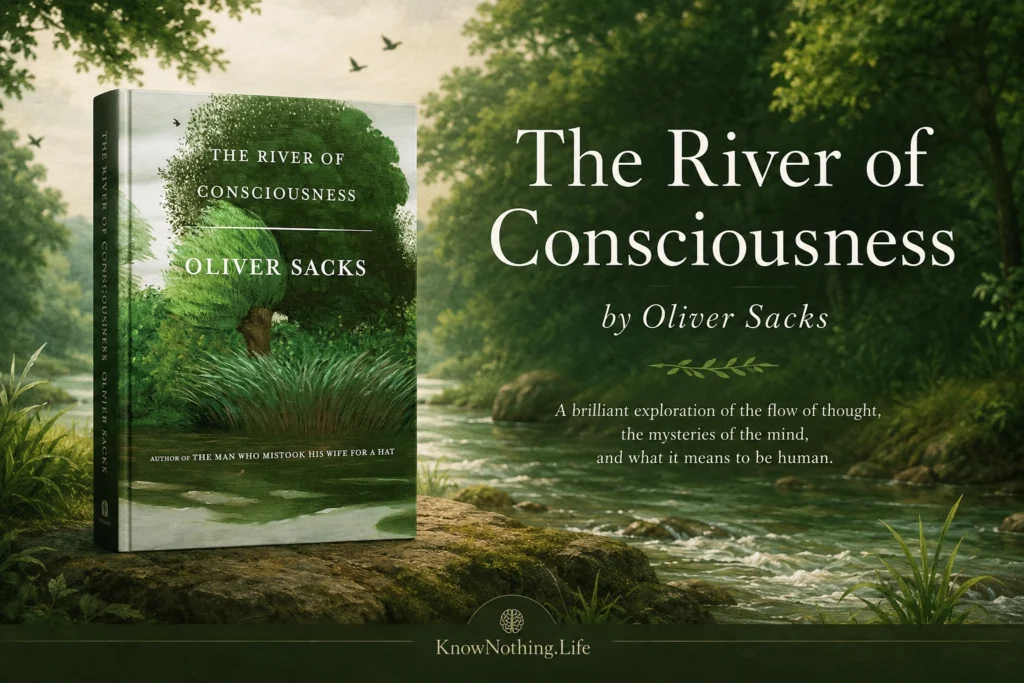
Oliver Sacks’ The River of Consciousness is not a conventional book with a single linear argument. Published posthumously in 2017, it gathers ten essays spanning evolution, botany, animal behavior, neurology, memory, creativity, perception, illness, and the history of science. Two weeks before his death in August 2015, Sacks personally outlined the contents of the volume and entrusted its publication to his longtime collaborators. The essays include “Darwin and the Meaning of Flowers,” “Speed,” “Sentience: The Mental Lives of Plants and Worms,” “The Other Road: Freud as Neurologist,” “The Fallibility of Memory,” “Mishearings,” “The Creative Self,” “A General Feeling of Disorder,” “The River of Consciousness,” and “Scotoma: Forgetting and Neglect in Science.” Sacks’ official foundation describes the collection as a book in which his lifelong interests in evolution, medicine, neuroscience, chemistry, botany, and art converge around questions about human experience and life itself.
The collection is especially revealing because it shows Sacks not primarily as the famous author of unusual neurological case histories but as a natural philosopher in the older sense of the term. Charles Darwin, Sigmund Freud, William James, Henri Bergson, Alexander Luria, and other scientific ancestors repeatedly appear as intellectual companions. Sacks is interested less in defending a single theory than in tracing connections across disciplines and centuries. The subjects can initially seem scattered, yet a common idea gradually emerges: living systems are dynamic. Organisms evolve, nervous systems adapt, memories are reconstructed, creative ideas recombine older material, perception depends upon expectation, and consciousness itself exists only as movement through time. The title’s river is therefore more than a metaphor for awareness. It becomes Sacks’ image for life as continuous change.
Darwin, Flowers, and Evolution as a Living Process
The collection opens with Charles Darwin, a figure Sacks admired not merely for the theory of evolution but for his extraordinary powers of observation. In “Darwin and the Meaning of Flowers,” Sacks emphasizes the botanical Darwin—the scientist who investigated orchids, climbing plants, insectivorous species, cross-fertilization, and the subtle relationships between flowers and their pollinators. Darwin’s achievement, in Sacks’ telling, lies partly in recognizing that apparently static natural forms contain histories. A flower is not simply an attractive object. Its shape, color, structure, and timing embody evolutionary relationships among plants, insects, reproduction, competition, and adaptation. Sacks especially admired Darwin’s willingness to spend years conducting simple but ingenious experiments, sometimes physically imitating pollinators himself to understand how flowers reproduced.
That historical perspective prepares the reader for one of The River of Consciousness’ central principles: nature is comprehensible only when examined through time. Biological structures are not fixed designs but products of processes. Sacks extends this evolutionary sensibility to psychology and neurology. A nervous system has a history, an individual mind has a developmental history, and even a seemingly immediate perception is produced by processes unfolding over milliseconds. Darwin becomes important not just because of natural selection but because his method taught Sacks to look for continuity between apparently different forms of life. That continuity appears again when Sacks turns to worms, jellyfish, plants, and primitive nervous systems, asking how sensation, learning, and eventually consciousness may have emerged gradually rather than appearing suddenly in fully formed human minds.
Speed and the Strange Elasticity of Psychological Time
In “Speed,” Sacks explores the fact that subjective time is not identical to clock time. Neurological patients made this discrepancy particularly visible to him. People with Parkinsonian disorders may experience movement and thought as painfully slowed, while people in accelerated neurological states can feel that events around them have become sluggish. Sacks also considers the familiar reports of time dilation during emergencies, intense concentration, drugs, dreams, and near-death experiences. What seems like a stable temporal world is actually the result of multiple neural processes coordinating perception, movement, memory, and attention. The clock on the wall may advance uniformly, but psychological time expands and contracts.
Modern research strongly supports the broader point while showing that the mechanisms are complex. Reviews of Parkinson’s disease find disturbances in interval timing and implicate interactions among dopamine, basal-ganglia circuits, motor planning, memory, and attention. Research on emotion likewise shows that arousal and attention can distort duration judgments, helping explain why frightening or intensely emotional moments may seem unusually prolonged. Sacks turns such findings into a philosophical question reminiscent of Henri Bergson’s writings on duration: if the time we actually experience can differ so radically from measured physical time, then lived time cannot be understood merely by reading a clock. Our consciousness is temporal through and through, but its tempo is actively created by the organism.
From Plants and Worms to the Origins of Mind
“Sentience: The Mental Lives of Plants and Worms” takes Sacks even further outside traditional clinical neurology. He returns to Darwin’s final book, The Formation of Vegetable Mould through the Action of Worms, in which Darwin carefully investigated the sensory capacities and behavior of earthworms. Worms distinguish light from darkness, respond to vibration, and alter their behavior according to context. Darwin was sufficiently impressed by this flexibility to suggest that they possessed some form of rudimentary mental capacity. Sacks follows this line through the work of George Romanes, Eric Kandel, and studies of jellyfish, sea creatures, and plants. His purpose is not to claim casually that plants think like humans, but to examine the evolutionary roots from which sensation, adaptation, learning, and nervous systems emerged.
Sacks is particularly interested in the continuity between elementary biological responsiveness and increasingly complex forms of mind. Plants transmit electrochemical signals, respond to light and touch, and coordinate elaborate behaviors despite lacking neurons; animals developed rapid sodium- and potassium-based signaling systems capable of supporting much faster movement, learning, and neural integration. Sacks connects this evolutionary history with Eric Kandel’s famous experiments on the sea slug Aplysia, in which relatively simple neural circuits revealed cellular mechanisms of learning and memory. The philosophical insight is characteristic of the entire collection: human consciousness should not be treated as something floating above biology. It is an elaboration of ancient living processes—sensing, remembering, responding, regulating, and learning—that exist in simpler forms far beyond humanity.
Freud the Neurologist and the Roads Science Does Not Take
“The Other Road: Freud as Neurologist” revisits Sigmund Freud before psychoanalysis. Before dreams, repression, and the unconscious became his dominant subjects, Freud trained as a neurologist and conducted detailed anatomical research on nervous systems. Sacks is fascinated by this forgotten Freud because he represents an intellectual path that might have developed differently. Freud worked during a period when scientists were beginning to realize that nervous systems across animal species shared fundamental cellular principles. For Sacks, the young Freud belongs to the same nineteenth-century world as Darwin and Romanes—a world in which detailed anatomical observation and ambitious speculation about mind had not yet become sharply separated.
The essay also reflects Sacks’ unease with excessively rigid divisions between psychology and neurology. Freud eventually chose a psychological vocabulary because the neuroscience of his era could not explain the phenomena he wished to study. More than a century later, researchers continue trying to connect subjective processes—emotion, memory, motivation, selfhood—with biological mechanisms without assuming that one level of explanation eliminates the other. Sacks’ own career repeatedly occupied that border. Awakenings, The Man Who Mistook His Wife for a Hat, and A Leg to Stand On all insist that a neurological mechanism and the lived meaning of that mechanism are different but complementary descriptions. Freud’s “other road” consequently becomes a reminder that scientific disciplines follow historical paths, and paths not taken can sometimes return decades later in new forms.
The Fallibility of Memory and the Fiction Inside Autobiography
“The Fallibility of Memory” may be the most psychologically important essay in the collection. Sacks describes occasions when memories he regarded as unquestionably his own turned out to have been acquired indirectly. One childhood memory of wartime bombing, for example, seemed vivid and personal until his brother informed him that Sacks had not actually witnessed the event he remembered; he had apparently absorbed the episode from another person’s detailed account. Sacks had also publicly misremembered a phrase by William James, unintentionally altering it into language that sounded more like his own style. When the error was pointed out, Sacks connected it to psychologist Frederic Bartlett’s classic argument in Remembering: recollection is an active reconstruction rather than playback from an internal recording.
Contemporary memory research strongly supports that view. Daniel Schacter and colleagues describe episodic memory as a constructive system that rebuilds past experience from distributed fragments and is therefore vulnerable to distortion. Importantly, this flexibility may be adaptive rather than simply defective: the same system that recombines past experience also helps humans imagine possible futures. Decades of misinformation research likewise demonstrate that later information can alter recollections of earlier events. Sacks draws a philosophical consequence from these findings. Autobiographical identity cannot rest upon perfectly accurate archives because such archives do not exist. We build our personal histories through memory, but memory itself is partly narrative, influenced by knowledge, imagination, conversation, and the stories of other people.
Mishearings, Expectation, and the Brain as an Interpreter
The short essay “Mishearings” examines what happens when sensory information is incomplete. As Sacks’ hearing declined with age, he increasingly found himself confidently hearing words that had never been spoken. Ambiguous sounds were unconsciously transformed into meaningful phrases. Such errors can be comic, but they reveal an important truth about perception: the brain does not wait passively for perfectly clear information. It uses vocabulary, context, expectation, and prior experience to infer what is probably being said. The perceived word is therefore a negotiation between sensory evidence and the listener’s internal model of the world.
Modern neuroscience gives this intuition considerable support. Experiments using degraded speech show that prior knowledge can substantially increase perceptual clarity. In one EEG and MEG study, participants heard noise-degraded words after receiving matching, mismatching, or neutral textual cues. Correct prior information increased the subjective intelligibility of the speech and produced neural evidence consistent with top-down feedback from higher-order language regions toward auditory cortex. This is closely related to contemporary predictive-processing theories in which perception combines incoming evidence with expectations. Sacks’ mishearings consequently belong on a continuum with many phenomena explored elsewhere in his work—from visual hallucinations to migraine aura. Perception is reliable precisely because the brain interprets; occasionally, that interpretive power produces a convincing mistake.
The Creative Self: Originality Through Recombination
“The Creative Self” develops the implications of constructive memory for art and originality. Sacks was fascinated by unconscious borrowing: writers, composers, and thinkers sometimes reproduce phrases, melodies, or ideas encountered long before while sincerely believing them to be new. Helen Keller, Mark Twain, George Harrison, and other figures appear in Sacks’ discussion of plagiarism, cryptomnesia, and influence. His question is not simply how to distinguish theft from originality. It is whether genuinely creative work could exist without absorbing and transforming the work of others. As one reviewer summarized Sacks’s conclusion, memory develops through the interaction of many minds.
Modern research on creative cognition fits this view surprisingly well. Neuroscience increasingly suggests that creative thought depends on cooperation between systems involved in spontaneous memory retrieval and systems involved in executive evaluation. The brain’s default network can generate candidate ideas by retrieving and recombining stored experiences, while control networks help evaluate whether those combinations fit the task or goal. Direct stimulation studies even provide causal evidence that disrupting parts of the default network can reduce creative fluency. Creativity therefore does not require creating something from nothing. It depends upon the ability to reorganize what has been encountered into combinations whose novelty may surprise even the person producing them. For Sacks, originality is less purity from influence than successful transformation of influence.
Illness, Interoception, and the “General Feeling” of Being Oneself
In “A General Feeling of Disorder,” written while Sacks himself was living with metastatic cancer, he considers the barely noticed sense through which we know whether our bodies are generally well. Most people do not consciously monitor heart rate, digestion, blood chemistry, blood pressure, temperature, and autonomic balance moment by moment. Instead, these processes are integrated into an overall background feeling: normal, tired, uneasy, feverish, sick, energetic, or somehow “not right.” Sacks connects this to Claude Bernard’s concept of the stable internal environment and to Antonio Damasio’s writing on core consciousness. Illness often announces itself not with a precise local symptom but with a global disturbance in the normally silent sense of bodily equilibrium.
Contemporary neuroscience calls this domain interoception, the representation of internal bodily states. A. D. Craig proposed that neural systems representing the physiological condition of the body contribute to subjective feeling, emotion, and self-awareness—the neurological representation of what he called the “material me.” Later predictive models suggest that bodily feelings, like external perception, may involve predictions about expected bodily states constrained by incoming visceral signals. Sacks’ essay consequently extends the book’s constructive model of mind inward. The brain interprets not only voices, visual scenes, and memories but also the body itself. The ordinary feeling of simply “being here” depends partly upon the continual and usually invisible regulation of an organism.
The River of Consciousness and the Problem of Continuity
The title essay brings Sacks most directly into dialogue with William James. In The Principles of Psychology, James famously described consciousness as a stream: thought appears to its owner as continuous, flowing from one moment into another rather than arriving as disconnected mental atoms. Henri Bergson later used cinematic imagery to ask whether apparent continuity might emerge from a succession of momentary snapshots. Sacks revisits this debate through neurological observations and modern neuroscience. Patients who perceive motion as disconnected still images or experience strange alterations in temporal flow suggest that the continuity of perception itself can break down.
The scientific debate remains unresolved. Some contemporary theories propose that conscious perception may be updated in discrete windows even though experience seems continuous, while others argue that the available evidence fits continuously evolving neural dynamics better. Sacks is ultimately more interested in the phenomenological problem than in declaring a winner. Even if perception depends upon neural events occurring in finite temporal windows, consciousness somehow binds them into the experienced continuity of one life. Perception interacts with memory; each present moment arrives already connected to previous moments and anticipations of what may come next. The “river” therefore exists not merely because events occur one after another but because each moment belongs to someone who inherits the moments that preceded it.
Scientific Scotomas and Why Knowledge Can Be Forgotten
The closing essay, “Scotoma: Forgetting and Neglect in Science,” shifts from individual consciousness to collective scientific memory. A scotoma is literally a blind spot, and Sacks uses the term metaphorically for discoveries that become invisible to later generations. Scientific history is not always a straightforward progression from ignorance to knowledge. Findings can be published, appreciated briefly, and then disappear because the conceptual framework needed to understand their importance has not yet developed. Sacks points to examples such as John Mayow’s seventeenth-century work anticipating aspects of oxygen chemistry and to older neurological descriptions that were effectively forgotten and later rediscovered. His own work on migraine repeatedly led him into nineteenth-century literature containing observations modern clinicians had overlooked.
This final essay completes the book’s argument beautifully. Individuals reconstruct memory; cultures reconstruct history; science does the same. Knowledge survives only when it can be incorporated into active networks of concepts, institutions, experiments, and communication. A discovery made too early may remain technically available yet functionally forgotten. That is why Sacks admired Darwin, James, Freud, and the older scientific literature so deeply: reading backward sometimes reveals ideas that modern specialization has accidentally left behind. The River of Consciousness itself performs this act of recovery, bringing Victorian natural history, early neurology, twentieth-century psychology, and contemporary neuroscience into the same conversation.
Why The River of Consciousness Still Matters
Sacks’ final collection has no single thesis in the ordinary sense, yet its essays repeatedly converge on one vision of life and mind. Nature evolves rather than remaining fixed. Subjective time expands and contracts. Primitive organisms reveal continuities in the development of nervous systems. Memory reconstructs rather than reproduces. Perception combines sensation with expectation. Creativity recombines inherited material. Bodily self-awareness depends upon continuous internal regulation. Scientific knowledge can disappear and return. Consciousness itself seems stable only because countless processes are constantly changing beneath it. The book’s remarkable unity lies precisely in this emphasis on process over static structure.
That may be why The River of Consciousness feels especially appropriate as one of Sacks’ final books. Across his career he had written about people whose familiar worlds were disrupted by changes in memory, movement, perception, music, language, or bodily awareness. Here he steps beyond the individual case and asks what all those disruptions imply about life itself. The answer is not that humans possess a fixed self hidden somewhere inside the brain. The self is closer to James’ stream: an ongoing continuity constructed from sensation, memory, attention, embodiment, relationships, and time. The river persists because it moves. For Sacks, this is not a weakness of consciousness but its defining achievement—we remain recognizably ourselves not by staying unchanged, but by continually carrying the past into a present that is already becoming something new.