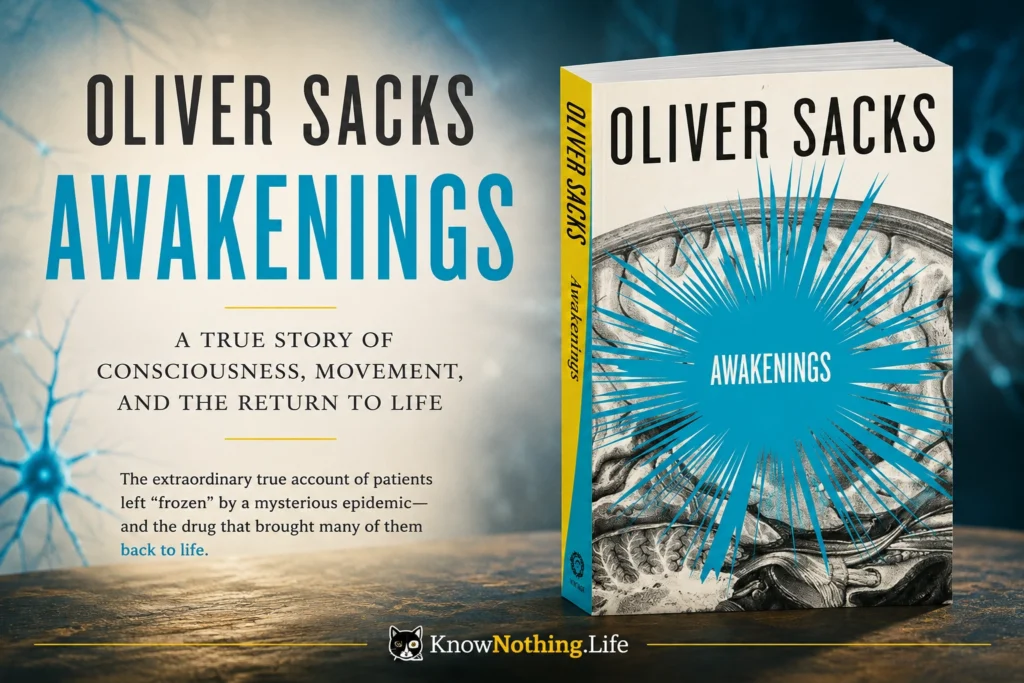
Oliver Sacks’ Awakenings is simultaneously a neurological case study, a history of a nearly forgotten epidemic, an investigation of consciousness, and a meditation on what it means to return to life after decades of profound disability. The book grew from Sacks’ work at Beth Abraham Hospital in the Bronx, where he encountered survivors of encephalitis lethargica who had developed severe postencephalitic parkinsonism. Some had spent decades almost completely motionless, unable to initiate ordinary actions despite retaining aspects of awareness and personality. In 1969 Sacks began treating these patients with the newly available drug L-DOPA, producing in some cases extraordinary improvements in movement, speech, attention, emotional responsiveness, and engagement with the surrounding world. His official account of the book describes patients who had remained transfixed for decades before experiencing dramatic “awakenings” under treatment.
Yet the title is deliberately more complicated than it first appears. These people were not simply asleep, and L-DOPA did not permanently restore them to an uncomplicated state of health. The awakenings could be ecstatic, frightening, unstable, and temporary. Many patients developed involuntary movements, behavioral disturbances, compulsions, fluctuations between mobility and immobility, and other complications as treatment continued. Awakenings therefore refuses the familiar medical narrative in which illness is followed by treatment and treatment by cure. Instead, Sacks presents recovery as a transformation that creates new possibilities and new problems simultaneously. The deeper subject of the book becomes the relationship between brain chemistry and personhood: how dramatically can the biological conditions of movement and motivation alter the experienced world without destroying the individuality of the person living through those changes?
Encephalitis Lethargica and the Lives Left Behind
The historical background of Awakenings begins with the mysterious epidemic of encephalitis lethargica that spread internationally during and after the First World War. Constantin von Economo provided the classic description in 1917. The acute disease could involve fever, headache, profound sleep disturbances, abnormalities of eye movement, delirium, and other neurological symptoms. Many patients died, while some survivors later developed chronic neurological syndromes, particularly severe parkinsonism characterized by rigidity, bradykinesia, abnormal movements, disturbances of speech, and sometimes striking psychiatric symptoms. Modern archival research confirms the extraordinary clinical diversity of the disorder and notes that its cause remains uncertain; infectious, autoimmune, toxic, and other explanations have been proposed, and the historical association with the influenza pandemic has never been conclusively established.
Sacks encountered the human aftermath decades later. By then, many survivors had spent much of adulthood inside institutions. Their condition could make them appear vacant or mentally absent even when closer observation suggested something far more complex. Postencephalitic parkinsonism could produce extreme difficulty initiating action, but inability to move is not the same thing as absence of intention. Von Economo had already distinguished disorders of volition from disorders in which a person possesses an intention but cannot successfully execute it. This distinction becomes one of the philosophical foundations of Awakenings. A motionless body can easily be misread as an empty mind. Sacks’s clinical method depends on resisting that assumption and searching for evidence of attention, preference, humor, memory, frustration, and personality inside patients whose ability to express these qualities has been neurologically constrained.
L-DOPA and the Extraordinary Possibility of Awakening
L-DOPA transformed the treatment of parkinsonism during the late 1960s. Work by George Cotzias and colleagues demonstrated that gradually increasing doses could produce major improvements in many patients with Parkinson’s disease, although involuntary movements and other complications were already apparent. In a 1969 New England Journal of Medicine study involving 28 patients, improvement ranged from modest to dramatic, while neurological side effects included involuntary movements that could become severe. Separate research in postencephalitic parkinsonism during the same period found that L-DOPA could substantially improve movement in a portion of these unusually difficult patients, while also producing restlessness, involuntary movements, nausea, hypotension, and other adverse reactions.
Against this scientific background, Sacks’ patients sometimes seemed to emerge almost explosively from states that had persisted for decades. Individuals who had barely moved began speaking, walking, writing, making plans, listening to music, and interacting with others in ways that appeared impossible only weeks earlier. A later historical review of Awakenings describes Sacks’ project as a collection of roughly twenty detailed case histories in which medical response was embedded inside accounts of each patient’s earlier life, character, and aspirations. The importance of this approach cannot be overstated. If Sacks had recorded only motor scores, L-DOPA would appear as a drug that increased movement. By recording what patients wanted to do with that movement, he transformed a pharmacological effect into a question about agency. Medicine had not merely caused muscles to work differently. It had reopened access to unfinished lives.
When a Miracle Drug Becomes Too Much
The most unsettling aspect of Awakenings is that improvement often refused to remain within desirable limits. Patients could pass from severe underactivity into involuntary excess: tics, dyskinesias, compulsive behavior, agitation, insomnia, impulsivity, or rapidly changing neurological states. This instability became part of the developing understanding of chronic L-DOPA treatment. Later Parkinson research would describe the now-familiar “on-off” phenomenon and levodopa-induced dyskinesias, but Sacks encountered these complications in unusually severe postencephalitic patients almost as they were becoming medically visible. The supposedly simple opposition between disease and cure collapsed. Too little dopaminergic function could imprison movement; attempts to restore it could sometimes release movement beyond voluntary control.
This raises a philosophical problem that runs through the book: health cannot always be defined as maximizing a biological variable. More dopamine is not simply better. More movement is not necessarily greater freedom if movements cease to be voluntary. Aristotle’s concept of the mean is distant from neuropharmacology, yet Awakenings repeatedly encounters a structurally similar problem—the organism needs a workable balance, not limitless activation. Sacks becomes increasingly interested in regulation, timing, proportion, and the ability of a person to inhabit bodily activity as his or her own. The experience also undermines technological triumphalism. A powerful treatment may expose previously hidden capacities while simultaneously revealing how finely balanced the nervous system must be for ordinary life to feel effortless.
Movement, Will, and the Embodied Self
Sacks was fascinated by the difference between wanting to move and being able to begin movement. His postencephalitic patients sometimes appeared incapable of ordinary voluntary action yet could suddenly move under unusual circumstances. Music, rhythm, visual cues, emotional urgency, or an externally structured activity might temporarily release a person from severe motor blockage. Such phenomena were historically described as kinesia paradoxa—paradoxical movement. What looked like total incapacity was therefore sometimes a failure of internally generated action rather than destruction of movement itself.
Modern Parkinson research supports the importance of this distinction. People with Parkinsonian disorders often perform externally cued movements more successfully than internally initiated ones, and visual or auditory cues can sometimes interrupt motor blocks. A phenomenological review of Parkinson’s disease notes improvements in gait, reaction time, movement amplitude, and other functions when movement is externally structured. Meta-analyses of rhythmic auditory stimulation similarly find improvements in gait speed and stride length, although study quality and treatment effects vary. Sacks’s observations thus point toward something larger than a curious symptom. Movement emerges from interaction among intention, brain circuitry, environmental structure, sensory information, and rhythm. The embodied self is not a commander issuing orders to an obedient machine; voluntary action depends upon a nervous system capable of converting intention into organized motion.
Time, Identity, and the Shock of Returning
The patients in Awakenings had not simply lost movement. Many had lost ordinary participation in historical time. Someone who became severely ill as a young adult might physically reawaken decades later into a society transformed by technology, fashion, sexual norms, family structure, and politics. Friends had aged or died. Parents who once provided care might be gone. The world remembered by the patient no longer existed. Sacks therefore describes awakening as a confrontation with temporal dislocation: the biological return of activity could suddenly expose the enormous human cost of the years that illness had taken.
This dimension recalls Henri Bergson’s distinction between measurable clock time and lived duration, as well as William James’ explorations of the stream of consciousness in The Principles of Psychology. Human identity is organized not merely by chronological age but by continuity of memory, expectation, relationship, and activity. Someone can be fifty years old biologically while still carrying projects and emotional orientations interrupted at twenty. The body has aged while important aspects of lived biography have remained suspended. Sacks refuses to reduce this situation to “adjustment difficulties.” His patients confront an existential problem: How does a person resume a life when the future that once gave that life direction has disappeared? The neurological awakening can therefore intensify grief as easily as joy.
The Person Is More Than the Deficit
This insistence on biography is one reason Awakenings became central to Sacks’ later style. The conventional neurological case report tends to compress the patient into symptoms, examination findings, diagnosis, and treatment. Sacks does not reject those categories; he expands them. His patients have histories, tastes, styles of humor, moral temperaments, artistic interests, fears, relationships, and ways of responding to illness. Even when neurological disease drastically alters what they can do, Sacks looks for continuities in who they are. This approach later becomes even more explicit in The Man Who Mistook His Wife for a Hat, An Anthropologist on Mars, and Musicophilia.
Several decades later, Rita Charon’s work on narrative medicine gave formal expression to a similar principle. Charon argues that effective clinical practice requires “narrative competence”—the capacity to recognize, absorb, interpret, and respond to patients’ stories rather than treating illness solely as biomedical information. Awakenings can be read as an important precursor to that movement. Sacks’ stories are not sentimental additions placed around the real medical facts. They demonstrate that the meaning of a treatment depends on the life in which the treatment occurs. The same increase in mobility could represent liberation for one patient, unbearable overstimulation for another, or an encounter with decades of unresolved grief for a third.
Neurology, Environment, and the Social World
Another striking insight in Awakenings is that neurological function is not expressed in isolation from surroundings. Some patients become more capable in environments that provide rhythm, structure, meaningful social interaction, or activities suited to their preserved abilities. Others deteriorate when overstimulated or deprived of familiar routines. Sacks repeatedly notices how music, gardens, relationships, institutional schedules, and the behavior of caregivers affect the expression of neurological symptoms. He does not imply that environment cures damaged basal ganglia. Instead, he shows that disability emerges partly from an interaction between neurological limitation and the world a person is asked to navigate.
This idea resonates with Maurice Merleau-Ponty’s Phenomenology of Perception, in which the body is understood not merely as an object located in space but as the means through which an individual has a world. Parkinsonian illness alters that relationship. An ordinary floor may become difficult to cross until visual markings convert it into a sequence of targets. A frozen gait may become fluid when music supplies temporal structure. Modern research on external cueing provides physiological evidence for some of the effects Sacks observed clinically. The broader implication is philosophical as much as rehabilitative: human capacities are often relational. What a person can do depends partly on how body, brain, task, and environment are fitted together.
The Ethics of Treatment and the Limits of Control
Sacks’ position as physician becomes increasingly complicated as the book progresses. Giving L-DOPA is not simply a technical decision once the drug produces profound changes in personality, movement, emotional life, and social engagement. If reducing the dose restores stability but also returns a patient toward immobility, what outcome should count as success? How much suffering is acceptable in exchange for greater freedom? Who should decide when the patient’s ability to evaluate treatment fluctuates along with the treatment itself? These are not abstract bioethical puzzles imposed on the story afterward. They emerge directly from the clinical situation.
The book therefore offers a powerful criticism of medicine defined solely by intervention. Sometimes Sacks can prescribe; sometimes he can adjust doses; sometimes all he can do is remain present while a patient encounters circumstances that medicine cannot repair. The physician becomes less like an engineer and more like a companion, observer, interpreter, and negotiator. This is one reason Awakenings influenced medical humanism so strongly. Scientific competence is indispensable, but powerful medicine creates ethical responsibilities precisely because biological intervention can transform the possibilities through which a person experiences selfhood.
Why Awakenings Still Matters
Modern neurology knows much more about dopamine, Parkinsonism, basal-ganglia circuits, levodopa pharmacology, and movement disorders than clinicians did in 1969. Encephalitis lethargica itself remains mysterious, and recent archival research continues to debate its etiology while confirming the extraordinary neurological and psychiatric diversity of the historical disease. Some of Sacks’s interpretations are products of his period, and Awakenings should not be read as a contemporary treatment manual. Its enduring importance lies elsewhere.
The book shows how a neurological disorder can illuminate general questions about human existence. What is the relationship between movement and intention? How much of identity survives when expression becomes almost impossible? Can a person return to a life interrupted decades earlier? When does treatment restore freedom, and when does biological activation become another form of captivity? Sacks answers these questions through observation rather than philosophical system-building. His patients repeatedly demonstrate that the human being cannot be adequately described as either a brain mechanism or a disembodied mind. We are embodied persons whose identities depend upon memory, movement, relationships, environments, time, and the biological systems that make participation in the world possible.
That is why Awakenings remains one of Oliver Sacks’ defining works. The dramatic effects of L-DOPA supply the book’s plot, but they are not its final subject. Its deeper achievement is to show what medicine encounters when a treatment changes not merely a symptom but an entire mode of existence. The patients awaken into bodies, histories, losses, relationships, and futures—not simply into improved neurological scores. Sacks’ great insight is that medicine becomes most fully human when it asks not only “What function has returned?” but also “What kind of life has become possible now?”