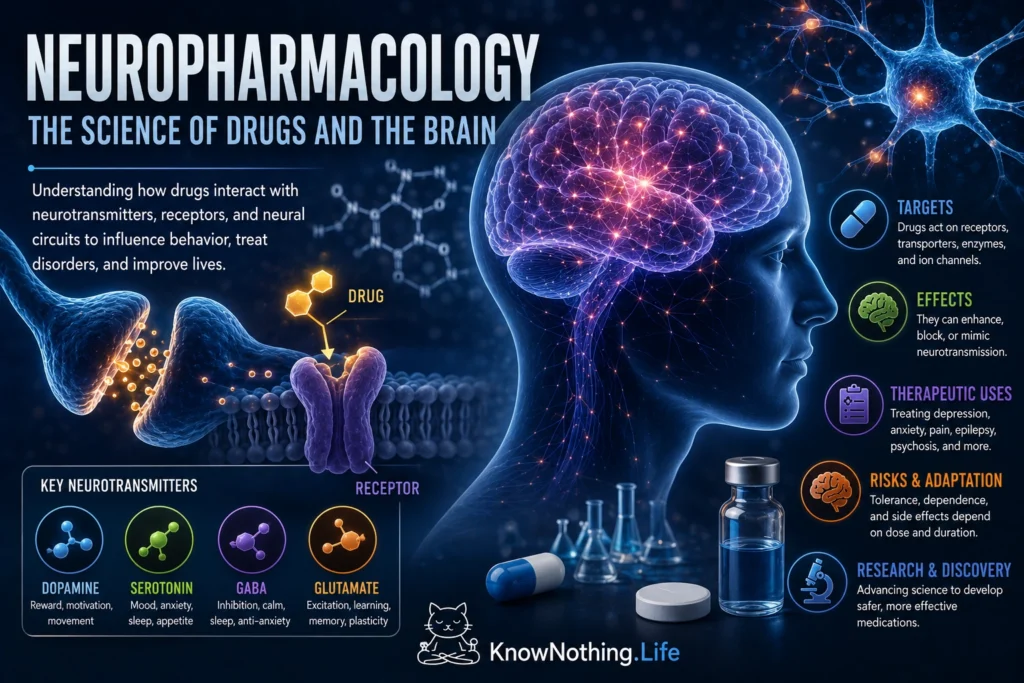
Neuropharmacology is the study of how drugs alter the nervous system. It examines the molecular targets drugs bind to, the circuits they influence, the behaviors they change, and the ways the body absorbs and removes them. The field includes medications used for neurological and psychiatric disorders, anesthetics, analgesics, sedatives, stimulants, and substances capable of producing tolerance or dependence. Its central question is not simply whether a drug works, but how changing neural signaling produces benefits, side effects, and adaptations. Landmark studies connecting opioids, antipsychotics, antidepressants, and other drugs to specific neural targets helped establish this modern molecular approach.
The brain presents a difficult pharmacological problem because its functions emerge from interacting networks rather than isolated pathways. Dopamine participates in movement, motivation, and learning; serotonin contributes to emotional and physiological regulation; and glutamate and GABA provide much of the brain’s excitatory and inhibitory signaling. A compound aimed at one receptor may therefore influence several behaviors, while drugs acting within the same transmitter system can differ because they bind different receptor subtypes or remain active for different lengths of time. The contrasting clinical effects of levodopa, fluoxetine, benzodiazepines, and ketamine demonstrate how different targets produce distinct changes in nervous-system function.
From Neurotransmission to Drug Receptors
Modern neuropharmacology grew from the recognition that neurons communicate chemically and that drugs can imitate, amplify, block, or prolong those signals. Receptors are biological proteins whose structures determine which molecules bind and what cellular response follows. Agonists activate receptors, antagonists prevent activation, partial agonists produce limited activation, and modulators change how strongly receptors respond to ordinary transmitters. Drugs may also inhibit enzymes or transporters, altering how quickly neurotransmitters are produced, broken down, or cleared from synapses.
Direct binding experiments transformed these concepts into measurable biology. In 1973, Candace Pert and Solomon Snyder showed that radiolabeled naloxone bound selectively to opiate receptors in nervous tissue and that competing opioids displaced it in relation to their pharmacological potency. That same year, Eric Simon and colleagues reported stereospecific binding of a potent narcotic analgesic. In 1977, Richard Squires and Claus Braestrup identified specific benzodiazepine-binding sites in rat brain. Such findings connected recognizable drug effects to identifiable molecular targets rather than describing them only through changes in behavior.
Dose, Selectivity, and Receptor Occupancy
A drug’s effect depends on concentration and selectivity. At lower concentrations, a compound may mainly occupy its highest-affinity target; as the dose rises, it can increasingly bind additional receptors and produce new effects. Therapeutic benefit and adverse reactions may therefore exist on the same dose-response curve. Pharmacokinetics determines how much drug reaches the brain and for how long, while pharmacodynamics describes what it does after reaching its targets. Half-life, active metabolites, receptor affinity, and speed of entry all influence the clinical response.
Receptor-binding studies allowed laboratory measurements to be compared with therapeutic potency. Ian Creese, David Burt, and Solomon Snyder reported in 1976 that the affinity of antipsychotic drugs for dopamine receptors predicted their clinical and pharmacological potency. Lars Farde and colleagues later used positron emission tomography to measure dopamine D2 receptor occupancy in living patients receiving antipsychotic drugs. Their work connected administered dose, molecular engagement, clinical effects, and movement-related adverse reactions within one experimental framework.
Dopamine Replacement and Parkinson’s Disease
Parkinson’s disease offered a clear demonstration that neurotransmitter research could lead to effective treatment. Herbert Ehringer and Oleh Hornykiewicz found that dopamine concentrations were greatly reduced in brain regions associated with movement in people with Parkinsonism. Dopamine itself was not a practical replacement medication for the brain, but levodopa, or L-DOPA, could serve as a metabolic precursor that entered the nervous system and was converted into dopamine. This strategy did not replace lost neurons, but it could restore enough transmitter availability to improve movement.
George Cotzias, Melvin Van Woert, and Lewis Schiffer reported major improvements in Parkinsonism after gradually administering large oral doses of L-DOPA in their 1967 study Aromatic Amino Acids and Modification of Parkinsonism. The work established a model of rational neuropharmacology: identify a deficient signaling system, select a molecule capable of reaching the relevant tissue, and adjust dosing to balance benefit against nausea, involuntary movements, and other complications. Disease progression and neural adaptation can nevertheless change the treatment response over time.
Antipsychotic Drugs and Receptor Balance
Antipsychotic pharmacology shows how one molecular action can provide both therapeutic value and unwanted effects. Many antipsychotic drugs reduce dopamine D2 receptor signaling in pathways associated with psychotic symptoms. The same receptors participate in movement, hormone regulation, reward, and motivation, so blockade outside the desired circuit can contribute to stiffness, restlessness, altered prolactin secretion, and motivational changes. Drugs with broader receptor profiles may reduce certain problems while introducing metabolic, cardiovascular, or sedative effects.
Clinical trials also show that receptor similarity does not make all drugs interchangeable. In 1988, John Kane and colleagues reported that clozapine was more effective than chlorpromazine in people with schizophrenia who had not responded adequately to previous antipsychotic treatment. Clozapine’s benefits came with serious safety concerns, including the possibility of a dangerous reduction in white blood cells, requiring careful monitoring. The study illustrated a recurring neuropharmacological problem: the most effective drug for a particular subgroup may also demand the most cautious management.
Antidepressants and Rapid-Acting Treatments
The development of selective serotonin reuptake inhibitors showed how transporter pharmacology could create more targeted drugs. David Wong and colleagues reported in 1974 that Lilly 110140, later named fluoxetine, selectively inhibited serotonin uptake compared with its effects on other monoamines. Blocking the serotonin transporter increases serotonin availability after release, but this immediate action does not fully explain why clinical improvement generally develops more slowly. Longer-term changes in receptor sensitivity and neural processing appear necessary for the complete therapeutic response.
Ketamine challenged the expectation that antidepressant effects must always emerge gradually. In a placebo-controlled study published in 2000, Robert Berman and colleagues found that a single ketamine infusion produced substantial improvement in depressive symptoms within seventy-two hours. Ketamine acts partly through NMDA-type glutamate receptors, shifting research attention toward excitatory signaling and synaptic plasticity as antidepressant targets. Its rapid action also shows why a drug’s first receptor interaction should not be confused with its complete downstream mechanism.
Sedation, Pain Relief, and Neural Adaptation
Benzodiazepines enhance signaling through receptor complexes associated with the inhibitory transmitter GABA. This can reduce anxiety, suppress seizures, relax muscles, and promote sleep, but the same inhibitory actions can impair coordination, memory, and alertness. The discovery of specific benzodiazepine receptors helped explain why drugs in this class share recognizable effects while differing in potency, duration, and metabolism. Useful and unwanted actions may therefore arise from the same molecular target operating in different neural circuits.
Opioids similarly demonstrate the difference between acute action and long-term adaptation. Activating mu-opioid receptors can produce powerful analgesia, but repeated exposure can alter receptor signaling and reduce responsiveness. Laura Bohn and colleagues showed in mice that beta-arrestin-2 contributed to mu-opioid receptor desensitization and morphine tolerance, while dependence involved partly different mechanisms. Tolerance and dependence thus involve measurable cellular changes, although human outcomes are also shaped by pain, environment, learning, dose, and patterns of exposure.
Why Neuropharmacology Matters
Neuropharmacology has changed medicine by making brain function experimentally accessible. Binding assays reveal molecular targets, animal studies examine circuits and adaptation, imaging measures drug engagement in the living human brain, and clinical trials determine whether molecular effects produce meaningful improvement. No single method is sufficient. A compound can bind well to its intended receptor yet fail clinically because it does not reach the correct cells, produces intolerable adverse effects, or targets a mechanism that is not central to the disorder.
The field’s central lesson is that brain drugs rarely act as simple chemical corrections. They enter dynamic systems that compensate, learn, and reorganize. Effective treatment depends on dose, timing, biological variation, coexisting illness, and the balance between symptom relief and adverse effects. From L-DOPA and clozapine to fluoxetine, opioids, benzodiazepines, and ketamine, neuropharmacology shows how molecular discoveries can transform care while revealing the complexity of changing the organ that generates thought, movement, memory, and behavior.