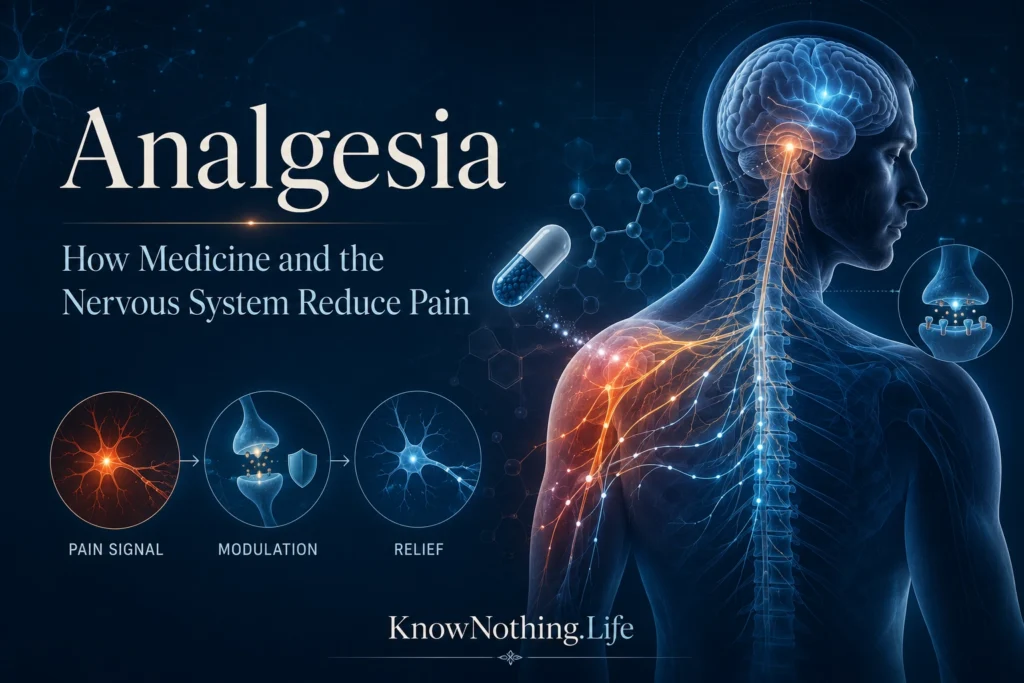
Analgesia is the reduction or absence of pain that would normally be produced by a painful stimulus. It differs from anesthesia, which may involve a broader loss of sensation, awareness, movement, or consciousness. A person can experience analgesia while remaining awake and able to feel pressure, touch, or temperature. The term describes an outcome rather than one specific treatment: analgesia can result from medication, nerve blocks, electrical stimulation, psychological processes, physical rehabilitation, or the nervous system’s own pain-suppressing mechanisms.
Effective analgesia does not always eliminate pain completely. In many clinical situations, the realistic goal is to reduce pain enough to restore sleep, movement, breathing, rehabilitation, communication, or quality of life without causing unacceptable adverse effects. The best method depends on whether pain is acute or chronic, inflammatory or neuropathic, localized or widespread, and associated with surgery, injury, cancer, nerve damage, or altered nervous-system processing. Analgesia is therefore not a single biological switch. It is the result of modifying one or more stages through which pain is detected, transmitted, interpreted, and regulated.
The Nervous System’s Natural Analgesic Systems
The human body possesses internal systems capable of suppressing pain. Signals from the cerebral cortex, hypothalamus, amygdala, and other regions can activate the midbrain periaqueductal gray and connected brainstem structures. Descending fibers then influence the spinal dorsal horn, where nociceptive information entering from the body can be inhibited before it travels farther toward the brain. These pathways help explain why pain may temporarily diminish during danger, intense physical activity, competition, or other situations in which immediate survival requires continued action.
The discovery of opioid receptors and endogenous opioid peptides transformed scientific understanding of natural analgesia. In 1973, Candace Pert and Solomon Snyder demonstrated stereospecific opioid-binding sites in nervous tissue. Two years later, John Hughes, Hans Kosterlitz, and their colleagues isolated met-enkephalin and leu-enkephalin, brain peptides with powerful morphine-like activity. These findings established that morphine and related drugs act upon a preexisting biological system involving receptors and naturally produced peptides rather than creating an entirely foreign effect.
Endogenous analgesia is not limited to opioids. Brainstem monoamines, endocannabinoids, inhibitory neurotransmitters, attention, expectation, and emotional state can also alter nociceptive transmission. Andrea Hohmann and colleagues reported in a 2005 Nature study that an opioid-independent form of stress-induced analgesia in animals involved endogenous cannabinoid signaling. Such findings illustrate why the nervous system can regulate pain through several overlapping mechanisms and why no single analgesic treatment works equally well for every person or pain condition.
Non-Opioid Analgesic Medications
Nonsteroidal anti-inflammatory drugs, including aspirin, ibuprofen, and naproxen, reduce pain partly by limiting the formation of prostaglandins. These signaling molecules sensitize nociceptors during inflammation, making an injured or inflamed area more responsive to mechanical, thermal, and chemical stimulation. In his landmark 1971 paper, John Vane demonstrated that aspirin-like drugs inhibit prostaglandin synthesis, providing a biological explanation for their analgesic, anti-inflammatory, and fever-reducing effects.
NSAIDs are especially useful when inflammation contributes substantially to pain, but their benefits must be balanced against gastrointestinal, kidney, bleeding, and cardiovascular risks. Analgesic strength cannot be considered separately from the person receiving the medication. Age, kidney function, cardiovascular history, gastrointestinal disease, pregnancy, other medications, and treatment duration all influence whether an anti-inflammatory drug is appropriate.
Acetaminophen, also called paracetamol, reduces pain and fever but has relatively weak peripheral anti-inflammatory effects. Its analgesic mechanism remains more complex than that of conventional NSAIDs. Research has shown that acetaminophen can be metabolized within the nervous system into AM404, a compound that influences cannabinoid, TRPV1, serotonergic, and other pain-regulating pathways. A 2005 study by Erik Högestätt and colleagues identified the enzymatic pathway through which AM404 is produced, while later animal research found that blocking cannabinoid CB1 receptors could prevent acetaminophen-induced analgesia. These mechanisms remain subjects of investigation rather than a completely settled explanation.
Opioid Analgesia
Opioids such as morphine, oxycodone, hydromorphone, and fentanyl produce analgesia primarily by activating opioid receptors in the brain, spinal cord, and peripheral tissues. Activation of these receptors can decrease neurotransmitter release, reduce the excitability of nociceptive neurons, and alter the emotional and motivational dimensions of pain. Opioids can be indispensable for anesthesia, major trauma, postoperative pain, palliative care, cancer pain, and selected severe pain conditions.
Their ability to suppress pain is accompanied by significant risks. Opioids may cause sedation, constipation, nausea, hormonal changes, tolerance, physical dependence, and life-threatening respiratory depression. Repeated exposure can also produce opioid-induced hyperalgesia, in which sensitivity to pain paradoxically increases. The U.S. Food and Drug Administration requires prominent warnings about addiction, misuse, overdose, respiratory depression, dangerous interactions with other central nervous system depressants, and opioid-induced hyperalgesia.
Long-term opioid treatment is not consistently more effective than non-opioid treatment for common chronic musculoskeletal pain. In the 2018 SPACE randomized clinical trial, Erin Krebs and colleagues compared opioid and non-opioid medication strategies for chronic back pain or hip and knee osteoarthritis. Opioid treatment was not superior for improving pain-related function over 12 months, and pain intensity favored the non-opioid group. The study does not mean opioids never have an appropriate role, but it demonstrates why their use must be based on the condition, expected benefit, alternatives, and individual risk rather than the assumption that stronger medication automatically produces better long-term outcomes.
Local and Regional Analgesia
Local anesthetics create analgesia by blocking voltage-gated sodium channels required for nerves to generate and transmit electrical impulses. A small injection around an injury can numb a limited area, while a peripheral nerve block can interrupt signaling from a larger region such as an arm, leg, chest wall, or abdominal area. Epidural and spinal techniques deliver medication near the spinal cord, allowing extensive analgesia during childbirth, surgery, or postoperative recovery without necessarily producing complete unconsciousness.
Regional analgesia can reduce the amount of systemic medication required and provide strong pain control during movement, coughing, or physical therapy. In a large randomized trial published in 2002, John Rigg and colleagues found that epidural anesthesia and postoperative epidural analgesia produced lower pain scores during the first three days after major surgery, although the technique did not significantly improve the study’s primary composite outcome of mortality and major morbidity. The findings illustrate an important principle: better pain scores are valuable, but analgesic methods must also be judged by safety, recovery, function, and broader clinical outcomes.
Regional techniques also carry risks, including bleeding, infection, low blood pressure, temporary weakness, nerve injury, or local-anesthetic toxicity. Their effectiveness depends on anatomical accuracy, medication selection, dosing, monitoring, and the patient’s underlying health. Modern ultrasound guidance has improved clinicians’ ability to visualize nerves, blood vessels, and surrounding structures when performing many peripheral blocks.
Psychological and Contextual Analgesia
Expectations, learning, attention, and treatment context can produce measurable analgesic effects. Placebo analgesia is not evidence that pain is imaginary. It occurs when expectations and prior experiences recruit neural systems that regulate the pain experience. In two functional imaging experiments published in 2004, Tor Wager and colleagues found that placebo treatment was associated with reduced activity in the thalamus, insula, and anterior cingulate cortex, together with increased anticipatory activity in prefrontal regions.
Later positron-emission tomography research showed that placebo analgesia can activate endogenous μ-opioid systems in several brain regions. These effects demonstrate that the meaning surrounding a treatment can contribute to its total clinical impact. The opposite process, known as nocebo hyperalgesia, occurs when negative expectations increase pain or weaken an active treatment’s effects. Clear communication should therefore be accurate without being unnecessarily alarming or deterministic.
Mindfulness, cognitive-behavioral methods, relaxation, distraction, virtual reality, and rehabilitative approaches may also reduce pain through attention, emotional regulation, learning, and descending modulation. In a 2015 brain-imaging experiment, Fadel Zeidan and colleagues found that mindfulness meditation produced pain relief through neural mechanisms that differed from those associated with placebo cream. Such approaches do not replace treatment for serious injuries or disease, but they can become legitimate components of analgesia when psychological and nervous-system processes contribute to the intensity or burden of pain.
Neuromodulation and Interventional Analgesia
Electrical stimulation can modify pain pathways without destroying nervous tissue. Transcutaneous electrical nerve stimulation applies current through the skin, while spinal cord stimulation uses implanted electrodes near the spinal cord. These devices may alter spinal transmission, sensory processing, descending regulation, or the patterns through which pain signals reach the brain. Newer systems use high-frequency, burst, or responsive stimulation intended to produce analgesia without the tingling sensation associated with traditional devices.
In the 2007 PROCESS randomized trial, Krishna Kumar and colleagues compared spinal cord stimulation plus conventional medical management with conventional treatment alone in selected patients with persistent neuropathic leg pain after spinal surgery. The stimulation group achieved greater pain relief and improvements in quality of life and functional capacity, although implantation involved device-related risks and the results do not apply to every form of chronic pain. Neuromodulation is most useful when patients are carefully selected and treatment goals include function as well as pain intensity.
Multimodal Analgesia
Multimodal analgesia combines interventions that act through different mechanisms. A postoperative plan might include acetaminophen, an NSAID, local anesthetic infiltration, a peripheral nerve block, rehabilitation, and a limited opioid when necessary. Because each component targets a different part of pain processing, combinations may provide better relief while reducing dependence on high doses of any single medication.
Multimodal care is not simply the accumulation of treatments. Every additional drug or procedure introduces possible interactions and adverse effects. The combination must be appropriate for the procedure, pain mechanism, health status, and recovery goals. In a 2023 randomized trial involving posterior lumbar fusion, a multimodal protocol reduced opioid consumption and pain intensity compared with an opioid-centered strategy. Other trials have found that non-opioid protocols can provide pain control comparable to patient-controlled opioid analgesia in selected surgical populations while improving outcomes such as bowel recovery.
The Future of Analgesia
Pain research is moving toward medications that act selectively on peripheral nociceptive pathways without producing opioid-like effects in the brain. One major target is Nav1.8, a voltage-gated sodium channel expressed predominantly in pain-sensing neurons. In January 2025, the FDA approved suzetrigine as the first drug in a new non-opioid class for moderate-to-severe acute pain in adults.
Two phase 3 trials involving pain after abdominoplasty and bunion surgery found that suzetrigine reduced pain significantly more than placebo over 48 hours. Its pain reduction was similar to hydrocodone combined with acetaminophen, although it did not demonstrate superiority over that active comparator. These findings represent progress toward mechanism-specific non-opioid analgesia while also showing that new treatments must be evaluated without exaggerating their advantages.
The future of analgesia will likely combine more selective medications, biomarkers, regional techniques, neuromodulation, behavioral interventions, and individualized treatment plans. The central challenge is not merely to suppress every pain signal. Pain can provide essential warning and protection. The goal is to reduce unnecessary suffering while preserving safety, function, awareness, and the person’s ability to participate in life. The most effective analgesia is therefore not always the strongest intervention, but the one that matches the biological mechanism, clinical situation, and needs of the individual.