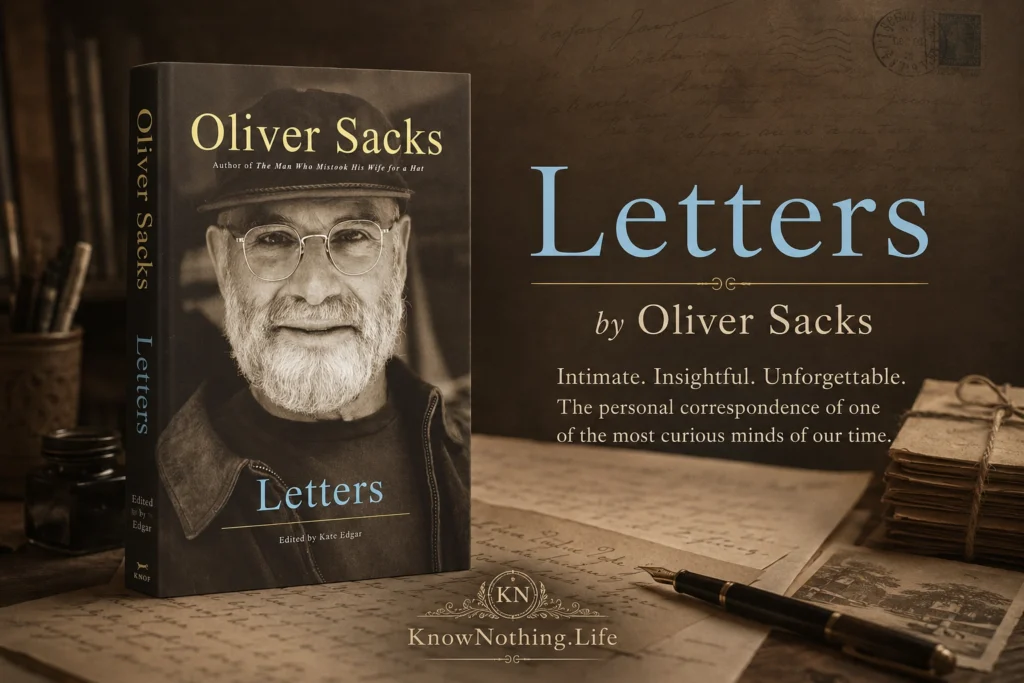
Oliver Sacks’ Letters, published posthumously in 2024 and edited by his longtime collaborator Kate Edgar, offers something his memoirs could never quite provide: Oliver Sacks before he knew how the story of his life would turn out. Uncle Tungsten and On the Move reconstruct the past from the vantage point of an older writer who already understands which experiences became formative. The letters are different. Written between 1960 and the final weeks of Sacks’ life in 2015, they capture decisions, anxieties, discoveries, relationships, and intellectual obsessions while they are still unfolding. Edgar selected the volume from an enormous archive containing nearly 35,000 letters exchanged with family, patients, scientists, writers, artists, and acquaintances. The New York Public Library, which acquired Sacks’ archive in 2024, describes correspondence with figures including W. H. Auden, Francis Crick, Saul Bellow, Susan Sontag, Harold Pinter, Alexander Luria, and Temple Grandin.
That immediacy makes Letters an unusually revealing companion to Sacks’ published books. Readers encounter the adventurous young doctor arriving in North America, the insecure trainee wondering whether medicine suits him, the motorcyclist and weightlifter testing his physical limits, the drug-dependent young man struggling with depression and loneliness, the clinician becoming consumed by postencephalitic patients, and eventually the celebrated author corresponding with some of the leading intellectual figures of his age. The collection runs to roughly 700 pages yet represents only a tiny fraction of what Sacks wrote; one scholarly review estimates that the complete correspondence filled around seventy boxes. What emerges is not simply a collection of private documents but an autobiography written without retrospective certainty—a record of a mind continually discovering what it cares about.
America, Freedom, and the Search for an Identity
The correspondence begins in 1960, when the twenty-seven-year-old Sacks leaves Britain for North America after completing his medical training. His letters home are filled with enthusiasm about landscapes, motorcycles, hospitals, strangers, and the immense physical freedom he associates with America. Yet beneath the exuberance lies uncertainty. He repeatedly asks what kind of physician—and what kind of person—he will become. In California he trains in neurology while immersing himself in bodybuilding, long-distance motorcycle journeys, friendships, sexual exploration, and eventually dangerous experimentation with amphetamines and other drugs. The young Sacks portrayed here is far removed from the serene medical humanist familiar from television interviews decades later. Reviews of the collection emphasize his self-doubt, depression, compulsiveness, and sometimes reckless search for intensity.
These early letters make Letters especially interesting from the perspective of personality psychology. Dan McAdams’ influential theory of narrative identity argues that people gradually create an evolving life story that connects remembered past, experienced present, and imagined future into a sense of personal unity. Sacks’ early correspondence catches that process before unity has been achieved. He has not yet become “Oliver Sacks” in the public sense; he is experimenting with possible selves—doctor, athlete, traveler, lover, scientist, outsider, writer. In that respect the book resembles Søren Kierkegaard’s observation that life has to be lived forward even though it can only be understood backward. The letters allow readers to see the forward part. Choices that later appear inevitable were, at the time, uncertain and reversible.
Awakenings and the Discovery of a Life’s Work
The most consequential transformation occurs after Sacks begins working at Beth Abraham Hospital in the Bronx. There he encounters survivors of encephalitis lethargica who had developed severe postencephalitic parkinsonism and, in some cases, had spent decades nearly motionless. When L-DOPA became available in the late 1960s, Sacks administered it and witnessed responses ranging from dramatic awakenings to disturbing neurological and psychological complications. His letters reveal his dawning realization that these patients were not merely an interesting clinical population but the intellectual and human problem around which much of his life would be organized. In correspondence with his parents, he described L-DOPA as an extraordinary tool for observing forms of human behavior ranging from basic motor function to complex psychological reactions.
The experience eventually produced Awakenings, but the letters are valuable because they show the discovery occurring before it became literature. Sacks is simultaneously astonished, clinically worried, intellectually excited, and emotionally attached to the people he treats. The conventional case report could describe dosage, movement, rigidity, dyskinesia, and adverse effects; Sacks wants to know what it feels like for someone to return to activity after decades of immobility. That approach becomes the foundation of his later medical writing. It also reflects the influence of Alexander Luria, whose works The Mind of a Mnemonist and The Man with a Shattered World treated neurological patients as complete individuals rather than examples of damaged functions. Sacks’ extensive correspondence with Luria survives in his archive, showing that the relationship was not merely one of distant admiration but part of his intellectual development.
Letters as a Laboratory for Thinking
Sacks did not appear to regard correspondence as separate from serious intellectual work. A letter might begin with an ordinary personal question and expand into several pages on migraine, memory, hallucination, autism, music, evolutionary biology, botany, or the philosophy of consciousness. Friends and colleagues became audiences against whom he could test observations before those observations were refined into books or essays. The Los Angeles Times described the correspondence as something like a biography of Sacks’ inner intellectual life, with many letters functioning as preliminary versions of ideas that later entered his published work. He wrote to scientists because he wanted to argue about mechanisms, to writers because he wanted to discuss narrative, and to patients because their descriptions frequently raised questions conventional literature had neglected.
This style of thinking recalls Michel de Montaigne’s Essays, whose original meaning of essai is an attempt or trial. Sacks’ letters are often intellectual attempts: tentative connections allowed to develop because correspondence did not demand the finality of publication. William James worked in a similarly pluralistic spirit, moving between physiology, psychology, philosophy, and first-person experience rather than defending rigid disciplinary borders. Sacks even described himself in these letters as a “philosophical physician.” The phrase captures his method. A strange symptom was never only a neurological curiosity. It raised questions about memory, agency, perception, freedom, identity, embodiment, or consciousness—and a letter gave him room to pursue those questions before he knew exactly where they would lead.
Vulnerability, Sexuality, and the Man Behind the Famous Doctor
The collection is also important because Sacks’ emotional life appears with much less protective distance than it does in formal autobiography. His childhood had included traumatic wartime evacuation, and his relationship with his mother became painfully complicated after he revealed his homosexuality as a young man. Later letters return repeatedly to feelings of abandonment, loneliness, self-doubt, and the fear that stable intimacy might remain unavailable to him. A clinical psychologist reviewing the volume noted how strongly the correspondence reveals both Sacks’ vulnerability and his lifelong effort to move beyond formative experiences of rejection.
Psychologically, letters provide a particularly interesting form for this kind of self-disclosure because they occupy a middle ground between private diary and public performance. They are written to someone. Martin Buber’s I and Thou argued that human existence is fundamentally relational: the self formed in genuine encounter is different from the self that treats others merely as objects. Sacks’ correspondence repeatedly illustrates this distinction. He changes according to the recipient. He can be the anxious son writing to his parents, the ecstatic intellectual writing to Luria, the doctor answering a patient, the admirer approaching a poet, or the deeply grateful older man writing to friends. These are not necessarily masks hiding one “real” Oliver. They suggest that personality itself is partly relational—the self becomes visible through the different kinds of attention we offer different people.
Friendship and the Intellectual Life
By middle age, Sacks had created an extraordinary network of correspondents. His letters passed among poets, novelists, neurologists, evolutionary biologists, physicists, mathematicians, actors, musicians, patients, students, and readers. The archive includes correspondence with W. H. Auden, Francis Crick, Susan Sontag, Stephen Jay Gould, Jane Goodall, Freeman Dyson, Robin Williams and many others. These relationships reveal that Sacks’ famous curiosity was not merely a private appetite for information. It was social. Someone would send him an observation, and he would respond with another observation, a historical reference, a personal story, and three new questions.
The psychology of gratitude offers one useful lens on Sacks’ later correspondence. Experimental research does not show that writing letters magically transforms mental health, but studies suggest that sustained gratitude writing can produce modest benefits in some contexts. In one randomized trial involving 293 psychotherapy clients, participants assigned to write gratitude letters subsequently reported better mental-health outcomes than comparison groups; other experiments suggest that longer-form gratitude letters can produce stronger positive emotional effects than simple gratitude lists. Sacks’ correspondence was not a psychological intervention, of course. Yet his later letters frequently enact something similar: they name what another person has given him. Knowledge, companionship, correction, affection, intellectual provocation, and simple presence are repeatedly acknowledged. His gratitude is relational rather than abstract.
The Patient as Correspondent, Not Merely a Case
Perhaps the most ethically important letters are those connected to Sacks’ medical practice. He often corresponded with patients and readers who recognized their own experiences in his descriptions of migraine, Tourette syndrome, visual agnosia, hallucinations, autism, amnesia, deafness, or unusual forms of perception. The New York Public Library notes that Sacks’ archive contains decades of patient material while also emphasizing that access to sensitive records will be restricted to protect privacy. This raises an important feature of Sacks’ legacy: his medical writing depended on individual stories, and storytelling about patients creates both extraordinary insight and serious ethical obligations.
Sacks’ letters reveal that he increasingly understood medicine as something broader than assigning diagnostic labels. His official site highlights his conviction that being a physician involves participating in some of the most intimate decisions in another person’s life. This position anticipates Rita Charon’s concept of narrative medicine, which argues that clinicians need the ability to recognize and interpret the stories through which patients communicate illness. Sacks’ contribution was not to replace biology with narrative but to insist that the two answer different questions. Neurology may explain why someone cannot recognize faces; the patient’s story explains what it means to move through a social world in which familiar people have suddenly become strangers.
Writing, Memory, and the Construction of a Life
Sacks wrote almost compulsively. He produced books, notebooks, case histories, journals, marginal notes, essays, lectures, and tens of thousands of letters. A review in the neurological journal Brain describes him spending many hours each week on correspondence, often handwriting long letters with fountain pens or typing rapidly on a manual typewriter. Writing seems to have functioned for Sacks as an extension of thinking itself. An experience became clearer when put into words, then clearer still when addressed to another person who might respond.
The psychological effects of expressive writing are more modest and variable than popular claims sometimes suggest. More than four hundred studies have explored expressive disclosure, with some reviews finding small benefits while others have found little or no reliable overall effect on physical or psychological health. The more illuminating connection to Sacks is cognitive rather than therapeutic. Writing externalizes thought. It creates a record against which memory can later be tested, revised, and reorganized. McAdams’ narrative-identity model emphasizes that people create continuity by turning autobiographical material into an evolving story. Sacks left behind an unusually immense external version of that process. His correspondence records decades of attempts to decide what experiences meant while their meanings were still changing.
Mortality, Gratitude, and the Last Letters
The later correspondence acquires added emotional force because the reader knows where it is heading. Sacks was diagnosed with metastatic cancer in 2015, and his final essays in Gratitude confronted death directly. His letters from this period contain the same mixture of curiosity and acceptance. Even as his physical world narrows, his intellectual world remains crowded with books, friends, scientific questions, memories, and unfinished thoughts. One of his final letters, written only weeks before his death, still identifies consciousness and its relationship to brain processes as one of science’s greatest remaining problems.
This ending places Letters in an ancient philosophical tradition. Seneca’s Moral Letters to Lucilius uses correspondence to think about time, friendship, death, and how a person should live while knowing that life is limited. Sacks is not a Stoic in any strict philosophical sense, but his late letters arrive at a related conclusion: mortality does not diminish the importance of relationships and inquiry; it concentrates them. The man who had spent much of his youth wondering whether he belonged anywhere ends life surrounded by networks of intellectual and emotional connection that he helped sustain through the simple but demanding practice of writing back.
Why Letters Still Matters
Letters is not the ideal first introduction to Oliver Sacks. Books such as The Man Who Mistook His Wife for a Hat, Awakenings, Musicophilia, or On the Move provide a clearer entry into his neurological method and literary voice. But after those books, Letters offers something different and perhaps ultimately more intimate. Kate Edgar’s selection allows readers to watch the finished author emerge from uncertainty: the physician discovering that patients are more interesting than diagnoses, the solitary young man slowly learning friendship, the scientist becoming a storyteller, and the celebrated public figure retaining an almost childlike excitement whenever someone sent him a new fact about the brain, a plant, a piece of music, or an unusual human experience. The full archive’s nearly 35,000 letters underline just how central correspondence was to Sacks’ life.
The book’s deepest insight is that thinking itself can be relational. Sacks’ ideas were not produced by an isolated brain and subsequently transmitted to others. They developed through patients, books, arguments, friendships, questions, replies, and decades of correspondence. Letters therefore expands the meaning of Sacks’ humanism. His famous attention to individual patients was part of a larger habit: when another person spoke, he wanted to know more. He answered. He asked another question. He sent a book, an observation, a memory, or a possibility back across the conversation. Read in that way, Letters is not simply the documentary remains of an extraordinary career. It is a record of a life built through sustained attention to other minds—and of a man who discovered himself partly by spending more than half a century writing to them.