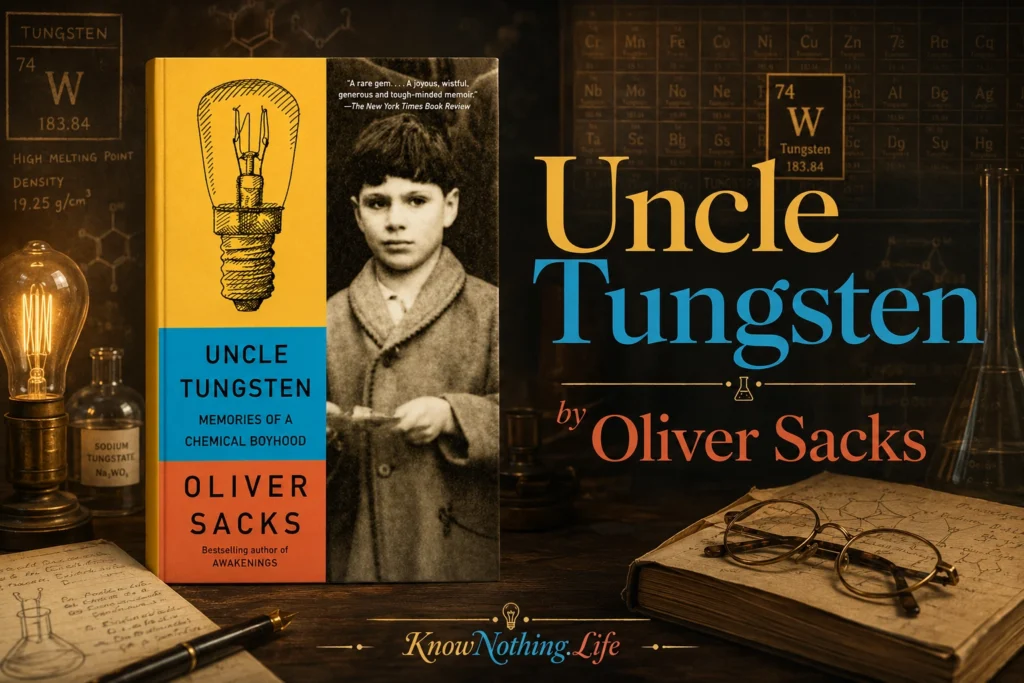
Oliver Sacks’ Uncle Tungsten: Memories of a Chemical Boyhood is simultaneously a childhood memoir, a history of chemistry, and an exploration of how intellectual passion can help construct a young person’s inner world. Published in 2001, the book reaches backward from the neurologist and writer Sacks eventually became to the chemically obsessed boy he had been in wartime London. Sacks later said that he originally intended to write about aging but instead found himself pulled toward memories of his “war-dominated” and “chemistry-dominated” youth. The resulting memoir focuses primarily on his first fourteen years, when metals, minerals, electricity, light, radioactivity, laboratory experiments, and the periodic table possessed an almost mythological power for him. His title character is his maternal Uncle Dave, a manufacturer of tungsten-filament light bulbs whose blackened hands and industrial workshop made the chemical elements seem tangible and alive.
Unlike a conventional autobiography, Uncle Tungsten does not organize childhood primarily around friendships, school milestones, or family drama. Sacks organizes memory through things and ideas: tungsten, sulfur, phosphorescence, batteries, crystals, photographic chemicals, spectral lines, radioactive elements, and the scientists who discovered their properties. Chemistry World described the book as intertwining three stories—the Sacks family, the boy’s experiments, and the history of chemistry itself. This unusual structure reveals one of the memoir’s deepest themes. Intellectual development is not something that occurs outside emotional life. For Sacks, chemistry became inseparable from security, beauty, personal identity, curiosity, and the attempt to create order during a childhood repeatedly disturbed by war and fear.
War, Fear, and the Search for an Orderly World
Sacks grew up in an exceptionally intellectual Jewish family in London. Both parents were physicians, while his extended family included doctors, teachers, mathematicians, engineers, chemists, and industrialists. Yet the security suggested by this environment was shattered by the Second World War. Sacks and his brother Michael were evacuated from London and sent to a boarding school where Oliver endured several miserable years. Sacks later described the experience as deeply traumatic and said that when he returned home he possessed a powerful need for “stability and order and clarity.” Chemistry, and eventually the periodic table, supplied exactly that. The physical world followed rules even when the human world appeared chaotic. Copper behaved like copper; tungsten retained its extraordinary density and strength; a reaction repeated under the same conditions could be expected to behave consistently.
This gives Sacks’s fascination with science a psychological dimension that goes well beyond precocious intelligence. The elements provide a universe governed by intelligible relationships. Metals have characteristic weights, melting points, colors, reactions, and crystalline forms. They do not suddenly change their personalities or violate their own properties. Sacks’s attraction to chemistry therefore resembles what psychologists might call an effort to impose cognitive structure on uncertainty, although it would be reductive to treat his scientific passion merely as a coping mechanism. Chemistry was also joyous, sensuous, and intrinsically fascinating to him. The book’s power comes from holding those motives together. Science provides refuge because it is beautiful, and it becomes beautiful partly because its regularities contrast with the unpredictable world surrounding the child.
Uncle Tungsten and the Sensuous Reality of Chemistry
Uncle Dave gives the memoir its title because his business manufactured incandescent lamps using extremely fine tungsten filaments. To the young Sacks, tungsten was nearly magical: enormously dense, physically resilient, and capable of surviving the high temperatures required inside a glowing bulb. Visiting the factory allowed him to see chemistry not as equations printed in a textbook but as matter being pressed, heated, hammered, drawn into wire, and transformed by industrial technique. Sacks recalled being fascinated by his uncle’s permanently darkened hands and imagining that years of working with the element had somehow infused tungsten into his body. The fantasy captures the style of the entire memoir. Chemical facts are never entirely separate from imagination.
Soon Sacks was experimenting himself. Household demonstrations involving vinegar, chalk, ammonia, red cabbage, minerals, and crystals developed into increasingly ambitious chemical investigations. He established a laboratory at home and pursued the odors, flames, precipitates, colors, explosions, and transformations described in chemistry books. His learning was intensely physical. He wanted to hold substances, smell them, heat them, dissolve them, crystallize them, and watch them react. This makes Uncle Tungsten a striking precursor to modern arguments for active scientific learning. A major meta-analysis by Scott Freeman and colleagues covering 225 STEM studies found that students in active-learning environments performed better on examinations and concept inventories than students taught primarily through traditional lecturing. Sacks’ improvised laboratory was obviously unlike a controlled educational intervention, but his experience illustrates the underlying principle vividly: understanding deepens when the learner becomes an investigator rather than merely a recipient of information.
Curiosity as the Engine of Learning
One of the most memorable characteristics of the young Sacks is his inability to stop asking questions. Why are metals shiny? Why do they conduct electricity? Why does tin make a distinctive sound when bent? Why are some substances stable while others react violently? One answer typically generates several new questions. This pattern resembles psychologist George Loewenstein’s influential “information-gap” theory of curiosity, which describes curiosity as arising when people become conscious of a gap between what they know and what they want to know. That gap produces a motivational tension encouraging information-seeking. Recent psychological reviews similarly describe childhood curiosity as internally motivated information seeking that directs attention and supports knowledge development.
Sacks’ curiosity also demonstrates how an initial fascination can become a stable intellectual identity. Suzanne Hidi and K. Ann Renninger’s four-phase model of interest development proposes a progression from triggered situational interest through maintained interest to emerging and eventually well-developed individual interest. Something similar unfolds throughout Uncle Tungsten. A surprising color change or metal initially captures Sacks’ attention; experiments maintain it; books and mentors deepen it; eventually chemistry becomes part of how he defines himself. He does not study because chemistry has been assigned. He seeks increasingly difficult explanations because previous knowledge makes him capable of seeing new questions. The memoir thus portrays expertise not as accumulation alone but as an expanding ability to perceive what remains unexplained.
Mendeleev and the Revelation of the Periodic Table
The intellectual climax of Sacks’ chemical childhood occurs when he encounters the periodic table at London’s Science Museum after it reopened following the war. The display allowed him to see samples and relationships among elements he had previously encountered individually. What had seemed like a large collection of peculiar substances suddenly revealed an underlying architecture. Sacks experienced the periodic system almost aesthetically—a pattern capable of bringing difference and regularity into a single structure. M. F. Perutz, reviewing the book, noted how profoundly this discovery affected the twelve-year-old Sacks: the periodic arrangement persuaded him that the apparent disconnectedness of individual elements could conceal a deeper natural order.
Dmitri Mendeleev’s achievement itself perfectly matched the kind of science Sacks loved. When Mendeleev developed his periodic system in 1869, he did not merely arrange known elements. He recognized recurring properties, left spaces where the pattern implied that undiscovered elements should exist, and predicted several of their characteristics with striking accuracy. Later discoveries vindicated much of this structure, while Henry Moseley’s work on atomic number supplied a deeper explanation for the ordering. For the young Sacks, this was science at its most beautiful: observation becoming classification, classification revealing pattern, and pattern making predictions about things no one had yet seen. The periodic table was therefore more than reference material. It was evidence that the human mind could uncover hidden regularities in nature.
Retracing the History of Discovery
Sacks does not learn chemistry as though its truths appeared fully formed in modern textbooks. He becomes fascinated with the people who discovered them: Antoine Lavoisier, Humphry Davy, John Dalton, Michael Faraday, Robert Bunsen, Gustav Kirchhoff, Dmitri Mendeleev, Marie Curie, Ernest Rutherford, and many others. He sometimes repeats historical experiments, effectively reconstructing parts of the development of chemistry for himself. Reviewers have noted that this historical progression is one of the book’s central methods: Sacks learns chemistry by retracing the intellectual route through which chemistry itself became a science. Scientific facts acquire drama because each once existed as a puzzle.
This approach carries an important philosophical insight about science. Thomas Kuhn’s The Structure of Scientific Revolutions famously emphasized that scientific knowledge has a history: concepts develop inside changing theoretical frameworks rather than appearing as timeless statements detached from human inquiry. Sacks is less concerned with Kuhnian revolutions than with the drama of discovery, but he shares the conviction that understanding science benefits from understanding how questions became visible in the first place. Educational psychology offers a parallel. Michelene Chi and colleagues found that stronger learners studying physics examples generated more self-explanations, relating individual procedures to broader principles rather than simply reproducing solutions. Sacks’s recreation of old experiments functions similarly. He does not merely memorize that Davy isolated certain elements or that spectral analysis reveals characteristic lines; he attempts to reconstruct why the evidence compelled scientists toward those conclusions.
Chemistry, Family, and the Formation of a Scientific Identity
Although the chemical elements dominate the book, Uncle Tungsten is also a family memoir. Sacks’ scientific curiosity is nurtured by relatives who answer questions, demonstrate phenomena, supply equipment, tell stories, and tolerate an unusual level of experimentation. His parents’ medical careers also make scientific inquiry seem like an ordinary part of adult life rather than an exotic occupation practiced by distant geniuses. At the same time, family life is not uniformly comforting. Sacks describes disturbing experiences, including harsh expectations and his older brother Michael’s serious psychological difficulties. The official Sacks account explicitly connects Michael’s psychosis with the young Oliver’s sense that an unpredictable and frightening world could close around him. Against this background, chemical order acquires emotional weight.
Yet Sacks also constructs a second, imaginary scientific family. Dalton, Davy, Faraday, Mendeleev, Curie, and other scientists become what he later called “honorary ancestors.” This is important because intellectual identity is partly narrative. People often understand themselves by locating their interests inside larger traditions: an aspiring musician adopts composers as predecessors; a writer develops a lineage of admired authors; a young scientist imagines entering a centuries-long conversation about nature. Sacks’ chemical heroes gave him such a lineage. Modern theories of autobiographical identity similarly emphasize that memories are organized partly according to the narratives people construct about who they are. A systematic review of the “reminiscence bump” found particularly strong recall for events from youth and early adulthood, with narrative and identity-based explanations receiving substantial support. Uncle Tungsten itself may be understood as Sacks reconstructing the origins of the person he became.
The End of the Chemical Boyhood
One of the book’s most poignant features is that the passion does not last forever. As Sacks enters adolescence, chemistry gradually loses some of the luminous immediacy it had possessed during childhood. Biology becomes more compelling, puberty changes his interests, and family expectations increasingly point toward medicine. Sacks’ official account places this transition at about age fourteen, when the onset of puberty, his discovery of biology, and the expectation that he would become a physician converge. The change is not presented as a rational decision in which he simply selects a more suitable career. It feels more like the disappearance of an entire mode of consciousness.
This gives the memoir its bittersweet philosophical edge. Sacks wonders whether intense childhood passions naturally burn themselves out, whether chemistry had already given him the stability he needed, or whether growing up itself involves losing some of childhood’s capacity for wonder. His thinking echoes William Wordsworth’s Ode: Intimations of Immortality, which reflects on the fading intensity with which childhood perceives the world. Decades later, however, chemistry returns through memory. A gift containing tungsten and a richly illustrated periodic table helped reactivate memories that eventually contributed to the memoir. Psychology’s reminiscence-bump literature makes this return especially interesting: memories from formative years remain disproportionately accessible in later adulthood and are often strongly connected to identity. Sacks does not merely remember facts about chemistry; he recovers the mind that once loved them.
Why Uncle Tungsten Still Matters
Uncle Tungsten belongs in conversation with Primo Levi’s The Periodic Table, another work in which chemical elements become vehicles for autobiography, history, and reflection. But Levi writes largely from the perspective of a trained chemist looking back through the elements, while Sacks reconstructs the astonishment of a child discovering that matter possesses an intelligible order. Chemistry World has noted this resemblance while emphasizing the unusually physical quality of Sacks’ fascination—the weight of tungsten, the smell of hydrogen sulfide, the colors of reactions, the danger and delight of laboratory experimentation. That sensuality explains why the memoir remains unusually successful as science writing. Sacks never treats scientific wonder as something that appears only after technical mastery. Wonder is what makes mastery worth pursuing.
The lasting value of Uncle Tungsten is therefore larger than its chemistry. It is a book about how a mind learns to love knowing. Curiosity begins with sensory astonishment, grows through questions, acquires structure through experimentation, discovers historical predecessors, and eventually becomes part of identity. Modern studies of curiosity, active learning, interest development, and self-explanation give psychological language to several processes that Sacks describes autobiographically. But the memoir preserves something experimental studies necessarily abstract away: the subjective feeling of discovery. For the young Sacks, scientific knowledge was not a pile of information. It was a way of transforming an unstable world into one containing patterns, histories, relationships, and astonishing possibilities. Uncle Tungsten ultimately reminds us that the making of a scientist—or any deeply curious person—may begin with something as simple and powerful as encountering one object and becoming unable to stop asking why it is the way it is.